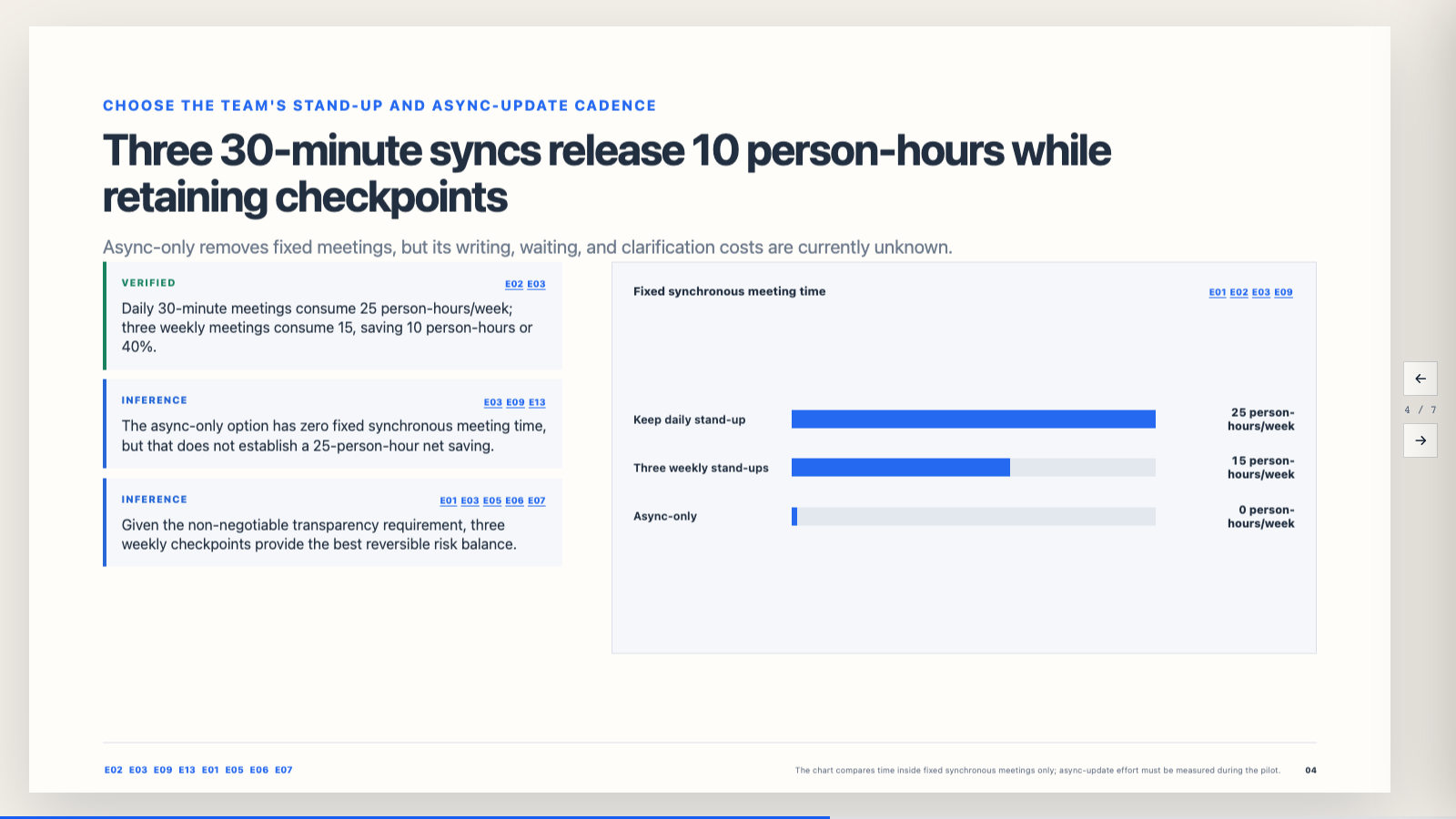
A 30-minute stand-up every day, without a shared decision framework
- Ten people attend five stand-ups each week
- Calculation: 10 people × 0.5 hours × 5 meetings
- No data for preparation, follow-up, productivity change, or team acceptance
Evidence-traceable decision presentations
Define the decision first, then build an evidence ledger and argument around it. Deliver a structured JSON contract, a self-contained HTML deck, and validation reports in HTML and JSON. Link material claims, numbers, charts, and recommendations to evidence IDs.
Decision ready
Before / After
Known inputs become a comparable baseline. Unknowns remain visible as measures to collect instead of being presented as facts.

Reducing fixed meeting time is not the same as producing a net productivity gain. Productivity, preparation time, and team experience still need to be measured.
Core Capabilities
The goal is not to accumulate information. It is to help a decision owner see the recommendation, its basis, its conditions, and the next move.
Set the audience, decision owner, options, evaluation criteria, time horizon, and hard constraints.
Assign stable IDs to sources, supplied material, calculations, and assumptions, then cite what supports each claim.
Separate facts, inferences, assumptions, and recommendations. Preserve conditions, timing, and limitations.
Use decision-first, options comparison, SCQA, or evidence synthesis with takeaway headlines that move the argument forward.
Keep slide content, evidence, visual type, limitations, and speaker notes in structured form.
Deliver self-contained HTML with the JSON contract and validation reports. A source manifest is an additional research deliverable when requested; the pipeline does not generate it automatically.
How It Works
Define who decides, what must be chosen, which options are in scope, and which constraints cannot move.
Read supplied material; research externally only when authorized, prioritizing primary sources for consequential claims.
Match the storyline to the decision instead of forcing a fixed slide count or generic section template.
Specify each slide's takeaway, claims, visuals, limitations, and evidence relationships.
Run the pipeline to write validation reports and render the offline HTML deck when validation has no errors. Review warnings and inspect the rendered slides. PDF export is optional.
Read every page at desktop and mobile widths, checking content, charts, sources, and navigation.
Use Cases
Build a consistent frame across budget, timing, risk, experience, and other decision criteria.
Bring current pricing, capability differences, implementation conditions, and upgrade triggers into one argument.
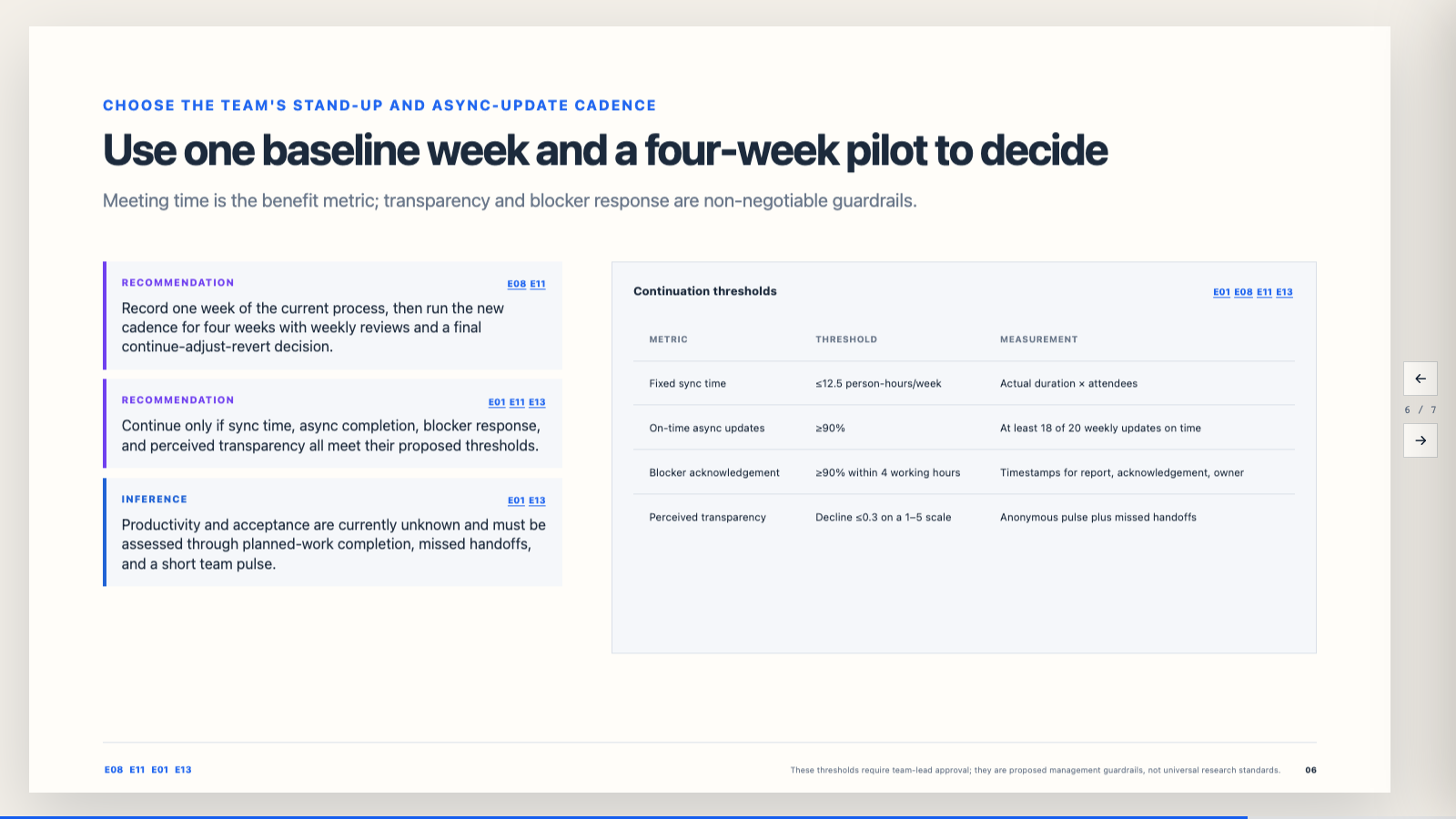
Start with the current baseline, then design a reversible move, observation period, and continuation thresholds.
Case Studies
The examples span a team activity, a task-management platform, and a meeting cadence—covering options comparison, product selection, and operating-process change.

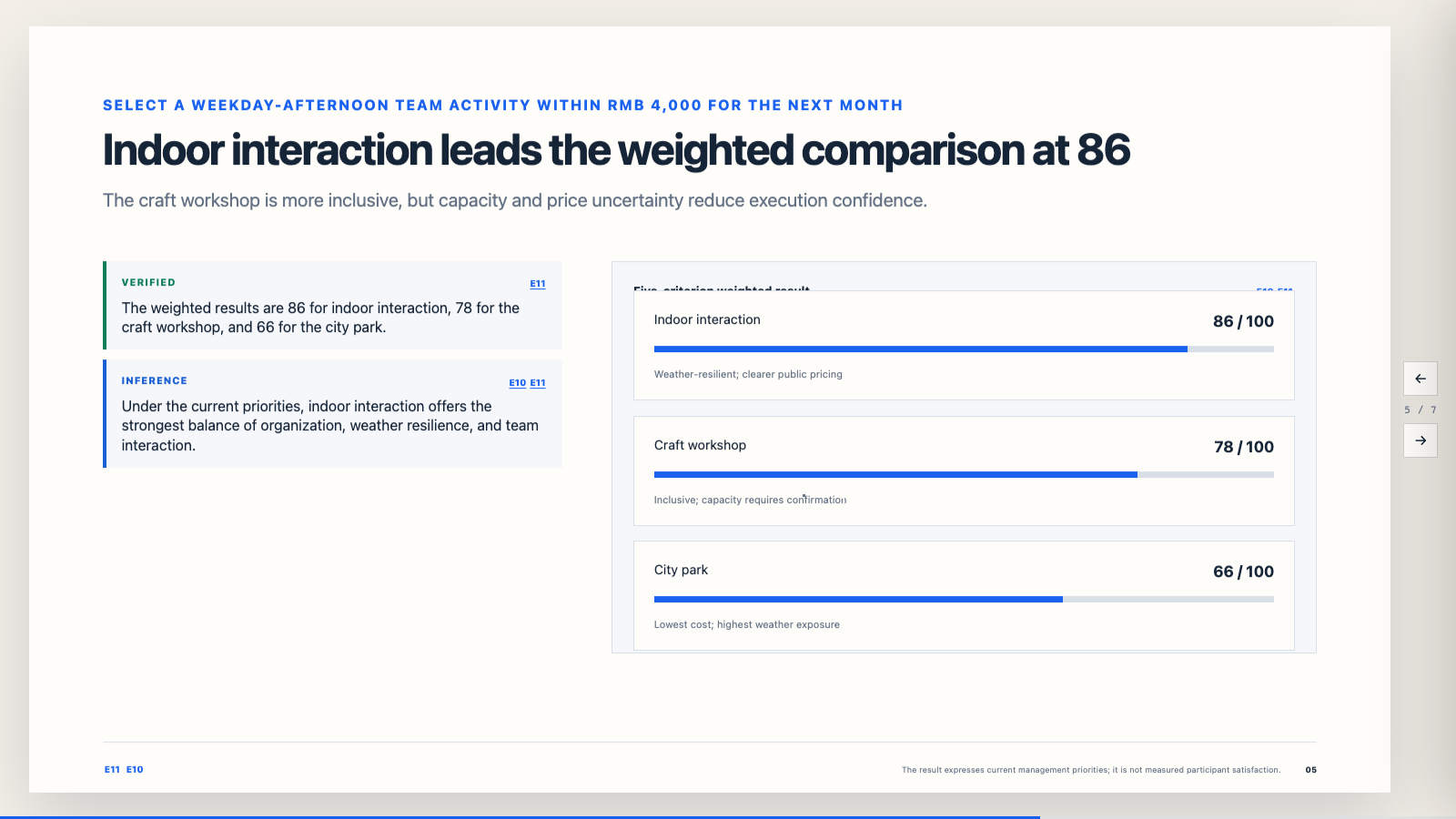
Compare indoor interaction, a city-park activity, and a craft workshop within RMB 4,000, four hours, and a low-weather-risk preference.
Use the park only if conditions are stable 72 hours before the event; confirm capacity and final pricing before booking.

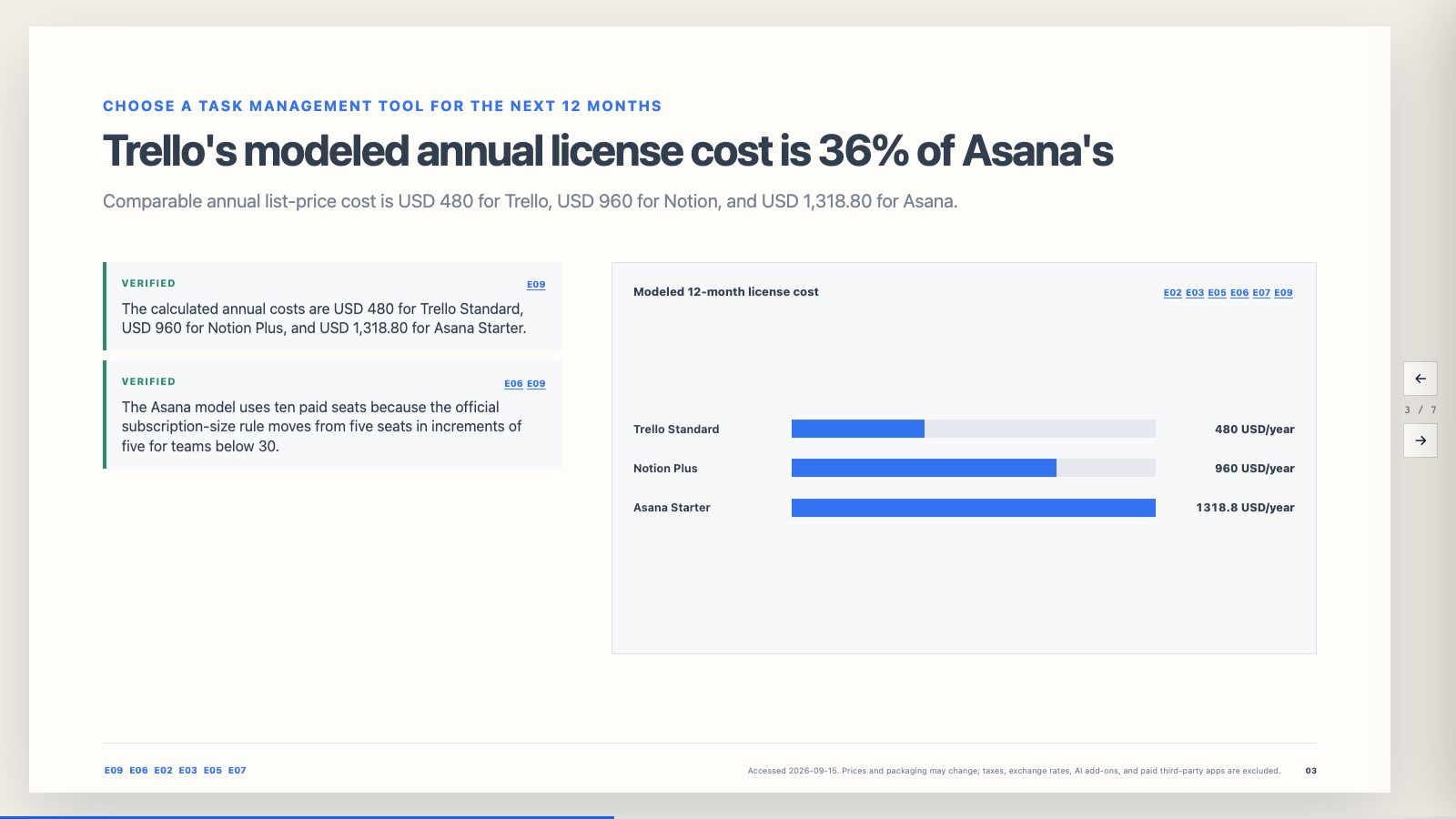
Compare Trello, Asana, and Notion across cost, adoption, project management, collaboration, and automation.
Move to Asana Starter if complex dependencies, Gantt views, or cross-project reporting become requirements.

Assess whether to replace a daily 30-minute stand-up with three weekly syncs and asynchronous updates on the remaining workdays.
Use transparency, on-time updates, and blocker response as continuation guardrails; do not assume productivity will improve.
Reliability
Prefer official pricing and product documentation, government material, peer-reviewed papers, and recognized research institutions.
Record input evidence, formulas, units, periods, and display precision, then use the same results in charts.
Keep pricing conditions, unconfirmed capacity, measures still to collect, and management assumptions in view.
The deck contains the styles, scripts, and graphics it needs for meetings, internal sharing, and archiving.
Target Users
Understand the options, trade-offs, and next move quickly.
Compare alternatives, quantify constraints, and form an executable recommendation.
Organize multiple sources into a reviewable argument without erasing uncertainty.
Present the recommendation, supporting evidence, and decision conditions in one delivery.
Start a decision
Provide the audience, options, evaluation criteria, and non-negotiable constraints. If no local material exists, state whether public research is authorized.
Please use the evidence-deck-builder Skill to create a presentation for [decision audience] about [decision question]. Compare [options], evaluate [criteria], and observe [time, budget, location, or other constraints]. Label facts, inferences, assumptions, and recommendations separately, and link material claims, numbers, charts, and recommendations to specific evidence IDs.
Select the prompt above to copy it.