Conventional manual workflow
FY2025 Form 10-K
2026 Q3 Form 10-Q
U.S. Treasury yield
Workflow illustrationFilings, share count, debt, and rates sit in different places. Reporting periods and model assumptions must be reconciled by hand.
Move from a company overview to a DCF or a catalyst calendar while keeping sources, dates, assumptions, and gaps in view.
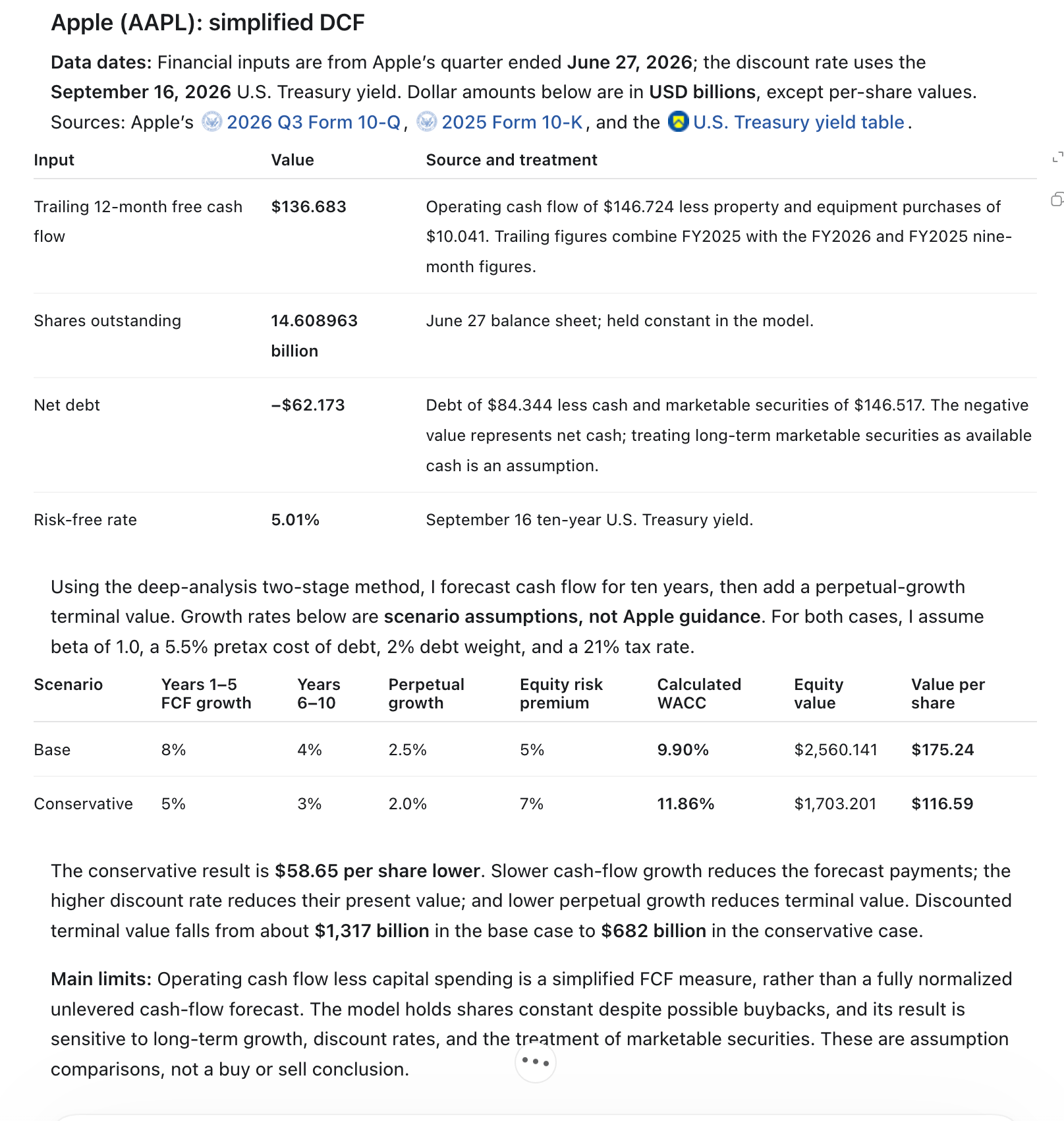
Apple’s simplified DCF shows how the work is organized. It is a scenario comparison, not a forecast of investment returns.
Filings, share count, debt, and rates sit in different places. Reporting periods and model assumptions must be reconciled by hand.
 Actual output
One answer lays out sourced inputs, scenario assumptions, model values, and limitations.
These are the capabilities demonstrated in the three company examples below.
Show reporting periods, price dates, primary sources, and inputs that remain unresolved.
Surface free cash flow, net debt, shares, growth, and discount rates before comparing DCF cases.
Compare rule-based value, growth, and technical readings without presenting them as actual investors’ views.
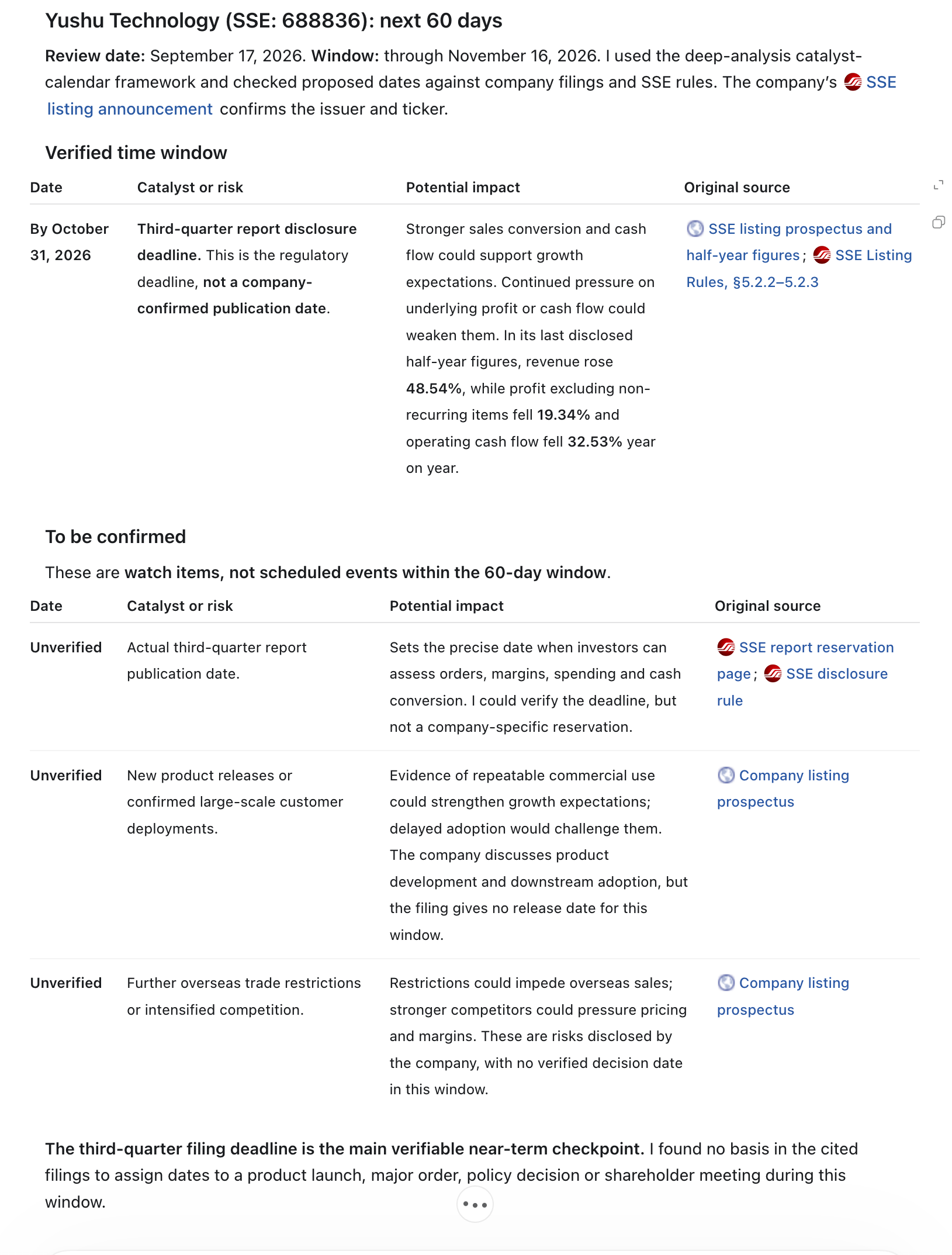
Separate regulatory deadlines, confirmed company dates, and developments with no verified date.
The examples use three focused paths: overview, DCF, and a 60-day event review. Source-level review still matters.
Specify the ticker, market, and the research output you need.
Reconcile reporting periods, price dates, units, and original filings.
Prepare an overview, compare DCF scenarios, or screen catalysts and risks.
Inspect missing data, model sensitivity, and dates that cannot be confirmed.
Choose the depth the question calls for. Each example stays short of a full research report.
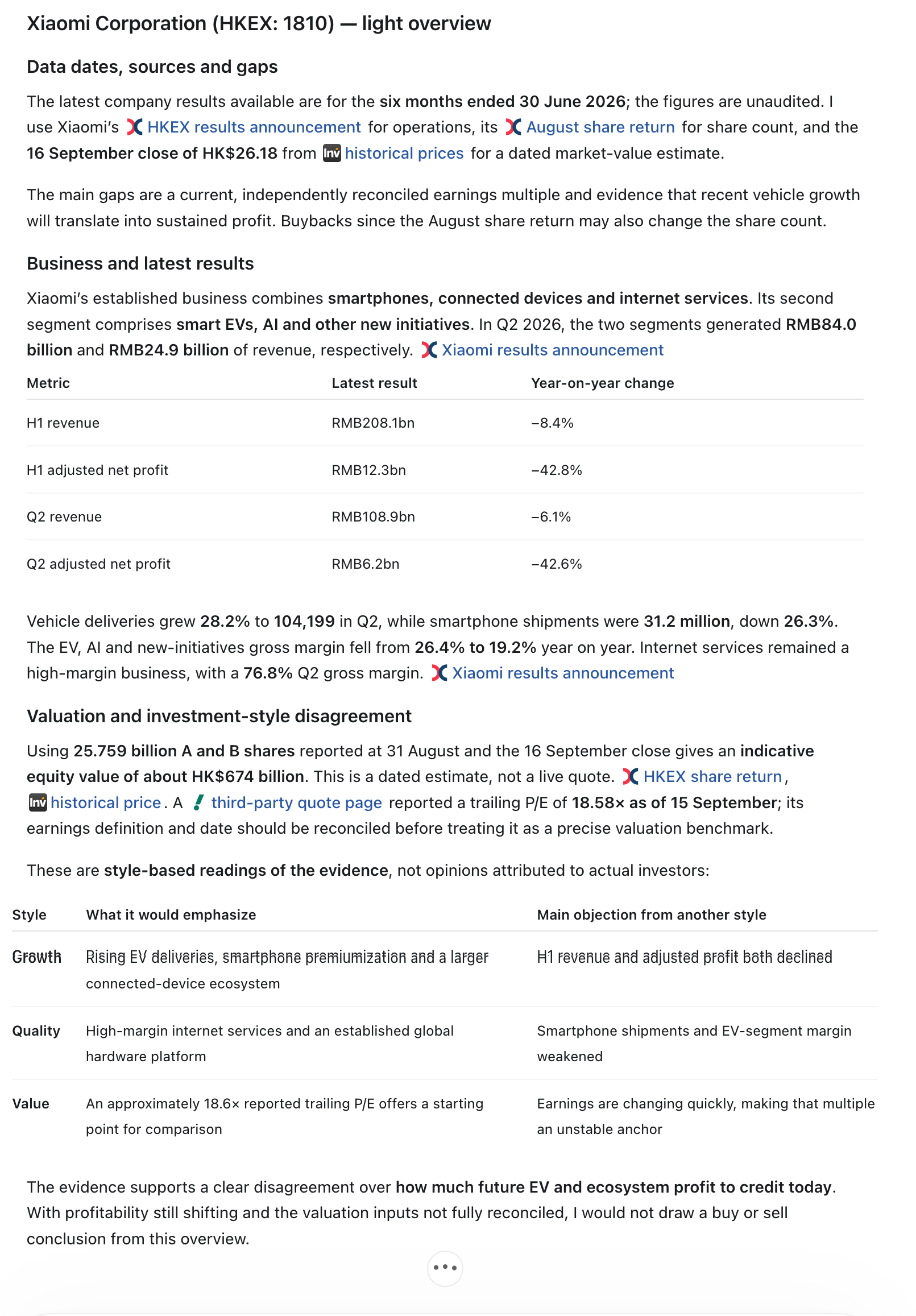
Start with the business, recent results, valuation context, and any material data gaps.
See Xiaomi ↗Put cash flow, growth, and discount rates side by side to see why DCF results diverge.
See Apple ↗Focus on dated disclosure checkpoints and keep undated risks clearly separate.
See Yushu ↗Read the question, then inspect the output. Figures are dated, not live market data.
Brings the business, latest results, valuation context, and rule-based style disagreement into one read.
Use the deep-analysis skill to prepare a light overview of Xiaomi Corporation (HKEX: 1810). Summarize its main businesses, latest financial results and valuation, and show where major investment styles disagree. Start with the data dates, sources and gaps. Do not give a buy or sell conclusion if the evidence is insufficient.
Sets out free cash flow, shares, net debt, growth, and discount assumptions, then compares two cases.
Use the deep-analysis skill to build a simplified DCF for Apple (AAPL). List the sources and assumptions for free cash flow, shares outstanding, net debt, growth rates and discount rates. Calculate a base case and a conservative case, then explain why their results differ. A full report is not needed.
Separates a verifiable reporting deadline from product, customer, and policy items with no confirmed date.
Use the deep-analysis skill to identify the main catalysts and risks for Yushu Technology Co., Ltd. (SSE: 688836) over the next 60 days. For each item, provide its date, potential impact and a link to the original company filing or official announcement. Put events whose dates cannot be verified in a separate “To be confirmed” section.
The examples call out conflicting valuation inputs, expose DCF assumptions and sensitivity, and place events with unverified dates in a separate section. Original filings remain the point of reference.
Frame company results, valuation inputs, and competing readings.
Compare scenarios in material that others can inspect and challenge.
Check sources and gaps before forming an independent view.
Explore the Skill’s instructions, or begin with one of the prompts above. Read the output alongside original filings and your own judgment.