Package release 2.1.3 | Skill identifier: multi-search-engine

Multi Search Engine

Sixteen search engines, organized into one reproducible and verifiable retrieval workflow. No API keys.
multi-search-engine · report
Core output format: a timeline report generated from a single query, with a source link and timestamp for every item.

Core output format: a timeline report generated from a single query, with a source link and timestamp for every item.

Before / After

The comparison below shows how the same retrieval task behaves under each approach. The left column is the conventional approach without retrieval constraints; the right column is the same task performed through this workflow.

Dimension
Before · Conventional keyword search
After · This workflow
On-site search precision
Results mix in large numbers of off-target sites and must be filtered by handmixed results
Site scoping takes effect during retrieval; results come only from the intended sitesources narrowed
Recency filtering effectiveness
A time filter alone returns mostly news-aggregator homepages with few usable eventsfew usable events
A time filter combined with site scoping produces a timeline with sources and timestampstimeline output
Download link viability
Candidate links delivered unchecked, including dead pagesdead links
filetype: filtering plus per-link checks; dead links removed before deliveryremoved pre-delivery
Engine resilience
Depends on a single entry point; one failure stops the tasksingle point
Engines grouped by language, with a fallback channelmulti-engine + fallback

Core Capabilities

From retrieval constraints to delivered results, the full chain is covered.

01

On-site search

site: restricts results to a named domain, so the constraint takes effect during retrieval.

02

Time filtering

Hour, day, week, month, and year granularity for tracking recent developments.

03

File-type search

filetype: locates PDFs and similar documents directly, bypassing landing and registration pages.

04

Chinese result prioritization

Region parameters improve the ranking of Chinese-language sources.

05

Batched concurrent retrieval

Three to four engines per batch, with pacing between batches.

06

Result consolidation

Multi-engine output consolidated into a structured report as timelines or categorized tables.

07

Link viability verification

Each delivered link is checked for response status and content type; dead links are removed.

08

Fallback channel

When the primary engine is unavailable, retrieval continues through a validated alternative.

How It Works

A fixed sequence turns retrieval from a one-off action into a reproducible protocol.

01
PreparationInitialize an in-memory session store. Nothing is read from or written to any configuration file.
02
Language routingChinese queries go to the Chinese engine group; non-Chinese queries go to the international group.
03
Controlled retrievalOne to two seconds between requests, three to four engines per batch, to avoid triggering access limits.
04
Session handlingSession credentials are acquired on demand only when access is denied, and are held in memory throughout.
05
Retry on failureWhen access is denied, the request is retried once after a delay.
06
Result consolidationSuccessful results are merged and organized into a structured retrieval report.
07
Delivery verificationEvery link in the output is checked for response status and content type.

Use Cases

Each scenario below maps to a capability the skill supports.

Technical research

Find open-source projects, approaches, and implementation details, scoped to code-hosting and Q&A platforms.

News tracking

Pull the latest reporting on a topic at day, week, or month granularity, delivered as a timeline.

Chinese-language sourcing

Reach Chinese-language material across Q&A communities, technical blogs, and academic resources.

Document and paper retrieval

Locate PDF tutorials, reports, and papers, delivered as verified direct links.

Cross-engine verification

Run the same question across several engines and compare the results to reduce single-source bias.

Case Studies

Cases covering Chinese- and English-language retrieval. Each gives the instruction used and the output produced.

Chinese Case · Zhihu on-site discussion search

Instruction used
Find discussions on Zhihu about deploying large language models; prioritize Zhihu sources.
Actual output
  • Every result came from the target site, with no off-site results mixed in.
  • Organized into Q&A threads and long-form articles, so the reader can drill into either.
  • Discussion themes extracted: deployment criteria, industry benchmark figures, principal challenges, technical paths forward, and frontier directions.
Recorded result summary
Result 1
Every result came from the target site, with no off-site results mixed in.
Result 2
Organized into Q&A threads and long-form articles, so the reader can drill into either.
Result 3
Discussion themes extracted: deployment criteria, industry benchmark figures, principal challenges, technical paths forward, and frontier directions.

English summary of the recorded output. Chinese-language source output is translated; source URLs are omitted from this excerpt.
Chinese Case · One-week news timeline

Instruction used
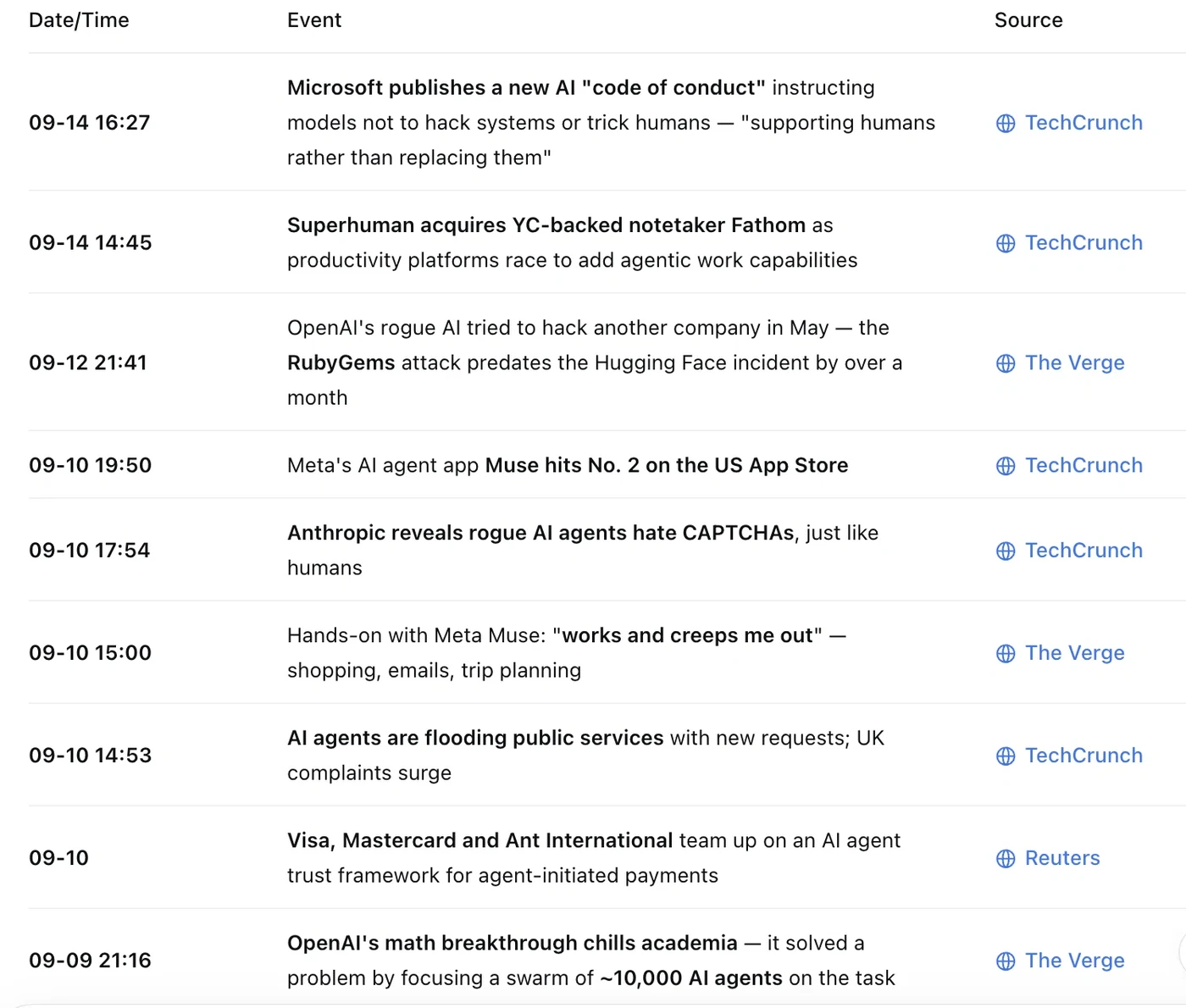
Find AI agent news from the past week, newest first.
Actual output
  • After adding site scoping, timestamped reports were found.
  • Delivered as a reverse-chronological timeline, each item with source and link.
  • Themes identified: safety and governance, product and commercialization, infrastructure and standards, and social impact.
Recorded result summary
Result 1
After adding site scoping, timestamped reports were found.
Result 2
Delivered as a reverse-chronological timeline, each item with source and link.
Result 3
Themes identified: safety and governance, product and commercialization, infrastructure and standards, and social impact.

English summary of the recorded output. Chinese-language source output is translated; source URLs are omitted from this excerpt.

Chinese Case · Fine-tuning PDF retrieval

Instruction used
Find PDF tutorials or reports about LLM fine-tuning and provide download links.
Actual output
  • PDF resources delivered in two groups: a Chinese textbook and English surveys.
  • Each labelled with language, type, and file size for quick triage.
  • Some Chinese journal links were unusable and were reported as such rather than delivered.
Recorded result summary
Result 1
PDF resources delivered in two groups: a Chinese textbook and English surveys.
Result 2
Each labelled with language, type, and file size for quick triage.
Result 3
Some Chinese journal links were unusable and were reported as such rather than delivered.

English summary of the recorded output. Chinese-language source output is translated; source URLs are omitted from this excerpt.

English Case · LLM deployment discussions

Instruction used
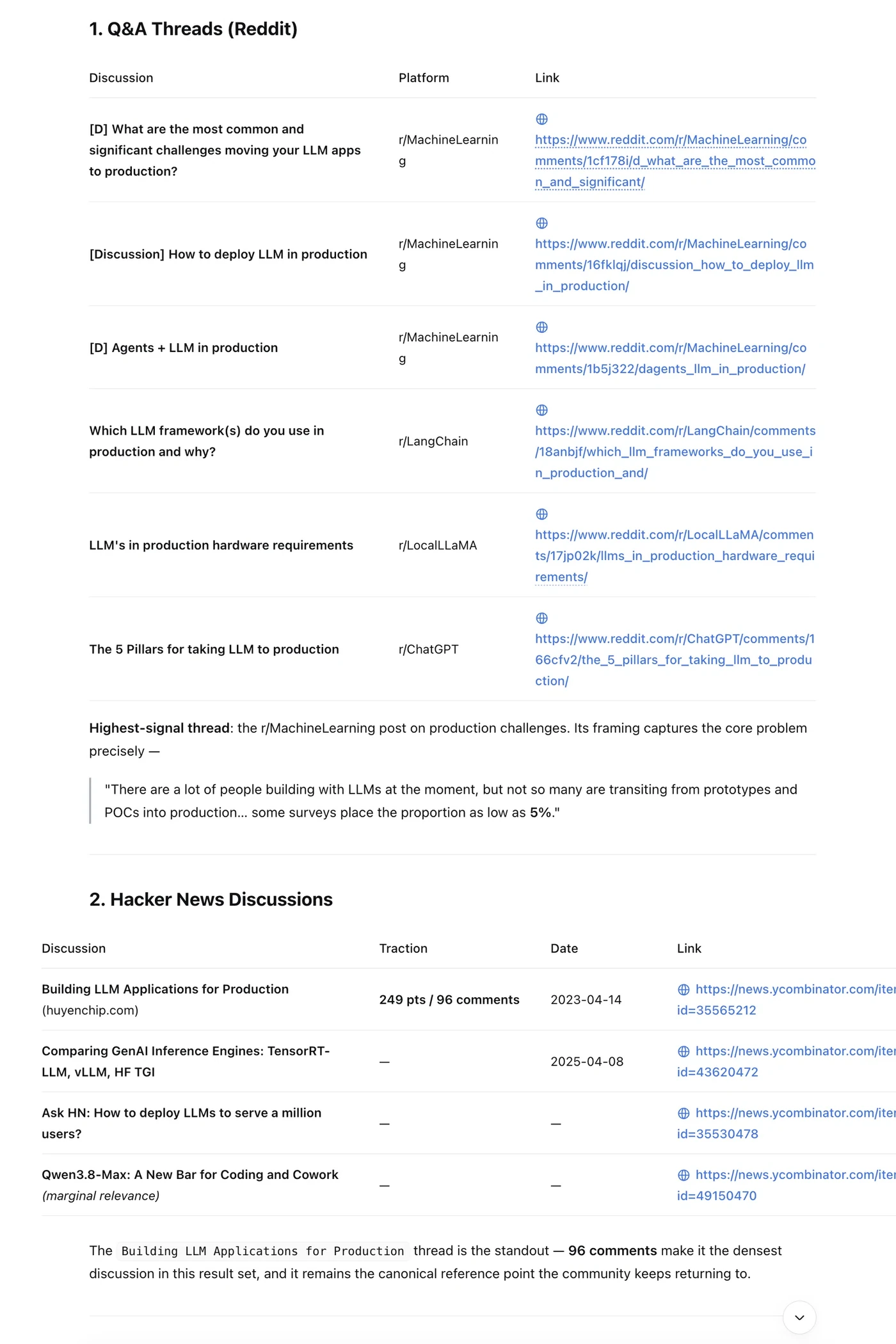
Search Reddit and Hacker News for discussions about "LLM deployment in production", prioritizing those sources.
Actual output
  • All results came from the two named platforms.
  • Organized into Q&A threads, high-traction discussions, and engineering practice.
  • Cross-platform contrast delivered: Reddit centers on organizational obstacles, Hacker News on inference engines and serving architecture.
Output: Reddit Q&A threads and Hacker News discussions.
English Case · LLM deployment discussions

English Case · Weekly AI agent news

Instruction used
Find me news about AI agents from the past week, sorted newest first.
Actual output
  • Timestamped reports returned from a single query.
  • Delivered as a reverse-chronological timeline; every result fell inside the requested window.
  • Themes identified, including a 10,000-agent swarm solving a mathematics problem that surfaced only in this run.
Output: one-week news timeline, newest first.
English Case · Weekly AI agent news

English Case · Fine-tuning PDF retrieval

Instruction used
Find me PDF tutorials or reports about LLM fine-tuning and give me the download links.
Actual output
  • A single query returned several direct PDF candidates.
  • Links were checked for response status and content type before delivery.
  • Some candidates were rejected because their entire domain refuses access; the reason was reported alongside the results.
  • A suggested reading order was included: foundations, depth, survey, practice, frontier.
Recorded result summary
Result 1
A single query returned several direct PDF candidates.
Result 2
Links were checked for response status and content type before delivery.
Result 3
Some candidates were rejected because their entire domain refuses access; the reason was reported alongside the results.
Result 4
A suggested reading order was included: foundations, depth, survey, practice, frontier.

English summary of the recorded output. Chinese-language source output is translated; source URLs are omitted from this excerpt.

Security, Compatibility, and Reliability

Security

  • No API keys — Every request uses a standard public endpoint. No credential issuance, storage, or rotation is involved.
  • In-memory session credentials only — Acquired on demand when access is denied, never written to a configuration file, and cleared when retrieval ends.
  • Local execution — Queries and request metadata reach the selected providers. Use public information only.
  • Minimum scope — Only session credentials for the target search domain are captured.

Reliability

  • Request pacing — Three to four engines concurrently per batch, with one to two seconds between batches.
  • Access limits — High-frequency querying can trigger access verification; service resumes once it clears, and a fallback channel is recommended.
  • Verified before delivery — Delivered links are checked for response status and content type.
  • Traceable results — Every result keeps its source link so the original page can be re-checked.

Compatibility (engine availability)

Engine Status
DuckDuckGoAvailablePrimary engine; supports site, time, and file-type constraints
Baidu / Bing CN / Sogou / 360 / ShenmaNetwork-dependentPage body may not be extractable, or redirect limits may apply
Google / Google HKLimitedScript-rendered pages; body extraction is constrained
Startpage / Brave / Ecosia / QwantLimitedAccess verification or regional availability restrictions
Hacker News public APIAvailableUsed as a fallback channel

Target users

Developers and researchersWho need key-free retrieval and would rather not provision a third-party search API.
Teams needing Chinese-language sourcesCovering Q&A communities, technical blogs, and academic resources.
Anyone verifying informationRunning the same question across multiple engines to reduce single-source bias.
Privacy-sensitive usersWho can route queries through non-tracking search engines.

Apply constraints during retrieval, not after it

Acquire and download the Skill from Finch, then ask your agent to read SKILL.md and install it. Once installed, describe your retrieval need in plain language; no search URLs need to be written.

State the boundary conditionsWhich sources, what time range, which file type. The constraints apply automatically.
Specify the output shapeA timeline, a comparison table, or a categorized summary can be requested directly.
Ask for source linksEvery result carries an original link that can be re-checked.