Turn a novel into production-ready character assets
Profiles, image prompts, voice prompts, 16:9 model sheets and an interactive report — grown from hundreds of thousands of words with a single sentence.
The problem
The costliest rework is "everyone has a different character in mind"
Designs from memory
Artists sketch designs from impression, drifting away from the novel; reviews turn into shouting matches with no ground truth.
One person becomes three
The same character answers to three names in the novel and ends up as three rows in the spreadsheet — the more you reconcile, the messier it gets.
No provenance
Nobody can tell which line is from the book and which is invented; and a voice note like "deep and magnetic" gives a TTS engine nothing to execute.
How it works
Read the source, keep the evidence, ship the standards
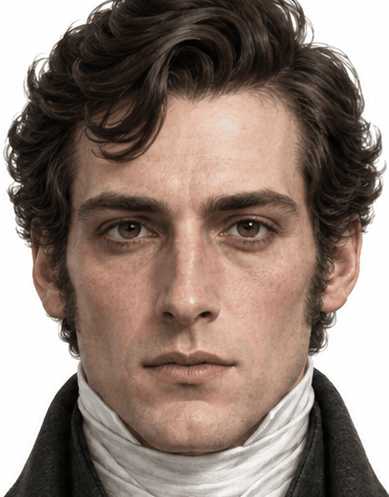
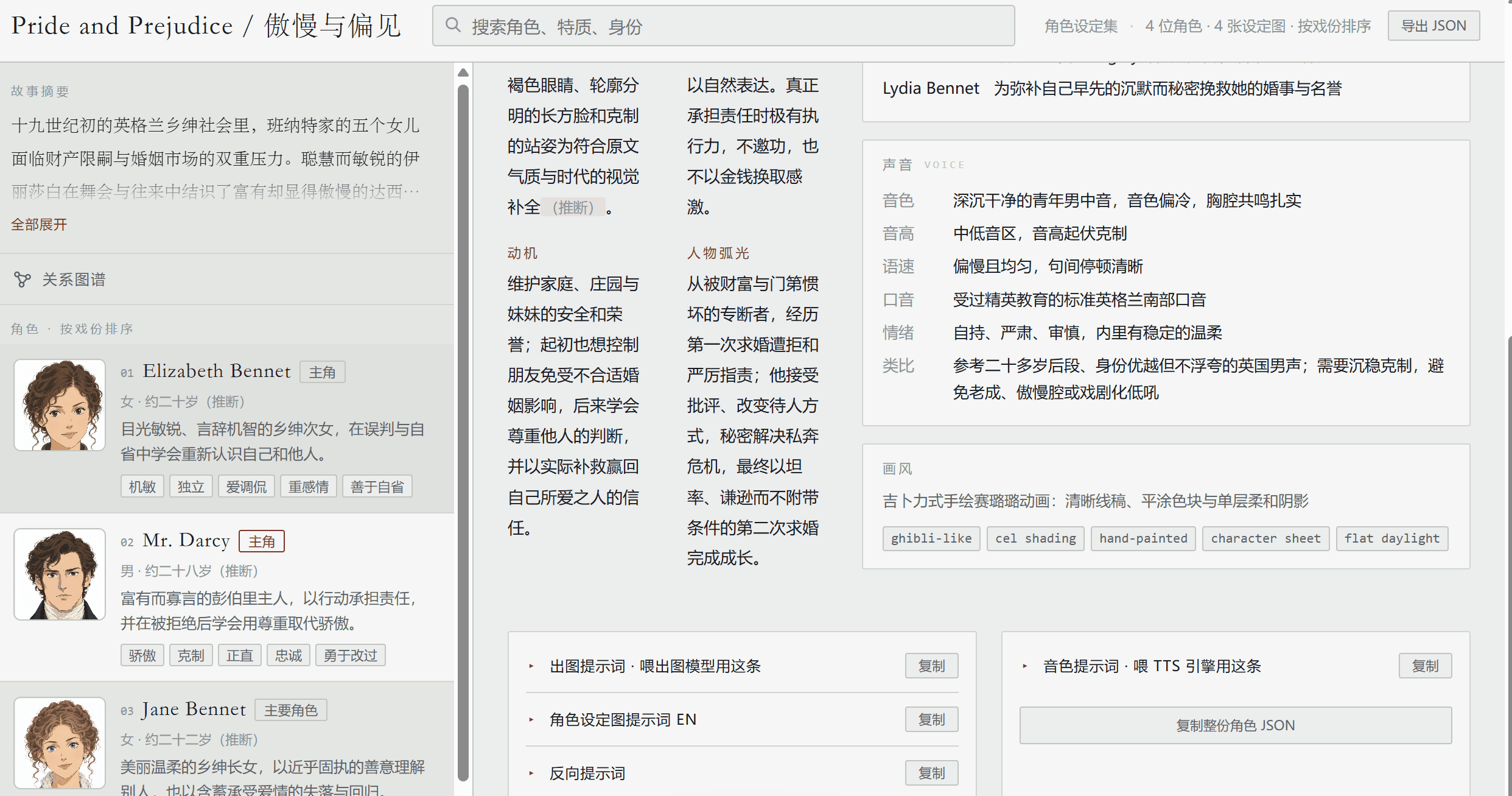
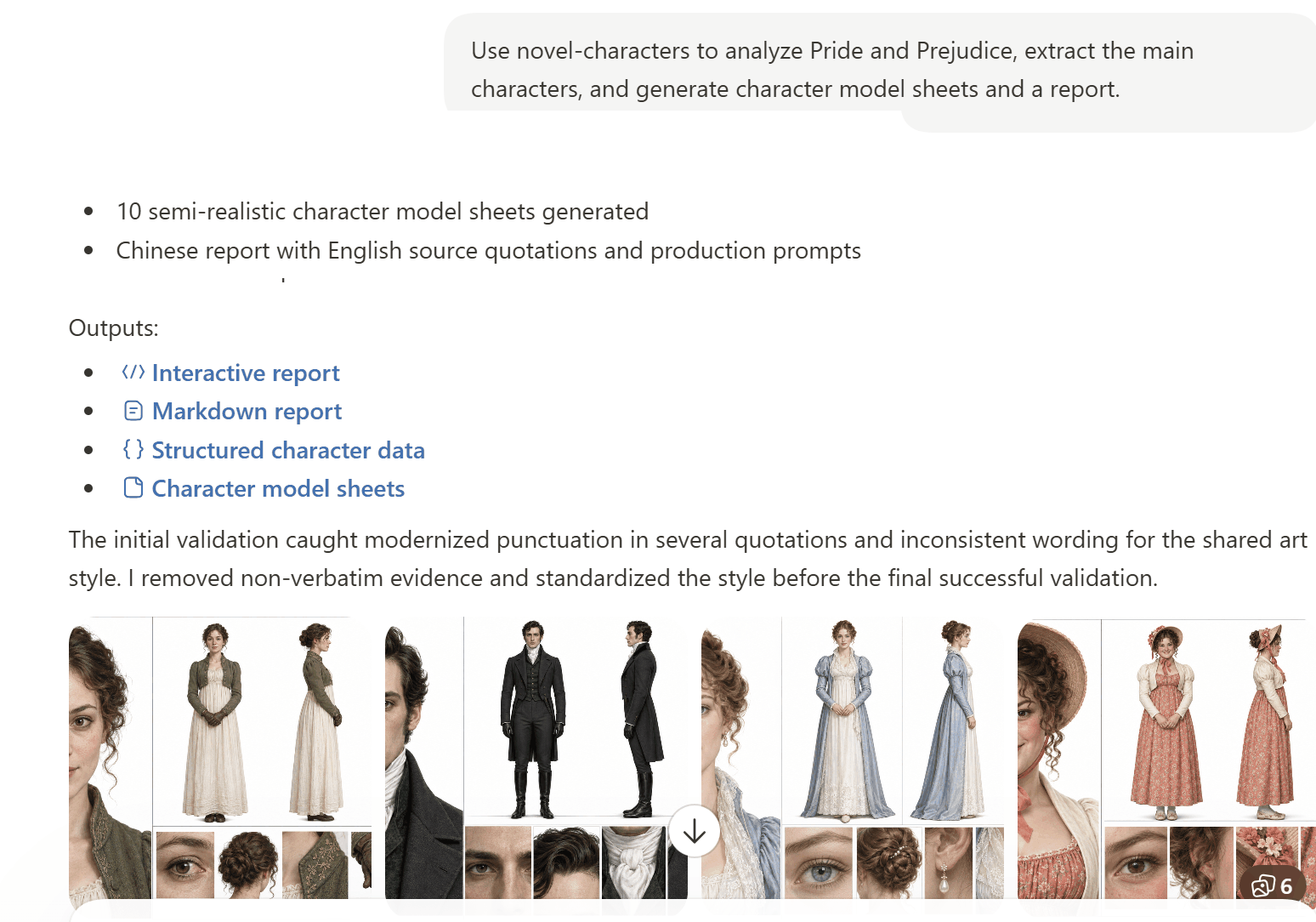
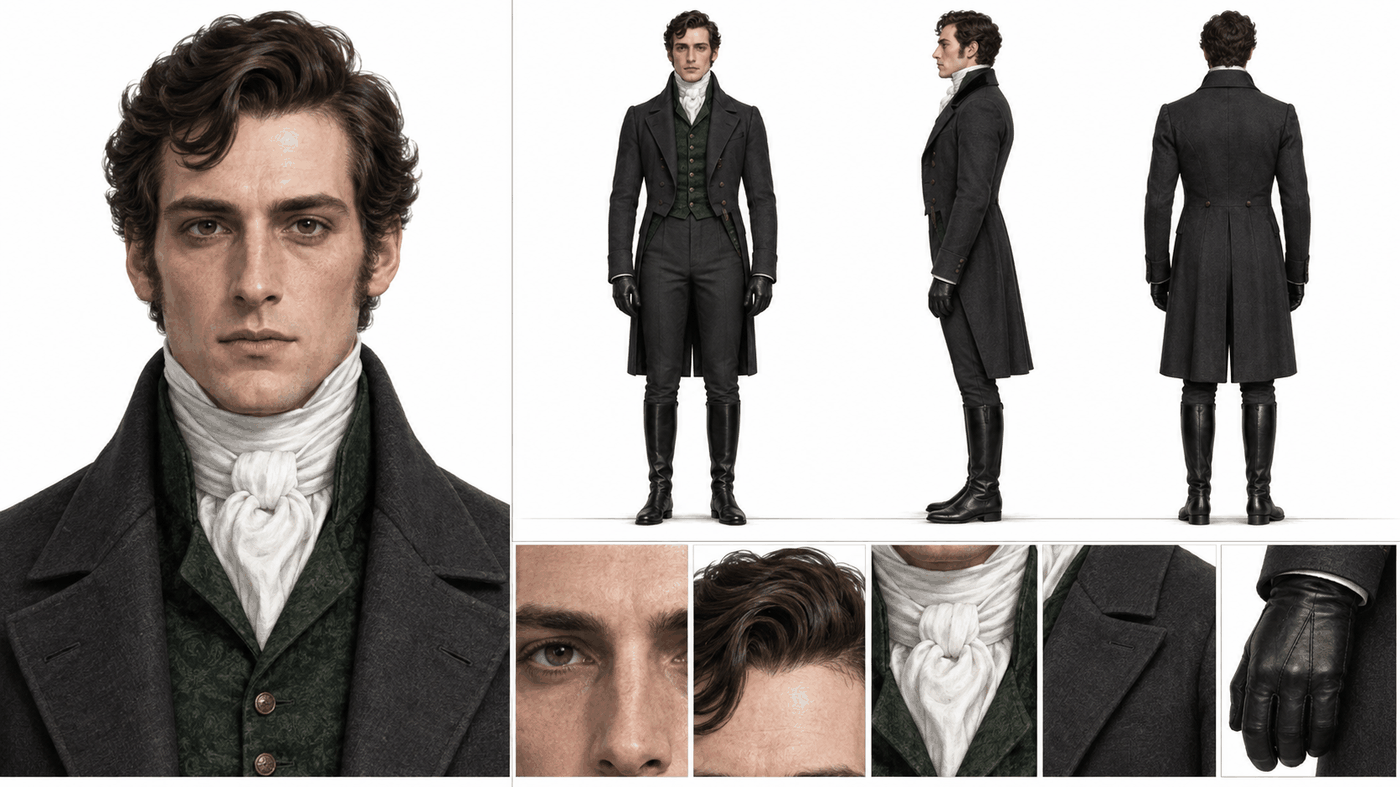
While reading the book, novel-characters records each person's appearance, behavior and verbatim quotes, automatically merging different names for the same person. Every line of the profile points back to the text. Image prompts are written to a professional model-sheet spec — bust portrait pins the face, three-view pins the body, detail strips pin the wardrobe — and ethnicity, era and region are mandatory, so the model cannot paint a Regency heroine as a modern Western face. The voice prompt is a parameterized voice prompt that plugs straight into text-to-voice engines.
What you receive is the whole set: structured JSON for downstream programs, Markdown for collaboration, an interactive HTML report for people, and full-size PNG sheets for artists.
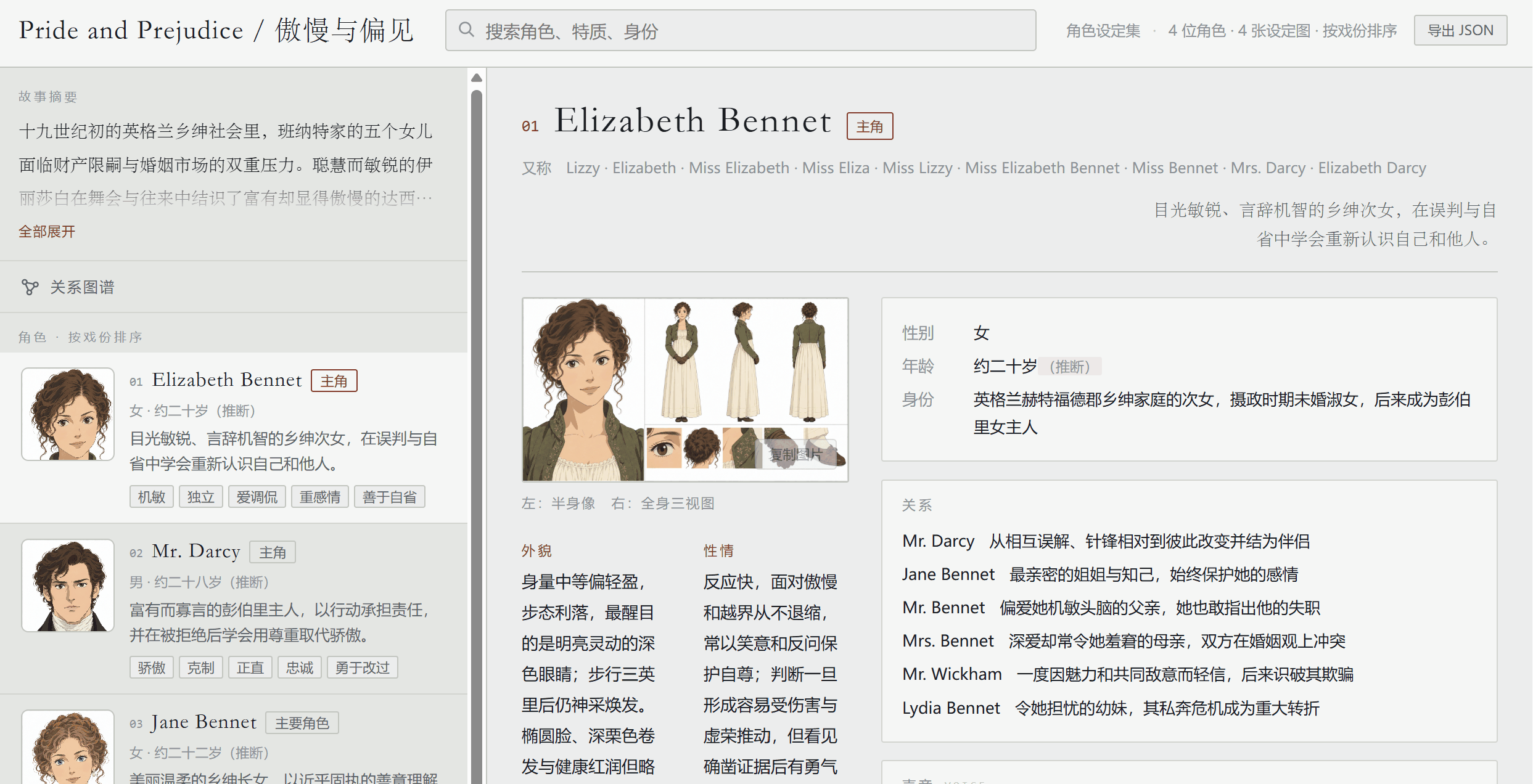
The report is not just pretty. Under every profile sits the source-evidence section — each trait paired with a verbatim quote, so nobody has to argue about "whether that line is actually in the book" in a review. Every prompt has one-click copy.
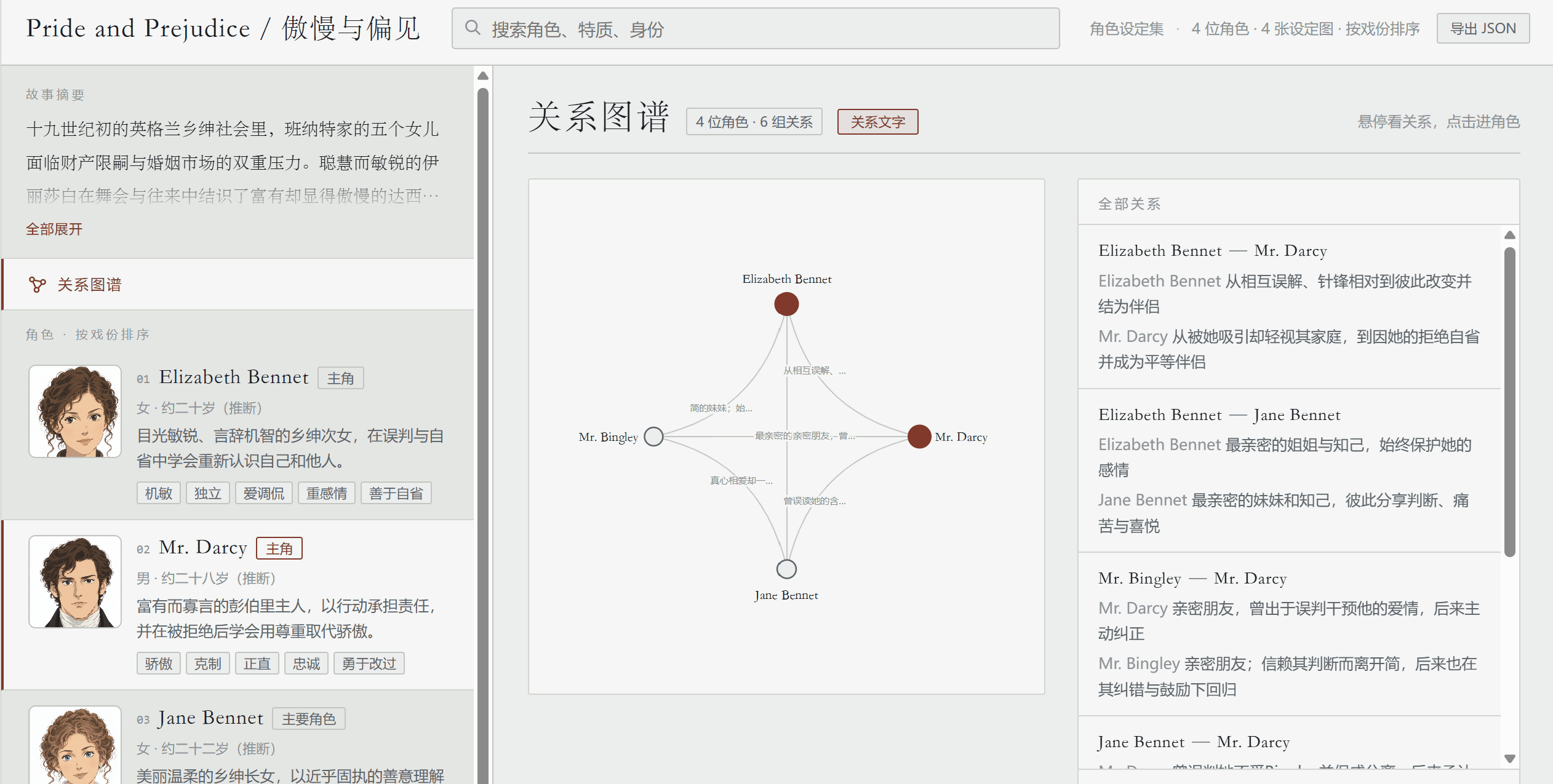
Relationships get a full graph — who owes whom what, at a glance — and clicking jumps to the character.
A real run
Pride and Prejudice: from the full novel to four leads
In a real session, the user attached the full text of Pride and Prejudice with a single sentence. The Agent identified the characters, fully profiled the 10 most important, and drew a model sheet for each. Then the user asked to keep only the four leads — the report was regenerated around that shorter list.
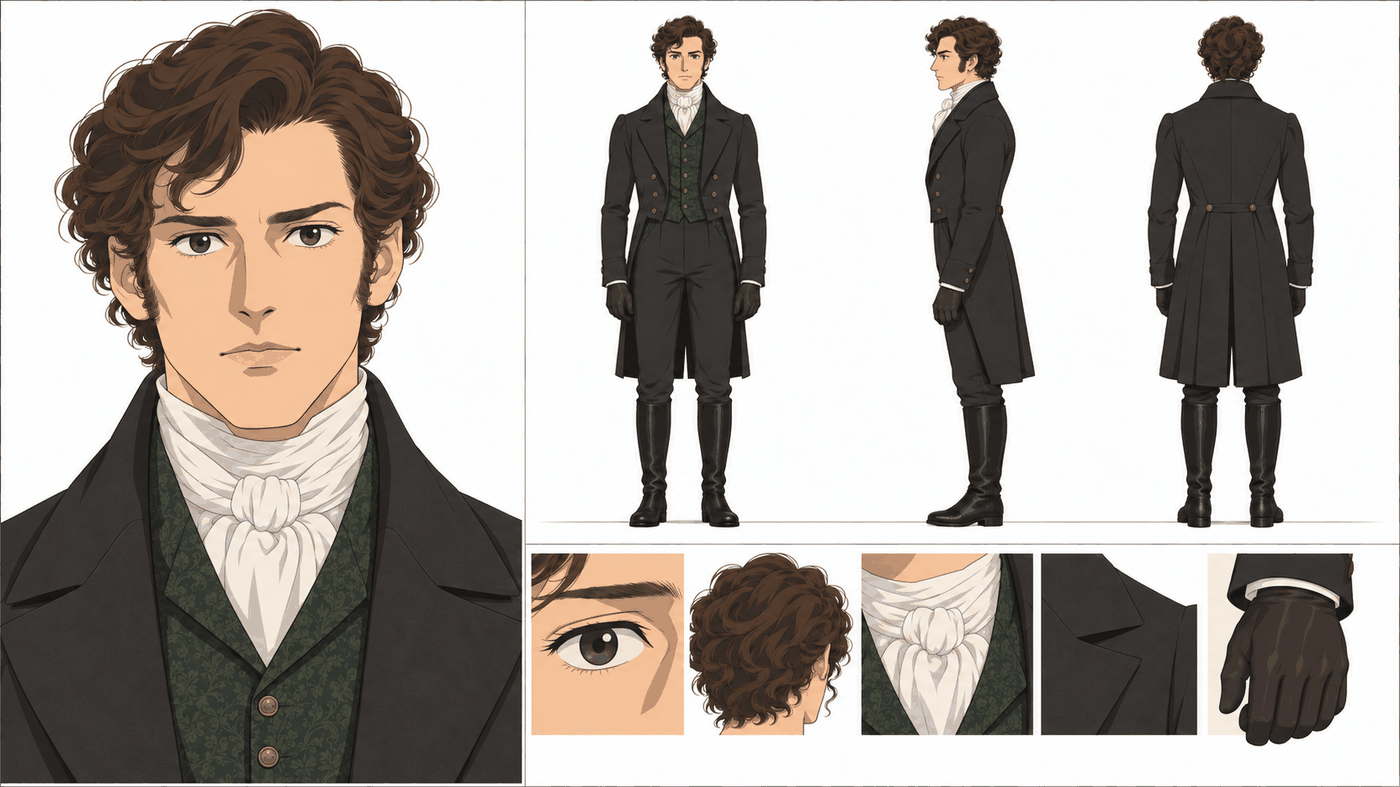
Changing the whole visual style is another one-liner. Below, Mr. Darcy moves from semi-realistic painterly to a Ghibli-inspired animation style — identity, costume and layout untouched, only the rendering shifts.
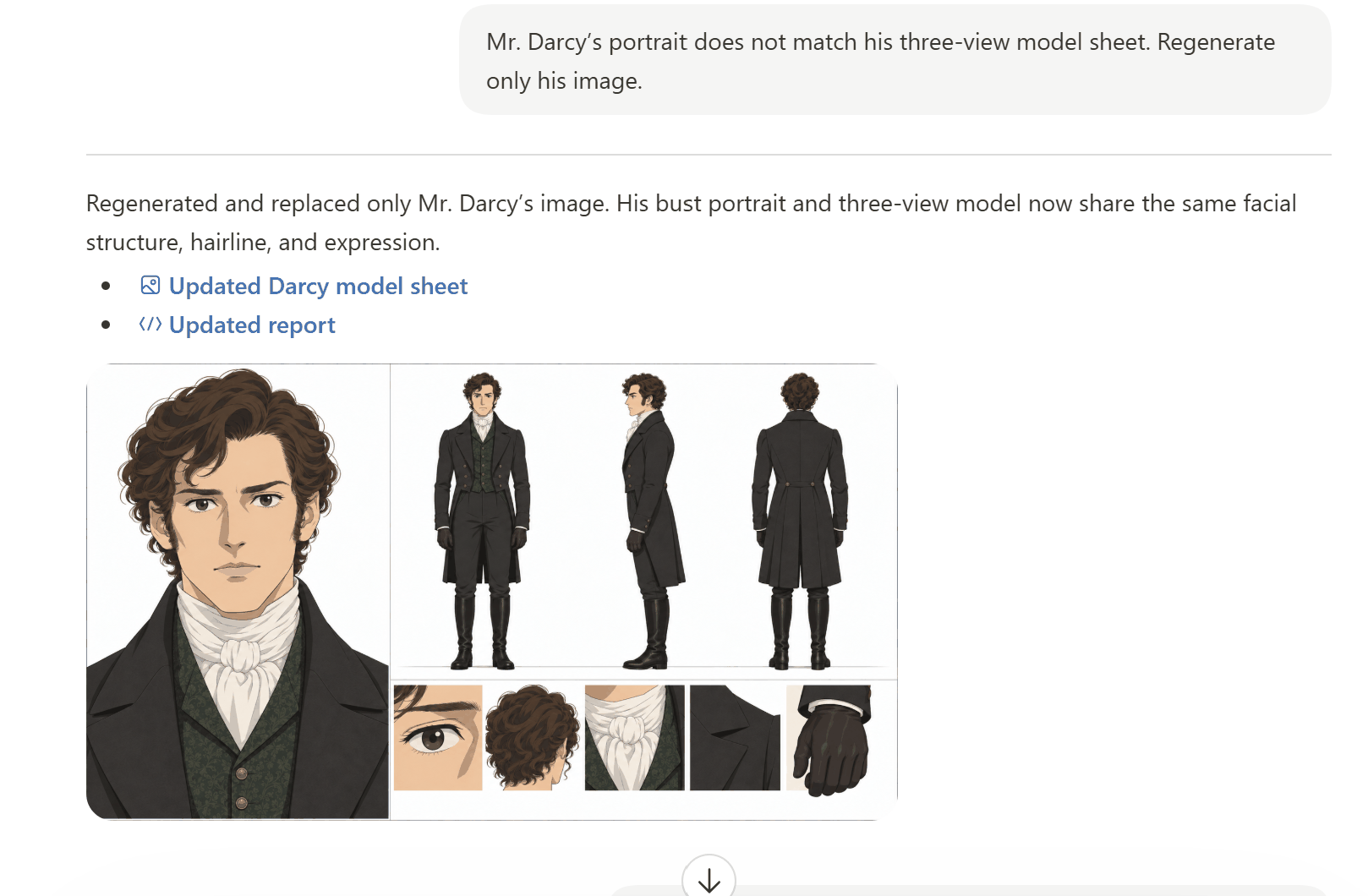
And when a single character looks off, you do not rerun the batch: "Mr. Darcy’s portrait does not match his three-view model sheet. Regenerate only his image" — and only that one sheet is replaced.
Why it wins
Five reasons to put it in your pipeline
Profiles backed by the text
Every key trait carries a verbatim quote; inferences are labeled. Quote fidelity is enforced by script, not by model goodwill.
Deliverables fit the pipeline
Image, negative and TTS prompts are written the way engines expect — copy and go. cast.json is stable enough to edit externally and feed back.
Plain language drives it
"Only the top four." "Switch to Ghibli style." "No images this time." "Regenerate just this one." All natural sentences.
Consistent, switchable looks
Two whole-batch presets — semi-realistic painterly and Ghibli-inspired — plus first-sheet-as-reference to pin the batch style.
Gets cheaper as it runs
Cards and images persist independently: shrinking the list reuses existing sheets, fixing one character regenerates one image, and resumed runs never pay twice.
What stays is the asset
IDs, profiles, quotes and prompts live on in JSON: restyle the batch, grow or shrink the cast, re-render the report anytime.
Who it is for
Three teams, three uses
AI drama / animation studios
Artists and production planners lock every lead character of a show within a week, straight into storyboarding and voice pipelines.
Web-novel IP evaluation
Audit the character assets of back-catalog titles in bulk — judge the cast before negotiating the license.
Solo creators
A one-person studio gets industrial-grade character designs and saves the time and cost of outsourcing key art.
Honest limits: it does not guarantee zero cross-image drift — sheets in one batch can differ slightly, so for feature-length consistency its output is best used upstream of LoRA training or reference-image workflows. Image generation depends on local codex; without it you still get everything except the PNGs. And the output stops at the character layer — storyboards, animation and final frames belong to the next stage of the pipeline.