Research that should take minutes is burning hours.
Writing research notes, running diligence, tracking competitors or following which companies mention an executive, a product or a phrase — it almost always comes back to SEC EDGAR.
EDGAR’s own full-text results are rough: rows come back without usable links, and company, form and date information is scattered across pages. So most people end up doing one of two things — opening a paid terminal, or copying a search result into Excel by hand, then adding links and company details back in, row by row.
General-purpose AI tools can generate a table in seconds — but they routinely invent company names, CIKs and form types that look completely real, and the links 404 the moment you click them.
The problem was never a lack of tools. It’s not being able to trust which links will actually open.
The same question, two very different workflows.
Three shifts you can verify yourself — in search, in link reliability, in statistics.
| Scenario | Before | After |
|---|---|---|
| Full-text search | Keywords in EDGAR’s old interface return fragments, not companies; different forms live in different places and get reassembled by hand every time. | Enter a keyword and a range; get one filing per row — company, CIK, form, date, accession number and an official link. |
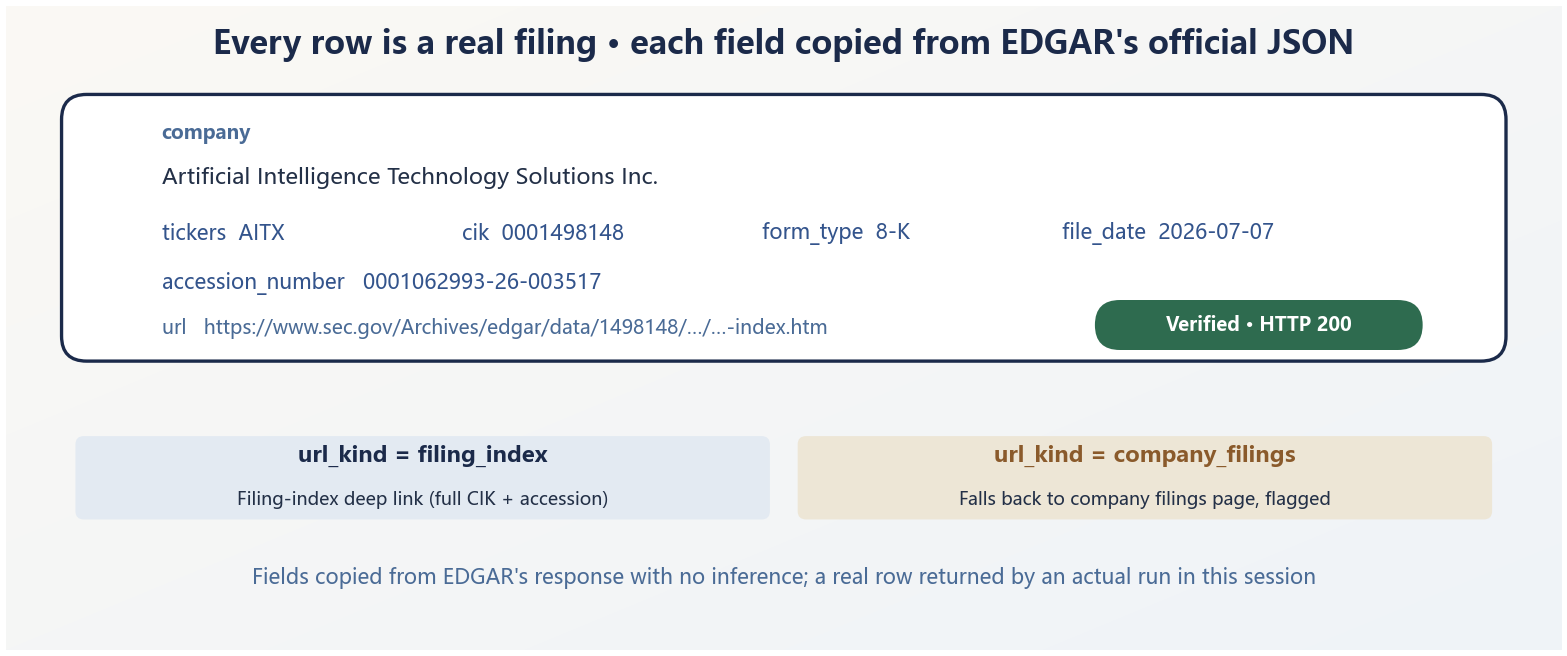
| Link reliability | Links from search engines or aggregators routinely break or land on the wrong page, so you reconstruct URLs yourself. | Every link is built from EDGAR filing identifiers; if a CIK or accession number is incomplete it falls back to the company’s filings browse page and flags url_kind. |
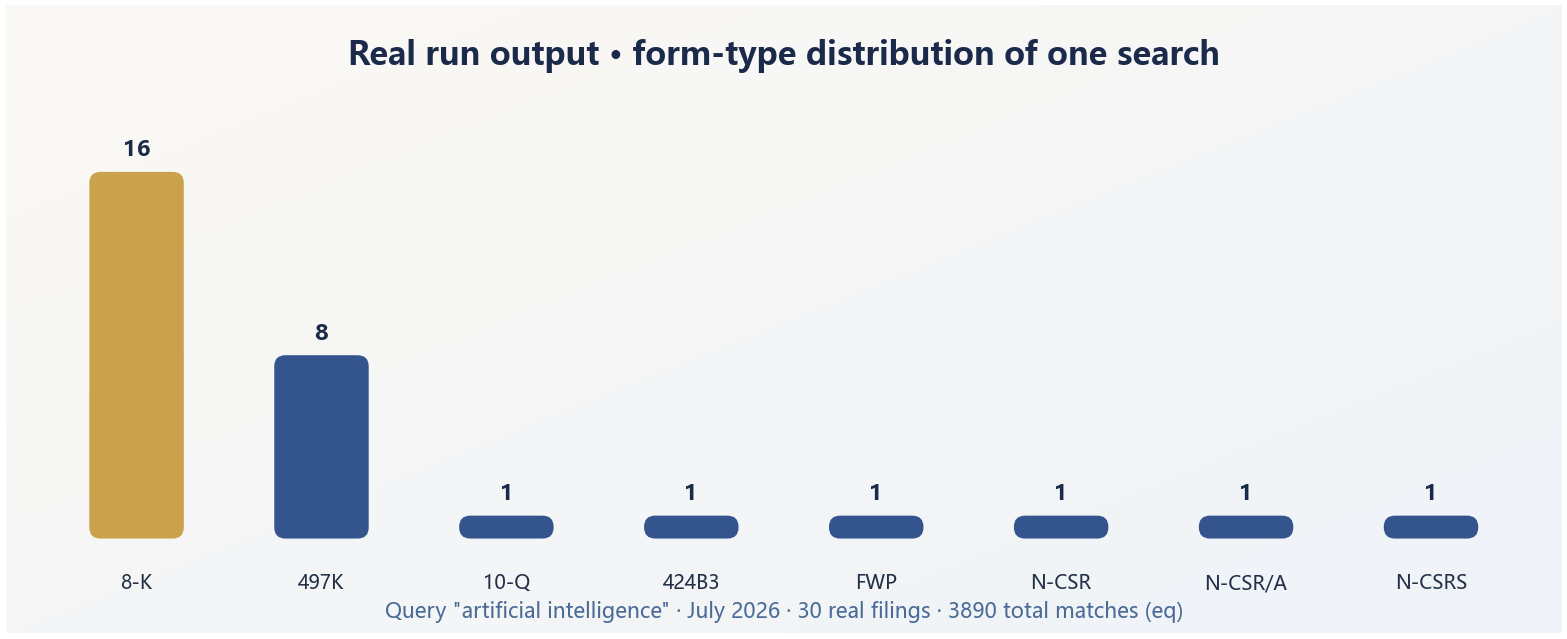
| Cross-form statistics | To see which forms mention a phrase you search several times, then stitch the results into a sheet by hand. | One response returns a by-form histogram and a total — e.g. 8-K ×16, 497K ×8, 10-Q ×1. |
One request in. A structured filing list out.
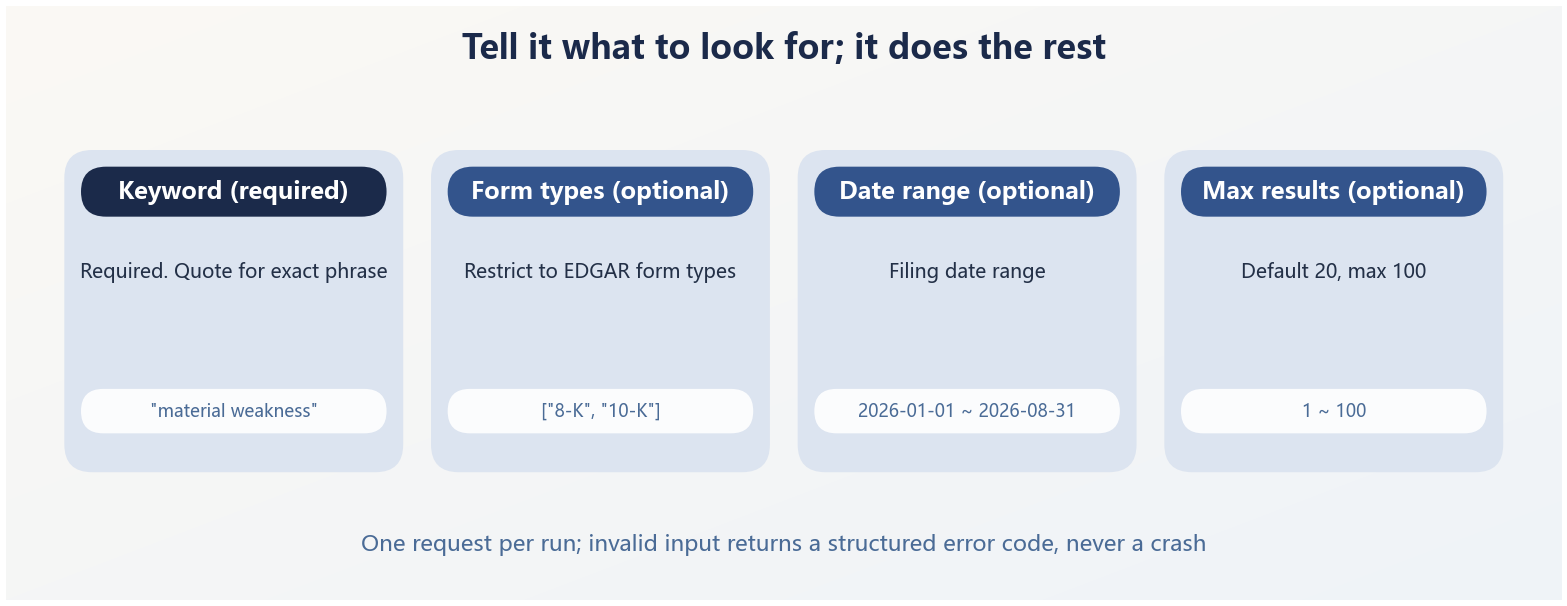
Give it the phrase you care about — quote it for an exact match — and optionally narrow by form type and date range.
SEC Filing Tracker calls SEC’s official EDGAR full-text search endpoint with a single, identified HTTP request and returns up to 100 hits. Documents inside the same filing collapse into one row, deduped by accession number, and EDGAR’s own relevance order is preserved end to end.
What comes back is row after row of real filing records: company, tickers, CIK, form type, filing date, accession number — plus a by-form distribution and the total match count. No guesswork, no fabricated fields.
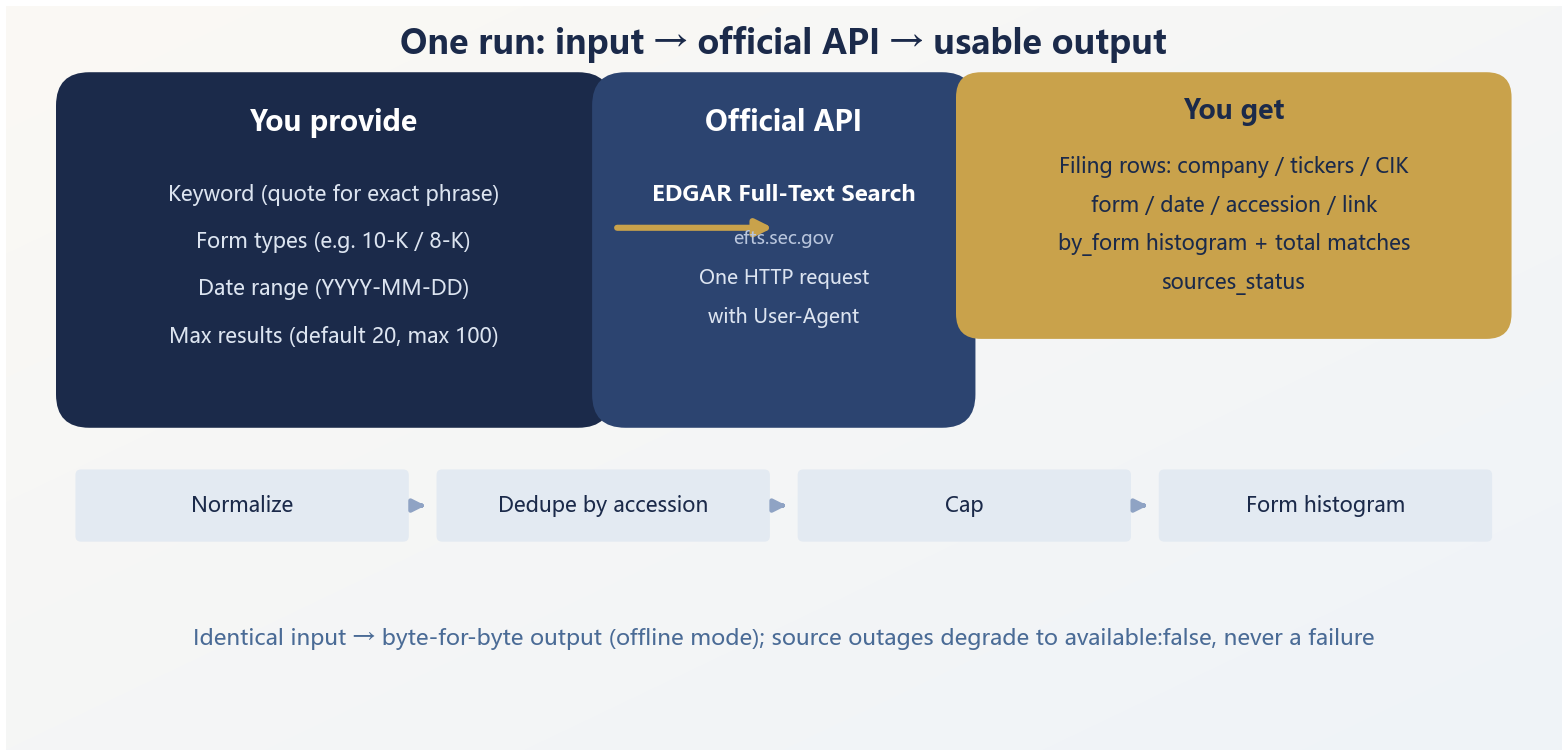
The Skill does the tedious look-up, dedupe and link construction first, and hands every source and piece of evidence back to you. Your judgment stays yours — it simply makes the finding correct and the links real.
See it run — three example cases.
Every case below is a real input and output from running the Skill. Nothing is fabricated, simulated or embellished.
Case 01 · Track an exact phrase — one month, every form
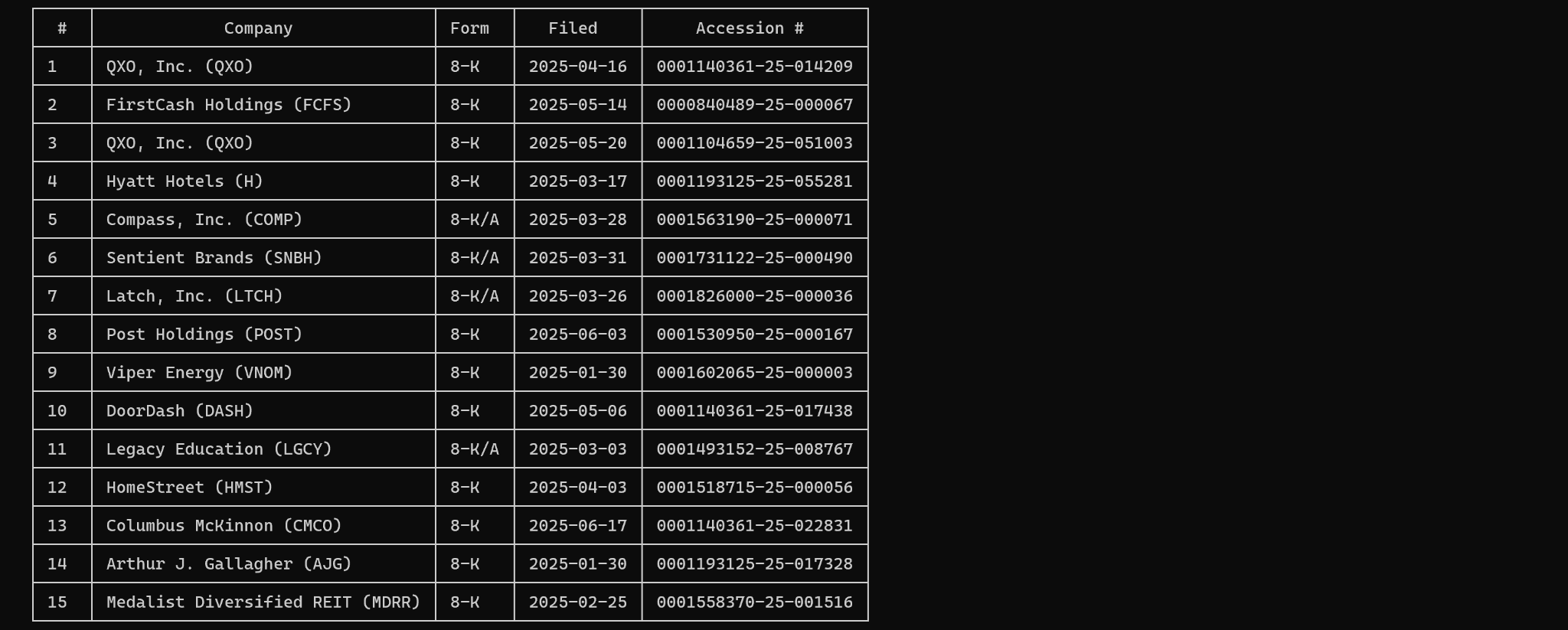
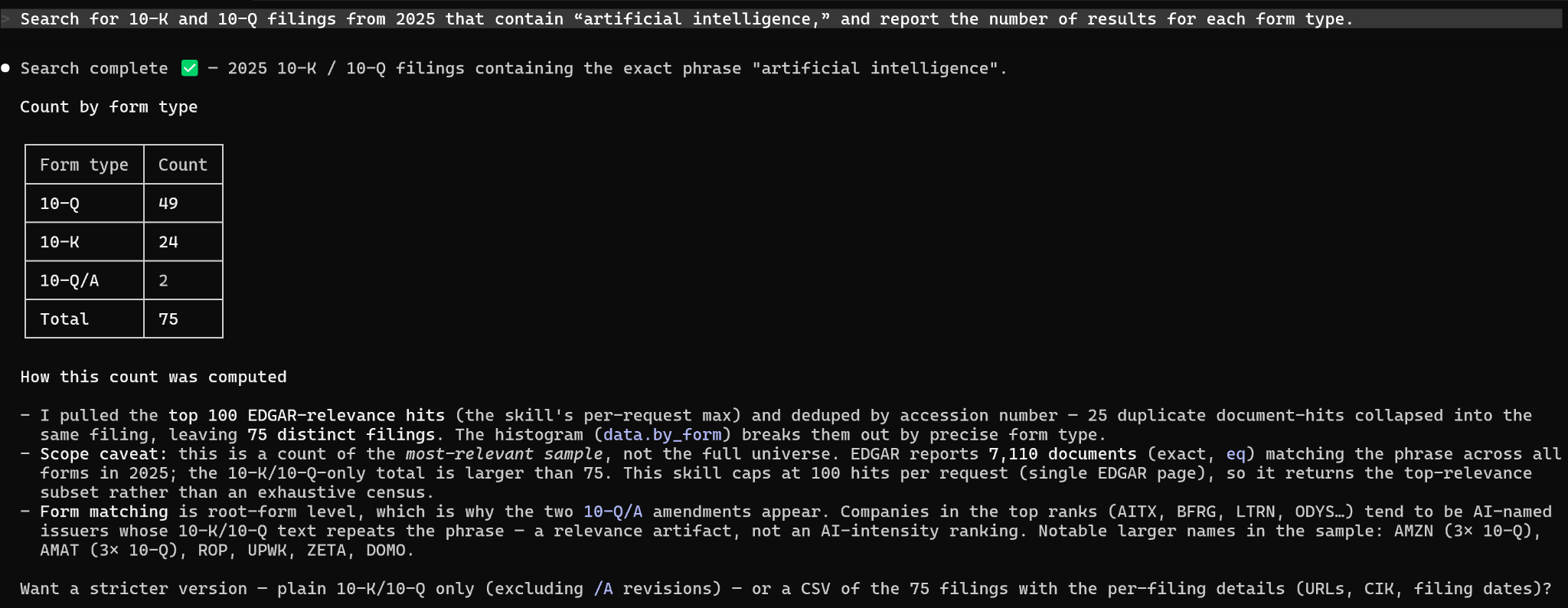
Input: “artificial intelligence”, 1–31 July 2026, up to 30 results. Output: 30 filings across 8 real form types — 8-K ×16, 497K ×8, 10-Q ×1, 424B3 ×1, FWP ×1, N-CSR ×1, N-CSR/A ×1, N-CSRS ×1 — with 3,890 total matches (EDGAR flag: eq) and 4 duplicates removed automatically. Companies include Artificial Intelligence Technology Solutions Inc. (AITX), Krane Shares Trust and more.
Case 02 · One form type, live against SEC — real companies
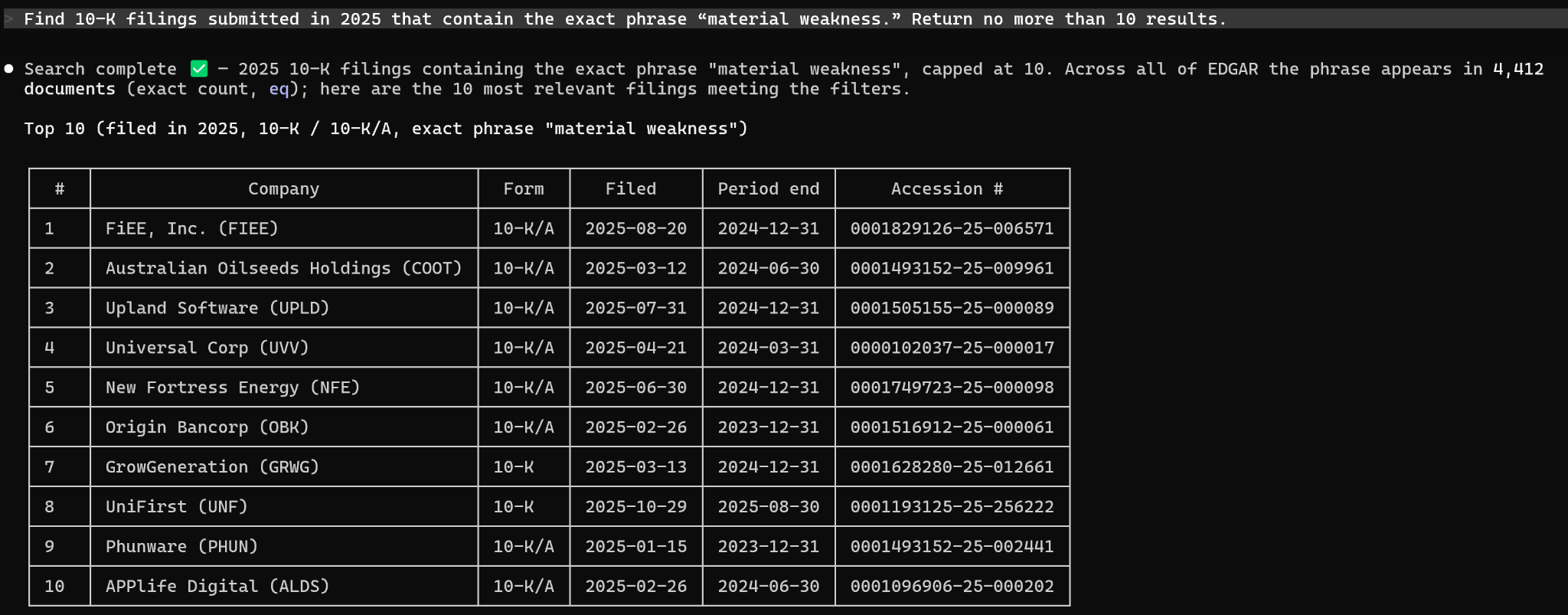
Input: “material weakness”, 10-K only, 1 January – 31 August 2026, up to 5 results. The live call to the SEC EDGAR API returned: ANAVEX LIFE SCIENCES CORP. (10-K/A), Where Food Comes From, Inc. (10-K/A), UNIVERSAL LOGISTICS HOLDINGS, INC. (10-K), SYNLOGIC, INC. (10-K) and Forian Inc. (10-K/A). Every row links to the official sec.gov filing page.
Case 03 · A source outage never becomes a crash
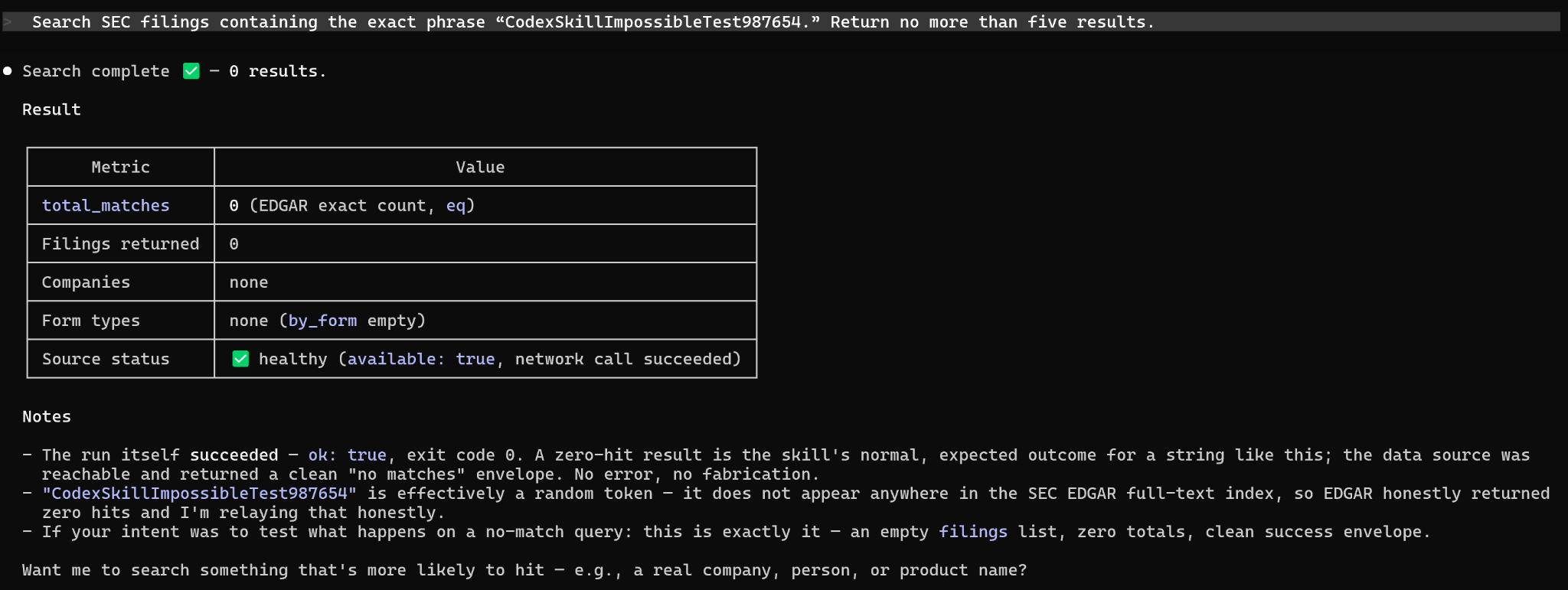
With the source marked unavailable, the run still succeeds (ok: true, exit code 0) and returns an empty list, while the status report shows available: false with the reason. A network hiccup is handled cleanly, not thrown as an error.
From installation to results — eight views
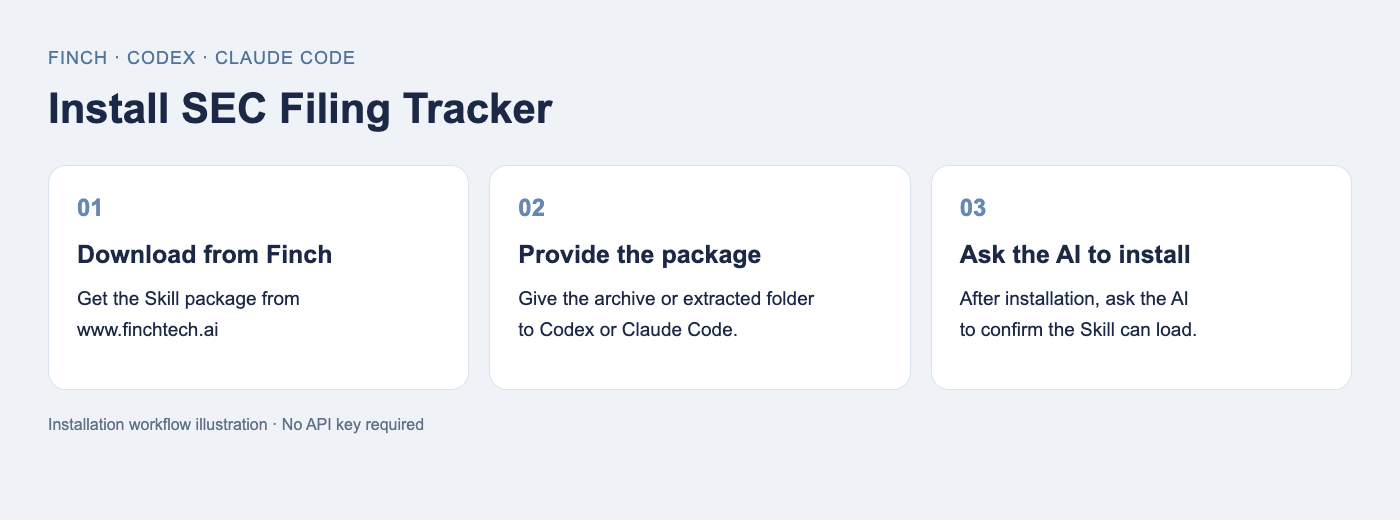
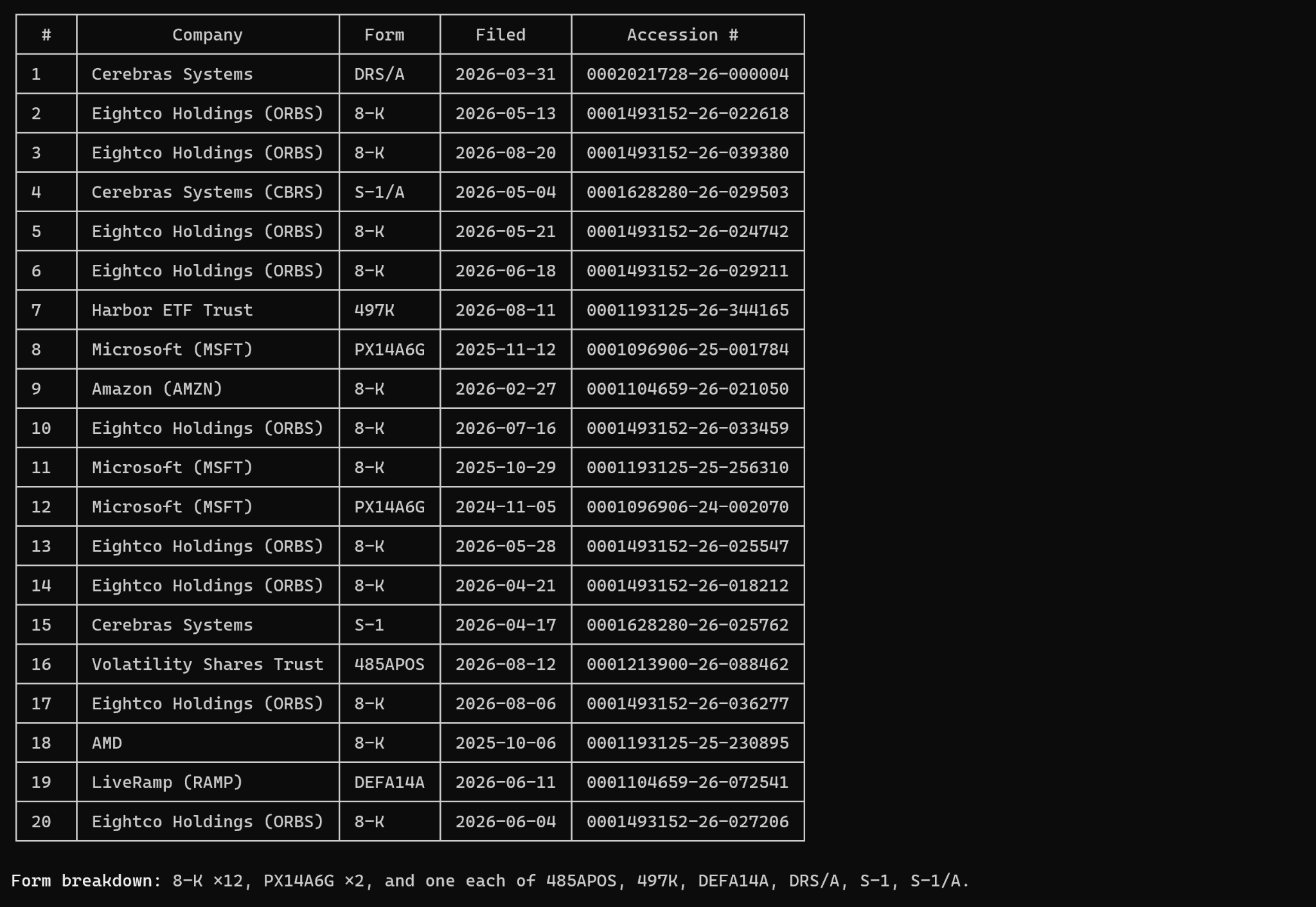
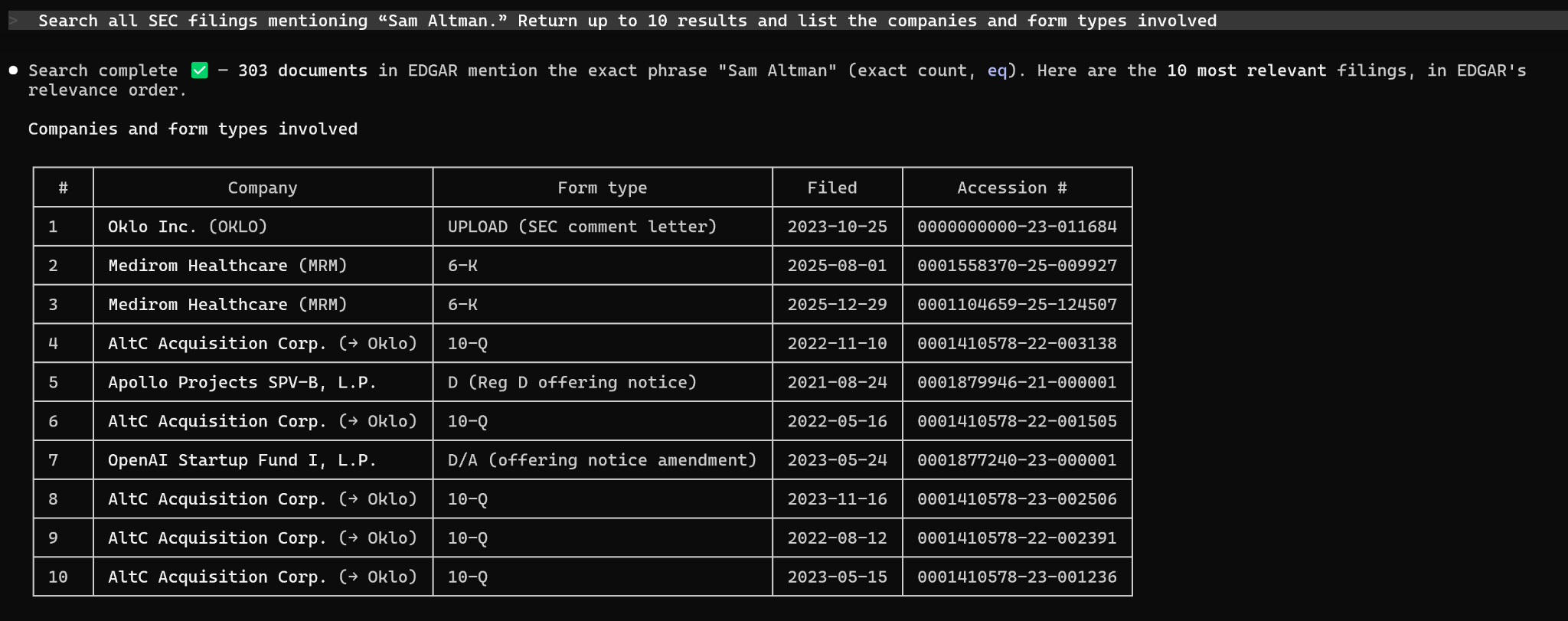
Installation uses a workflow illustration. Search screenshots are excerpts from the English user guide, with command details removed; they illustrate separate queries.

Everything you get — and the line it will never cross.
Each run is built so the only thing you still need to do is read the filing itself.
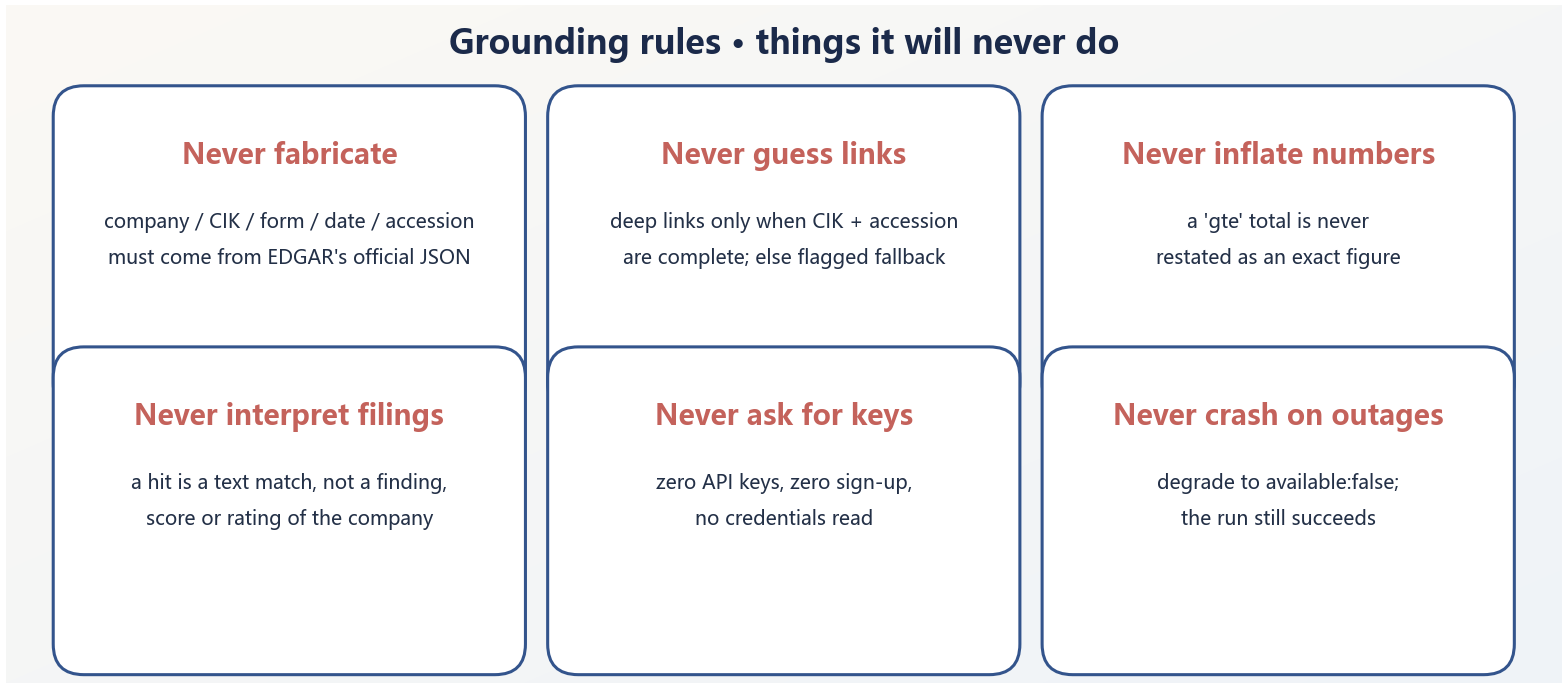
Every field comes from EDGAR’s official JSON
Company, tickers, CIK, form, date and accession number are copied or mechanically derived from EDGAR’s response — never inferred, never invented. Every value you receive can be checked verbatim on sec.gov.
Links are constructed from filing identifiers
A filing-index deep link is built only when a real CIK and a well-formed accession number are both present; otherwise it falls back to the company’s filings browse page and flags url_kind.
No API key of any kind
EDGAR’s full-text endpoint is anonymous, free and registration-free. The Skill sends only an identifying User-Agent and never reads, requires or accepts credentials.
One request per run — fair-access compliant by construction
Exactly one HTTP request per run, with results capped at 100 (EDGAR’s per-response ceiling), so the SEC’s 10 requests/second limit is satisfied by construction. No rate limits, no paging.
Deterministic offline runs
Offline mode runs the full pipeline — normalize, dedupe, cap, histogram — on fixture data; identical input yields byte-for-byte identical output. Ideal for CI and regression testing.
Built for people whose job is reading primary sources.
The point was never “it can search SEC too”. It turns a research hypothesis inside SEC’s primary disclosures into a set of audit-ready, machine-readable evidence candidates — fast, and far lighter than a research terminal.
It removes the recurring rhythm of research — search, copy, re-check the link, stitch a sheet by hand. The first search feeds the next step: widen or narrow from the by-form distribution, open the original from the accession number, keep tracking a phrase over time.
| Who it is for | Typical tasks | Why they reach for it |
|---|---|---|
| Investment research · event-driven analysts | “Which 8-Ks this quarter mention material weakness, an acquisition or a cybersecurity incident?” | Turns a disclosure sweep across many filers into a reviewable candidate set — less time opening files one by one. |
| IB, consulting, corporate strategy & diligence | Tracking whether a target, client or competitor surfaces a product name, customer name, executive or counterparty. | Going straight to primary regulatory disclosure builds a fact-verification chain instead of relying on second-hand news. |
| Compliance, legal & commercial intelligence | Periodic sweeps over risk words, contract terms, policy language or competitive signals. | Form and date filters compress noise; structured JSON plugs into existing agents, sheets or internal monitoring. |
- Individuals & small teams — free, zero-setup, cross-company disclosure scans.
- Research teams — let analysts move from finding files to reading and judging them.
- Agent workflows — a strict, predictable, citable structured entry point, ready to feed summarization, classification, monitoring and report generation.
Its primary value is research support, not a trading signal. If you only want standard financials or already run a mature research terminal, this is not a replacement for that.
Put it to work on your next research question.
Tell it the phrase, the form types and the date range you care about. It returns each real filing’s company, CIK, form, date and accession number — plus an official link on sec.gov.
A Finch Skill for Codex and Claude Code. Download from Finch and give the package or extracted folder to your AI to install. No API key required.