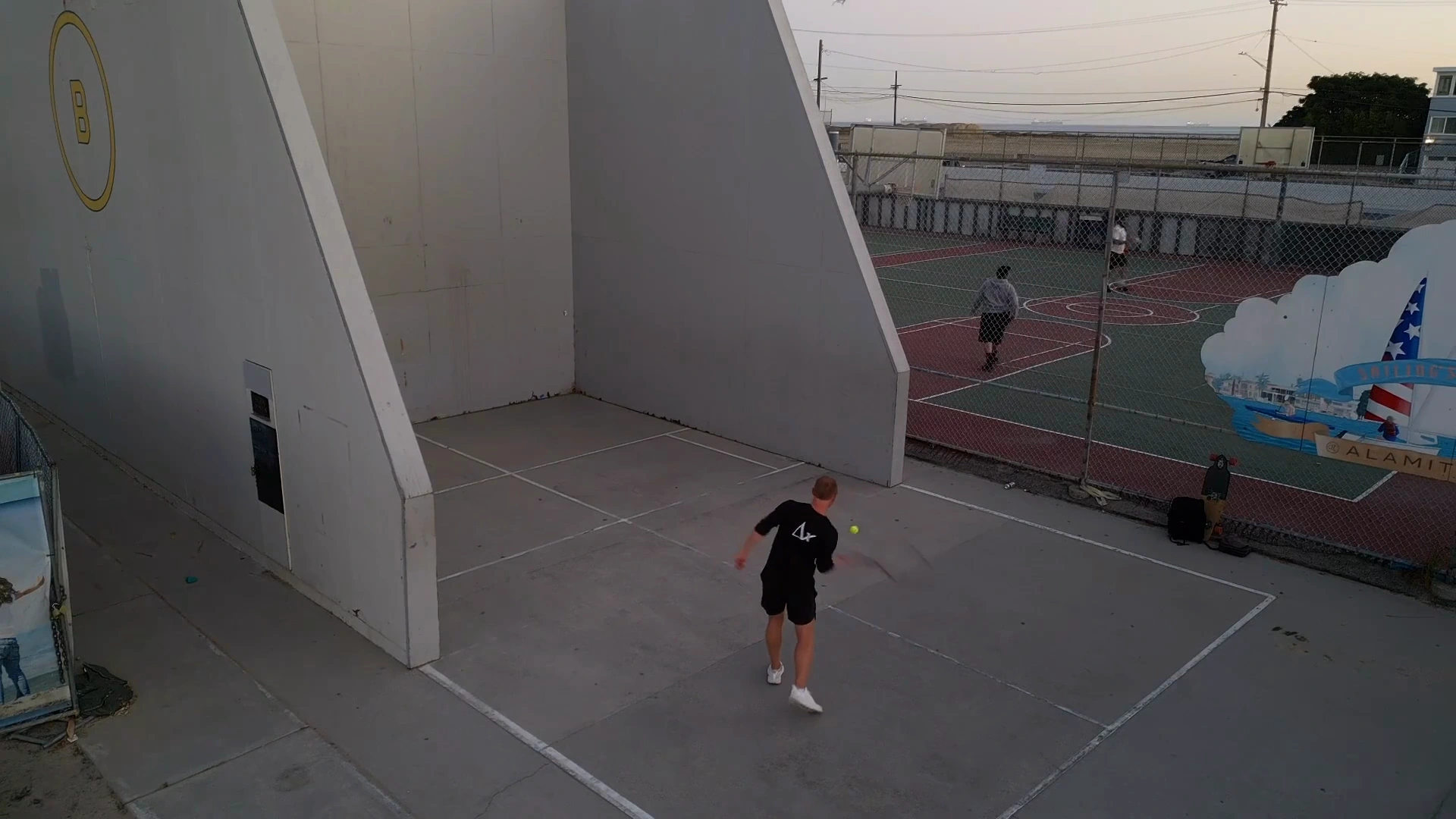
Tennis video / Stroke review

Turn tennis
video into a
clearer review.

Understand one swing, compare several strokes, and decide what to work on next. Tennis Motion Lab brings keyframes, original timestamps, concise observations, and practice suggestions together, with clear limits on what the footage can show.
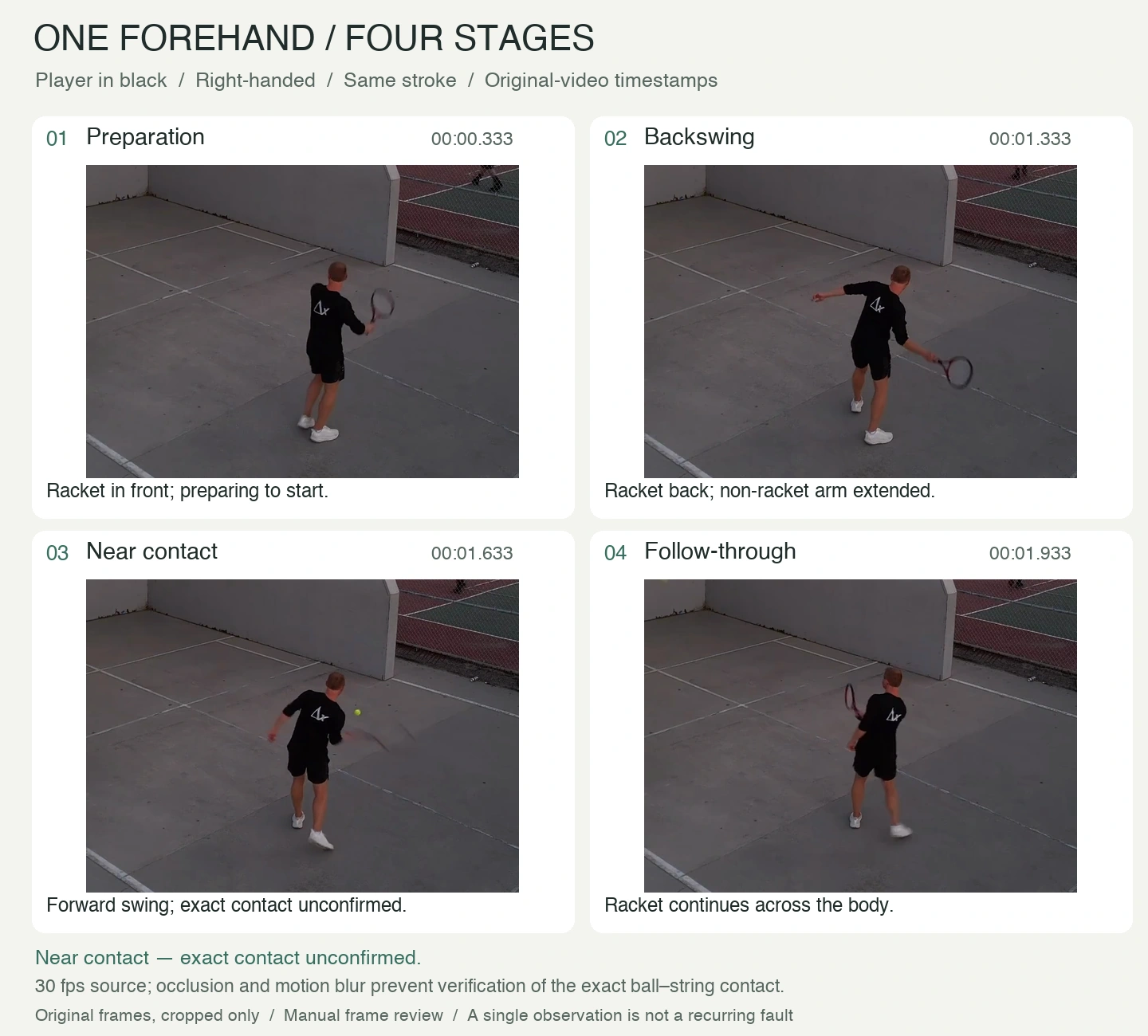
ONE FOREHAND / FOUR STAGES↗
From preparation to the finish
ORIGINAL TIMESTAMPS
RETURN TO THE MOMENT
REVIEW ONE SWINGCOMPARE STROKESPLAN WHAT TO CHECK NEXT
Before / After

From raw footage to a clear stroke review

BeforeRaw footage
Before

The movement is spread across a continuous clip. You pause and replay it to find the preparation, backswing, and finish.

AfterFour-stage review
After

Four stages of the same forehand appear together, with timestamps and short captions. Uncertain contact is clearly labeled.

This is a change in how the stroke is reviewed, not evidence that the player’s technique has improved.

See the movement before choosing the practice

The original video remains the starting point. Keyframes help you locate the movement, while the commentary makes uncertainty visible and gives the next practice session a clear focus.

Core capabilities

Three ways to review your forehand

4 stagesKeyframes from preparation to finish

Break down one stroke

See preparation, backswing, near contact, and follow-through in one image. Original-video timestamps let you return to each moment.

3 forehandsComparable moments from one player

Spot recurring patterns

Review several strokes together and distinguish a single observation from a recurring pattern. A possible fault stays tentative when the view cannot confirm it.

10 minutesA card with two simple drills

Plan your next practice

Turn one concern into a short practice card with timings, sets, coaching cues, and specific checks for the next recording.

These figures describe the examples below, not accuracy or training outcomes.

How it works

Start with your video

01

Provide the footage

Upload a video or provide a local file. Identify the player; include the racket hand and stroke type if you know them.

02

Choose your focus

Ask for a breakdown of one stroke, a comparison of several strokes, or a short practice card.

03

Review the images and explanation

Use the timestamps to revisit the clip. Pay attention to labels such as “near contact” and “unconfirmed.”

04

Record again with a clear focus

Try the practice and record the same stroke type, looking at control through the finish and the return to ready.

Ask in Chinese or English, and request matching language throughout the images.

One stroke

Understand one complete forehand

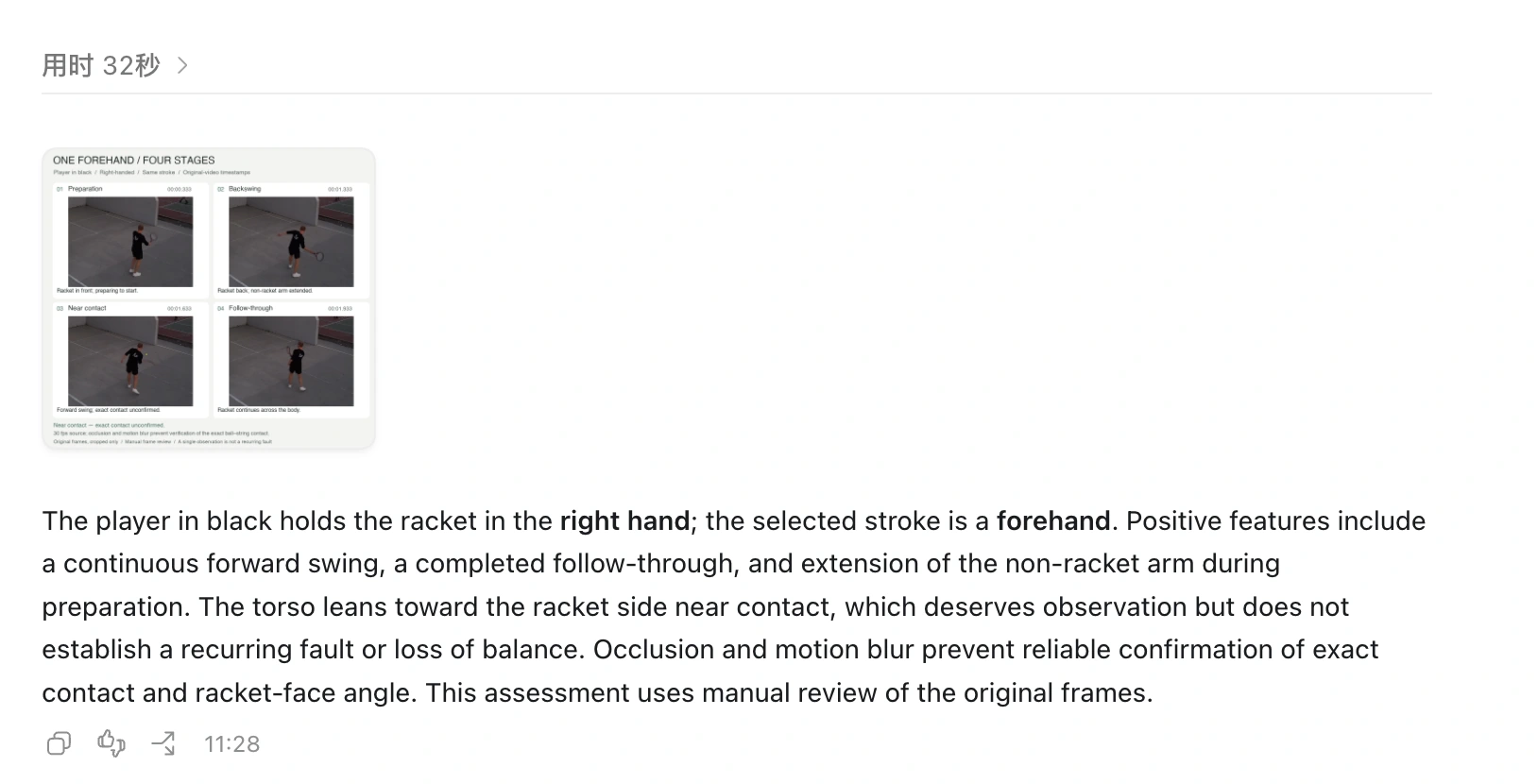
For players who want to see how a swing unfolds. The player in black is right-handed, and the selected stroke is a forehand.

The response identifies a continuous forward swing and a completed follow-through. Torso lean remains a single-stroke observation, not a recurring fault.

Occlusion and motion blur obscure the ball–racket interaction. The image therefore labels the third panel “Near contact” rather than claiming an exact contact frame.
From preparation to the finish
Four stages of the same stroke, each linked to the original video by its timestamp.
View the full prompt
Use tennis-motion-lab to analyze the uploaded video. Identify the player’s racket hand and stroke types first, then select one of the clearest forehands. Do not assume the player has a technical fault. Create one keyframe collage showing four stages of the same stroke: preparation, backswing, contact, and follow-through. Include brief English captions and timestamps from the original video. If exact contact cannot be confirmed, label that panel “Near contact — exact contact unconfirmed.” Show the collage first, followed by a summary of no more than 100 words describing what the player does well and what deserves attention. Treat anything seen in this single stroke as an observation, not a recurring technical fault. Clearly state what cannot be seen reliably. Write everything in English, including all text inside the generated image. Use a clean, compact layout suitable for screenshots.
The forehand review in conversation
Repeated strokes

Find what repeats across three strokes

For players who want a comparison they can revisit, rather than relying on an impression from one shot. Three forehands are shown at comparable stages.

All three follow-throughs show torso lean toward screen right, more pronounced in the second. This supports one tentative balance concern; a side view is needed to assess it further.

The strokes around 1.6, 3.2, and 8.4 seconds support a recurring observation. The rear-oblique view cannot establish whether it reflects normal weight transfer or a loss of balance.
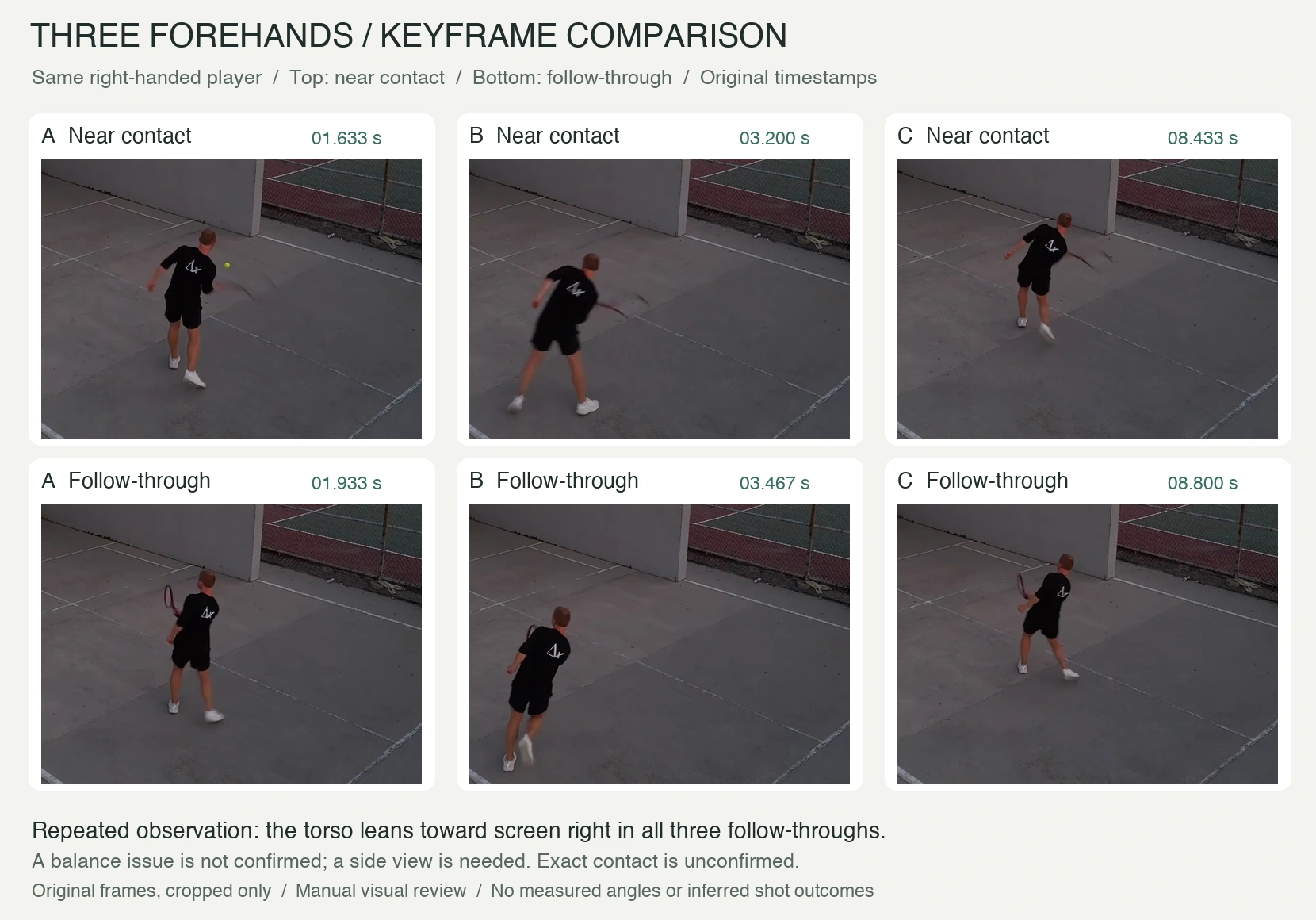
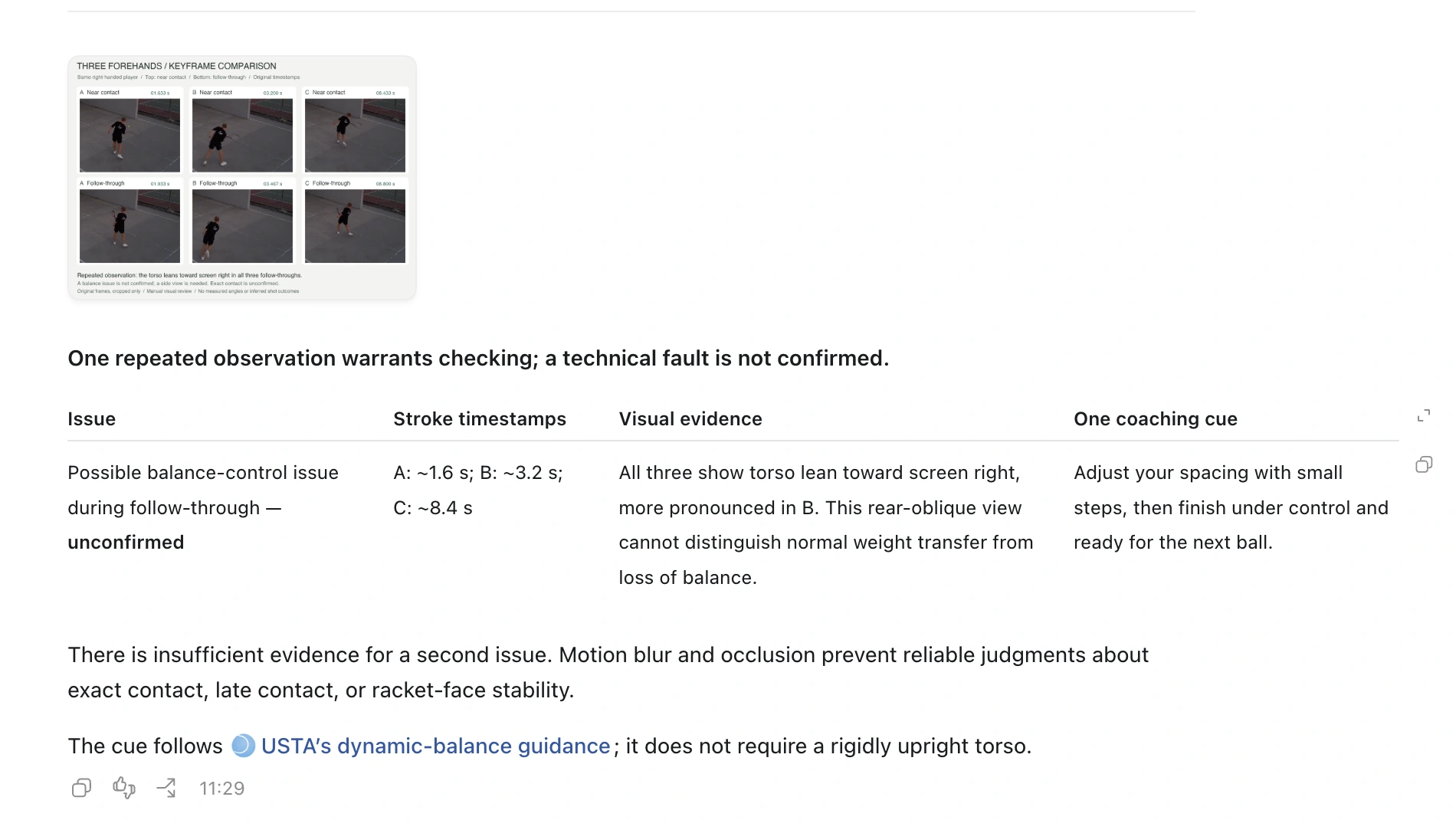
Three forehands side by side
Top row: near contact. Bottom row: follow-through. Each column follows one stroke.
View the full prompt
Use tennis-motion-lab to analyze the uploaded video. Compare three clearly visible forehands by the same player. Identify at most two potential technique issues, each supported by evidence from at least two of those strokes. Do not invent problems to fill the list. Provide a concise English table with these columns: “Issue | Stroke timestamps | Visual evidence | One coaching cue.” Clearly distinguish confirmed observations from possible issues that need another camera angle to verify. Include one keyframe comparison image showing the three strokes side by side at comparable stages. Add original-video timestamps and brief English labels. Do not label a frame as exact contact unless it can be verified. Write everything in English, including the table and all text inside the generated image. Keep the main findings compact and suitable for screenshots.
Comparing three strokes in conversation
Next practice

Give your next practice a clear focus

For players who want to turn a movement observation into a short session. Here, the focus is control at the finish, with practice designed to check and improve balance.

The card combines four minutes of shadow forehands with six minutes of gentle wall hitting: ten minutes in total, including rest and ball collection.

The timings and repetitions are suggested for this session. They are not a promise of improvement, and they do not establish the visible torso lean as a technical fault.
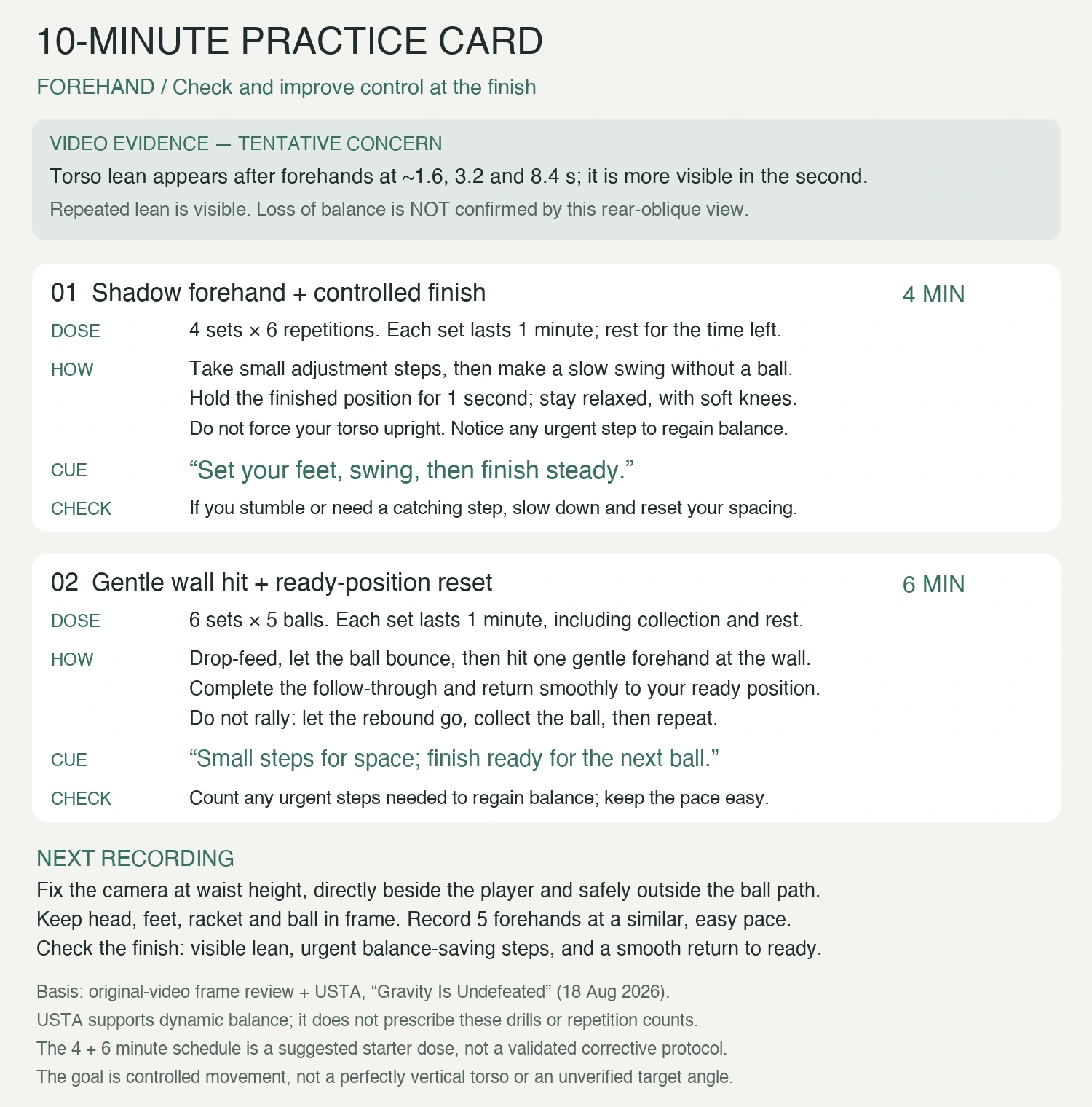
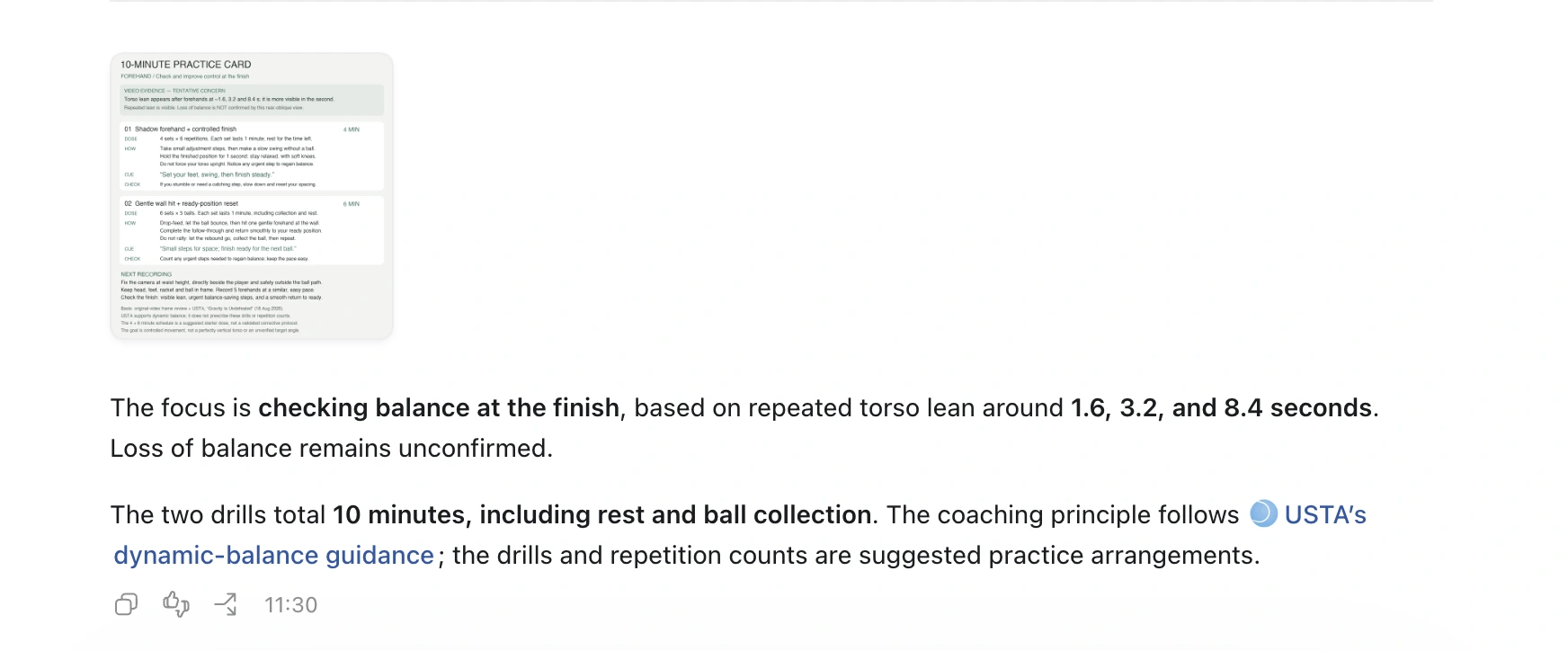
A practice card to take to the court
Each drill includes sets, repetitions, a coaching cue, and checks for the next recording.
View the full prompt
Use tennis-motion-lab to analyze the uploaded video. Select one recurring issue supported by at least two forehands that is most worth prioritizing in practice. If the footage only supports a tentative concern, label it clearly and frame the practice as a way to check and improve control, rather than correcting a confirmed fault. Create one “10-Minute Practice Card” image containing exactly two simple drills. For each drill, state the duration, number of sets, repetitions per set, short instructions, and one memorable coaching cue. The two drills must total 10 minutes, including rest and ball collection. Briefly connect the practice focus to visible evidence and original-video timestamps. Include what to check in the next recording and how to position the camera. Briefly cite the coaching basis, and distinguish your suggested practice dosage from any source-backed guidance. Write everything in English, including every heading, label, instruction, and note inside the generated image. Use a clean, readable layout suitable for screenshots.
The practice card in conversation
Clarity and limitations

Clear observations with clear limits

Keep the original timestamps

Keyframes retain the timing of the source clip so you can check the continuous movement. The examples use a 1920 × 1080 MP4 video at 30 fps.

Separate a pattern from a fault

Seeing the same movement more than once does not establish an error. Camera angle, occlusion, and motion blur limit the interpretation; uncertain contact details are labeled.

Use practice to guide the next observation

This plan focuses on control at the finish. Balance is dynamic: it does not require a rigidly vertical torso or an uncalibrated target angle.

Who it is for

Who it is for

Recreational playersLearners working with a coachPlayers planning a short session

Recreational players reviewing regular practice, learners who want specific footage to discuss with a coach, and players looking for a short practice plan. Footage that keeps the full body, racket, and ball visible makes the movement easier to assess.

Your next step

Start with one forehand video

Download tennis-motion-lab from Finch and give the installation package or extracted folder to your AI assistant to install. Provide your video, choose the movement you want to review, and ask for the output in Chinese or English.

Download on Finch