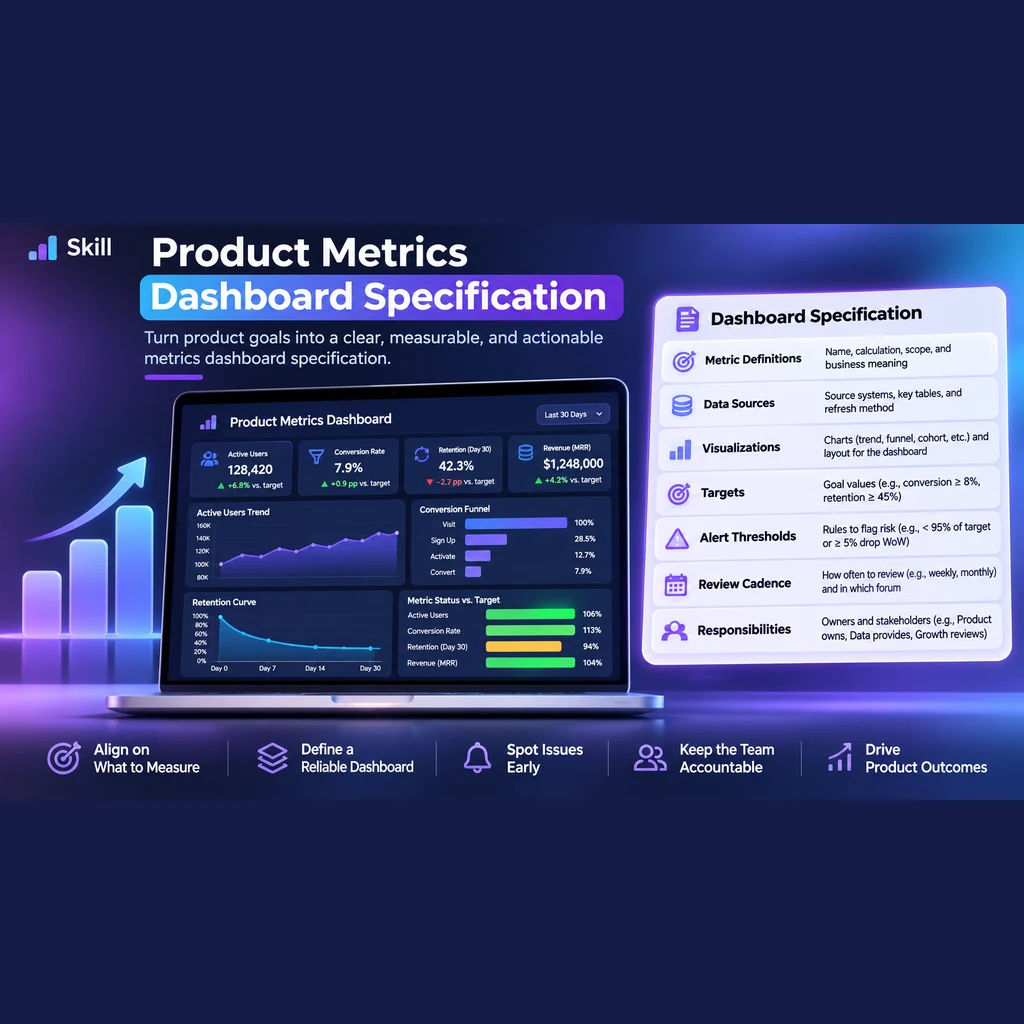
A product metrics specification that connects customer value, operational levers and the decisions your team can take.
Saved result · Fictional Tidewell Desk
Weekly offices receiving reliable lunches
The North Star in one saved specification.
A count of paid offices with at least 40 accepted meals and all promised deliveries complete and on time. Current measured value: Unknown.
DailyRestore reliability
WeeklyInvestigate one lever
MonthlyReview economics
QuarterlyRecalibrate
01 / Purpose
Choose the signal that changes a decision.
A useful metrics dashboard begins with a measurement contract. This Skill helps a product team define what value means, identify the levers that influence it, and specify the guardrails and economics that keep it sustainable.
You receive a Markdown specification: metric calculations, proposed data sources, visualization choices, targets, alert thresholds, layout, review cadence and responsibilities. A team can review that artifact before building or changing a dashboard.
The output is a specification. It does not connect to your database, deploy charts, monitor pipelines or send alerts.
02 / Four concentric layers
A map from value to operating health.
Center · North Star
One customer-centric measure of core value delivery. In the case, reliable office lunches anchor the view.
Inner orbit · Input metrics
Three to five levers that can influence that value. The saved run uses four: activation, reorder, coverage and fulfillment.
Guardrail orbit · Health
Measures that prevent growth from hiding damage. Unused meals, complaints and freshness expose different risks.
Outer orbit · Business
Revenue, cost and unit economics keep value delivery grounded in an operating model.
03 / Fit
For people who own the questions.
Works well for
Product managers defining KPIs before analytics implementation.
Founders choosing what to review as a product grows.
Analysts aligning numerator, denominator and reporting windows.
Operations teams agreeing which thresholds deserve attention.
Needs a different layer of work
Deploying a BI application or production alerting service.
Auditing a database schema the assistant cannot inspect.
Guaranteeing causal relationships or business outcomes.
Replacing food-safety, accounting or operational procedures.
Bring context that the assistant is allowed to read. A fictional demo does not establish suitability for confidential or regulated data.
04 / Exchange
Bring the goal. Receive the measurement contract.
Your input
Product, customer and value-delivery context.
Goals, existing metrics and known blind spots.
Available data sources and business calendars.
Owners, review routines and operating constraints.
Any existing dashboards, strategy documents or OKRs.
Your output
A North Star and 3–5 input levers.
Health and business measures with exact definitions.
Visualization, target and alert choices for each measure.
A layout sketch and daily-to-quarterly review cadence.
Named roles, channels and response expectations.
If a source, target or current value is missing, ask for explicit unknowns and proposals. An attractive number without a trustworthy denominator is still an unknown.
05 / Runtime
A file-based workflow for your assistant.
Extract the official source ZIP and load its folder through a compatible Agent Skill mechanism, or ask a file-capable assistant to read SKILL.md and follow it. Codex and Claude Code are possible host environments; this batch exercised a source-guided Codex worker only.
No additional service API key or executable dashboard engine is bundled. A capable language model is required, and subscriptions or usage charges may apply. The supplied-context specification can be produced without web research. Current vendor capabilities and prices need separate current research before adoption.
Implementation comes later: your selected analytics tools, databases, access controls and notification systems determine what can actually run. Native-client installation and production integrations were not tested here.
06 / Evidence
One controlled specification, with its boundary intact.
12
defined metrics
The saved output contains one North Star, four inputs, three health measures and four business measures.
13
structural checks passed
The executable validator checks coverage, metric fields, alert ownership, cadence and explicit uncertainty rules. It does not score strategy quality.
All 12 required section headings are present. Targets remain proposals; current readings remain unknown until measurement exists. No dashboard was deployed, no alert was delivered, and no retention or margin improvement was measured.
07 / Official delivery
Free plaintext source, verified.
Base 8453 · Skill #316 · version 1. The coordinator verified the official page, Manage state, bound cover and source download with Finch login. No acquire transaction or gas was required.
AI-generated promotional artwork. The chart numbers are illustrative artwork, not results from the saved run.
SKILL.md is preserved byte for byte from the original MIT source. The package adds distribution README, NOTICE, source provenance and this cover; it includes no HTML, video, model subscription or API entitlement.
Further-reading links are references, not included access to paid material. Review proposed calculations and thresholds with the people who own your operations and data.