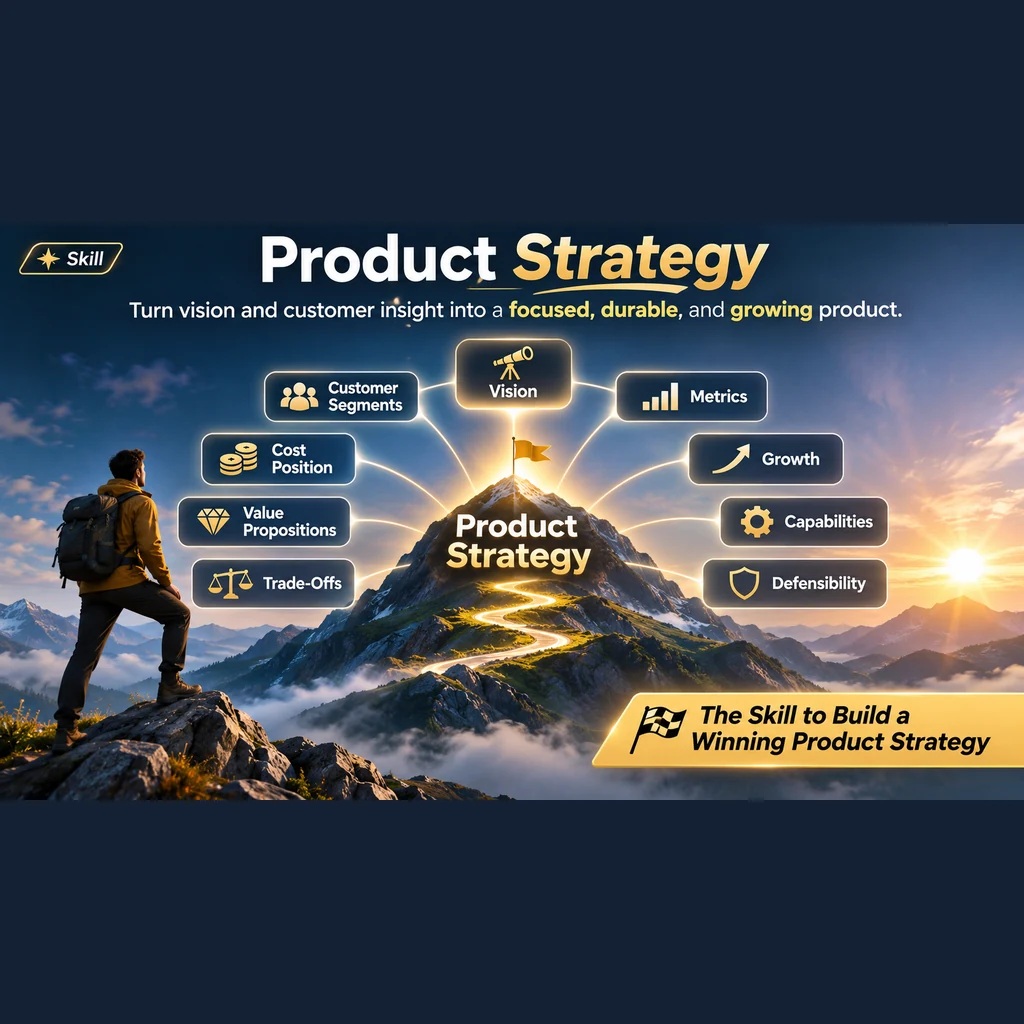
Vision
State the aspiration and values that will shape decisions.
Nine connected choices. One direction.
Connect where you want to go with whom you serve, how you compete and what you will deliberately leave behind.
From the saved Tidewell Desk run
“Start with Segment A in Portland.”
The canvas concentrates the fictional lunch-kit business on reliable weekly office demand, then defers a second-city kitchen and a snack add-on until the underlying retention and economics are understood.
Abridged interpretation of one saved result. This is a strategy hypothesis, not a business outcome.
A product description, market context, customer evidence, resources and constraints. Unresolved facts belong in the input too.
A nine-section strategy canvas, a coherence check, critical hypotheses and inexpensive ways to test them.
The atlas
The original workflow covers more than an aspiration or a list of features. Each choice must support the others.
State the aspiration and values that will shape decisions.
Choose two or three problem-based segments, including who comes first and why.
Decide whether low cost or differentiated value is the economic stance.
Connect the current situation, your mechanism, the intended outcome and alternatives for each segment.
Make exclusions explicit so focus is visible in everyday choices.
Separate the long-term North Star from the metric that matters this quarter.
Choose an acquisition motion, explain scaling and expose unknown unit economics.
Distinguish what to build, partner for and develop.
Ask why competitors cannot or might choose not to copy; do not invent a moat.
In the saved run, the Monday delivery model conflicts with a proposed Wednesday auto-skip promise. The canvas makes that tension visible before turning a feature idea into a customer commitment.
The canvas helps organize reasoning; it cannot create customer validation from thin inputs. The Tidewell Desk run identifies unmeasured customer acquisition cost, unverified Seattle demand and no demonstrated strong moat. Those gaps remain explicit.
These are different evidence categories. An internally coherent strategy still needs external validation.
Extract the official source ZIP into an empty folder. Load it through your assistant’s supported Agent Skill mechanism, or ask the assistant to read SKILL.md and follow it with the material you provide. The package contains the original instructions and distribution documentation, not a standalone application.
A capable model and access to a host that reads files are required. Model access may carry subscription or usage charges. No additional service API key, bundled script or web connection is required for this supplied-input workflow. Further-reading and template links are references; their access is not bundled.
One Codex worker execution has been checked. A host capable of reading these instructions may use them, but installation in Codex or Claude Code was not separately tested, and no cross-client compatibility result is claimed.
All nine canvas sections and the three follow-up sections were present in the saved run. Sixteen rule checks covered structure, required content, arithmetic and source preservation. The source and MIT license were preserved byte for byte; ZIP integrity and a fresh extraction were checked separately.
Those checks establish the recorded artifact’s structure and integrity. They do not measure strategic correctness, repeatability, performance or commercial impact.