One weekly lunch routine
Use the existing Friday ordering and Monday delivery rhythm to address repetitive coordination.
Product Positioning Ideas / information
A structured way to compare alternatives and articulate five credible directions for your product.
A Friday choice, a Monday delivery, a plan for the week.
A verbatim supporting message from the saved Tidewell Desk run. Tidewell is fictional; the line is a hypothesis for testing, not a proven business result.
The work you leave with
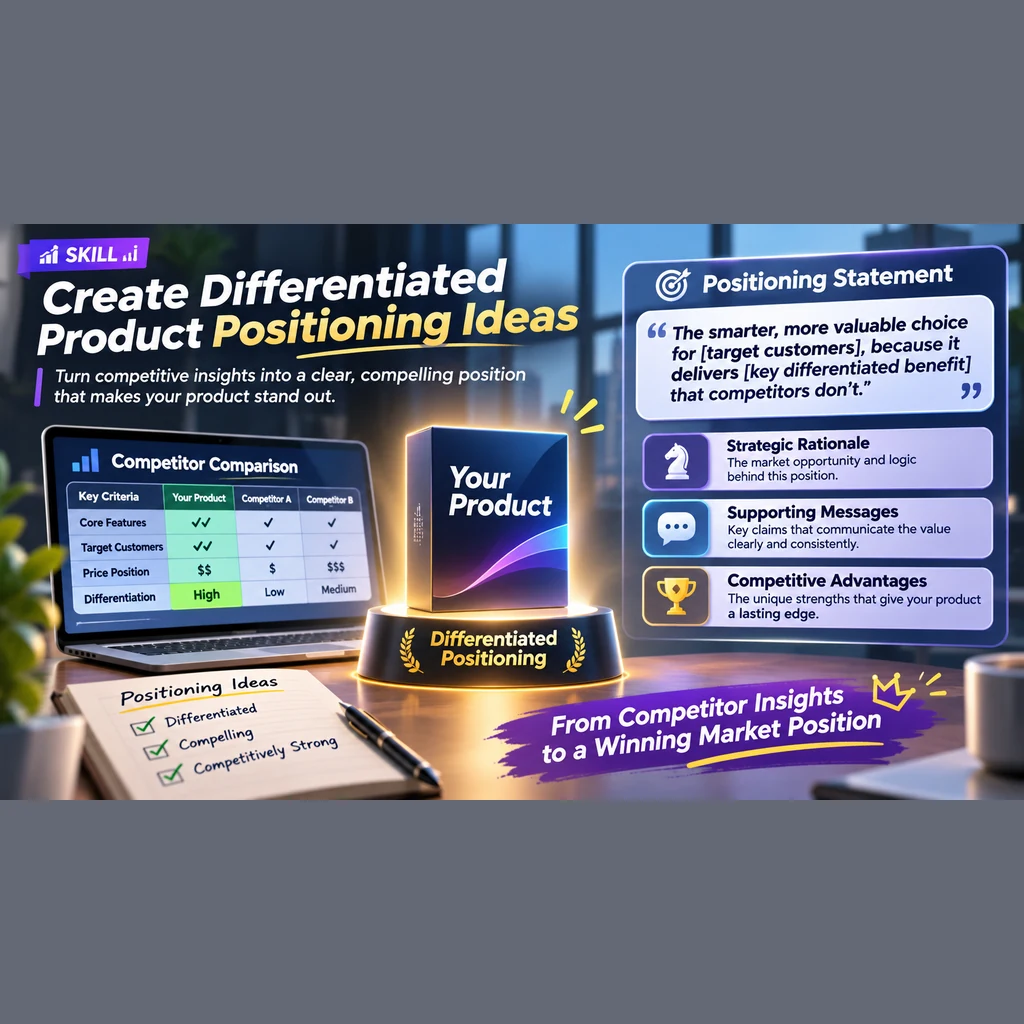
This Skill compares competitor positioning, then develops five differentiated positioning options for your product and audience. Each option includes a one-sentence statement, strategic rationale, supporting messages and the capabilities that would justify its competitive advantage.
It gives a team several coherent directions to examine. It does not turn a catchy line into proof that a market is unclaimed. Current claims need evidence; unverified territory remains a hypothesis.
Describe the product, the people who decide and use it, their pain points, current capabilities, market scope and competitor messaging. Separate shipped features from future plans.
Compare five competitors or clearly scoped alternatives. Explore five positions with a statement, rationale, supporting message and competitive advantage for each.
A closer look at the saved result
Use the existing Friday ordering and Monday delivery rhythm to address repetitive coordination.
Connect personal web-app choices with a shared weekly office delivery.
Speak to Portland studios of 20–45 people, while making the 40-meal minimum visible.
State the $11.50 meal price and a $460 minimum meal subtotal without inventing a final invoice.
The fifth direction highlights the chilled kit format. Team bonding and satisfaction remain untested hypotheses.
Faithfully abridged from one fictional Codex response. The five options explore different messages; they are not five product launches.
Product marketers, founders and product teams preparing positioning workshops, testing a segment focus, or revisiting competitor differentiation.
Use it when you can provide precise capabilities, customer needs, a target segment and competitor claims that can be checked. Fresh market research benefits from a browsing-capable host.
It is not a complete competitor database, a legal clearance service, a campaign launch tool or a guarantee of persuasive copy, revenue growth or exclusive market ownership.
Extract the source ZIP into an empty folder. Load it using your assistant's supported Agent Skill mechanism, or ask a file-capable assistant to read SKILL.md and follow the instructions with your product context.
The workflow can be read by Skill-aware assistants such as Codex and Claude Code. This delivery was exercised by a Codex worker only; native installation and Claude execution were not tested. A capable language model is required, and its subscription or usage fees may apply. There is no additional service API key or executable application bundled.
When current competitive claims matter, use current primary evidence. Without browsing, provide your own material and label unknown facts. This smoke run used only an invented fixture and performed no web research.
The original English SKILL.md and repository MIT license are retained byte for byte at the pinned commit. README, NOTICE and SOURCE-PROVENANCE.md identify the source and explain the distribution. Further-reading links in the original instructions do not include access entitlements.
The team remains responsible for checking claims before publication, protecting customer information and deciding which hypothesis to test. Do not paste confidential research unless the assistant environment is approved for it.
Verification boundary
One actual source-guided Codex response was saved with its prompt, fixture and executable validator. All four required sections and eight rule checks passed. Source bytes, license bytes, ZIP safety, fresh extraction and cover public hash were checked separately.
These checks do not establish market accuracy, persuasive quality, repeat-run consistency, native installation or business outcomes. The Benchmark page gives the pass rules and missing scenarios; the Showcase page shows the input-to-output trail.