You bring
A Python experiment, the metrics worth measuring, run configuration and conditions that should raise an alert.
An experiment is a story in numbers.
Keep the metrics, diagnostic alerts and configuration of an ML experiment in one readable record.
Observed in our representative local CPU test.
Trackio is Hugging Face's experiment tracking library. This official Agent Skill teaches a coding assistant how to instrument a training loop, retrieve saved metrics and follow diagnostic alerts.
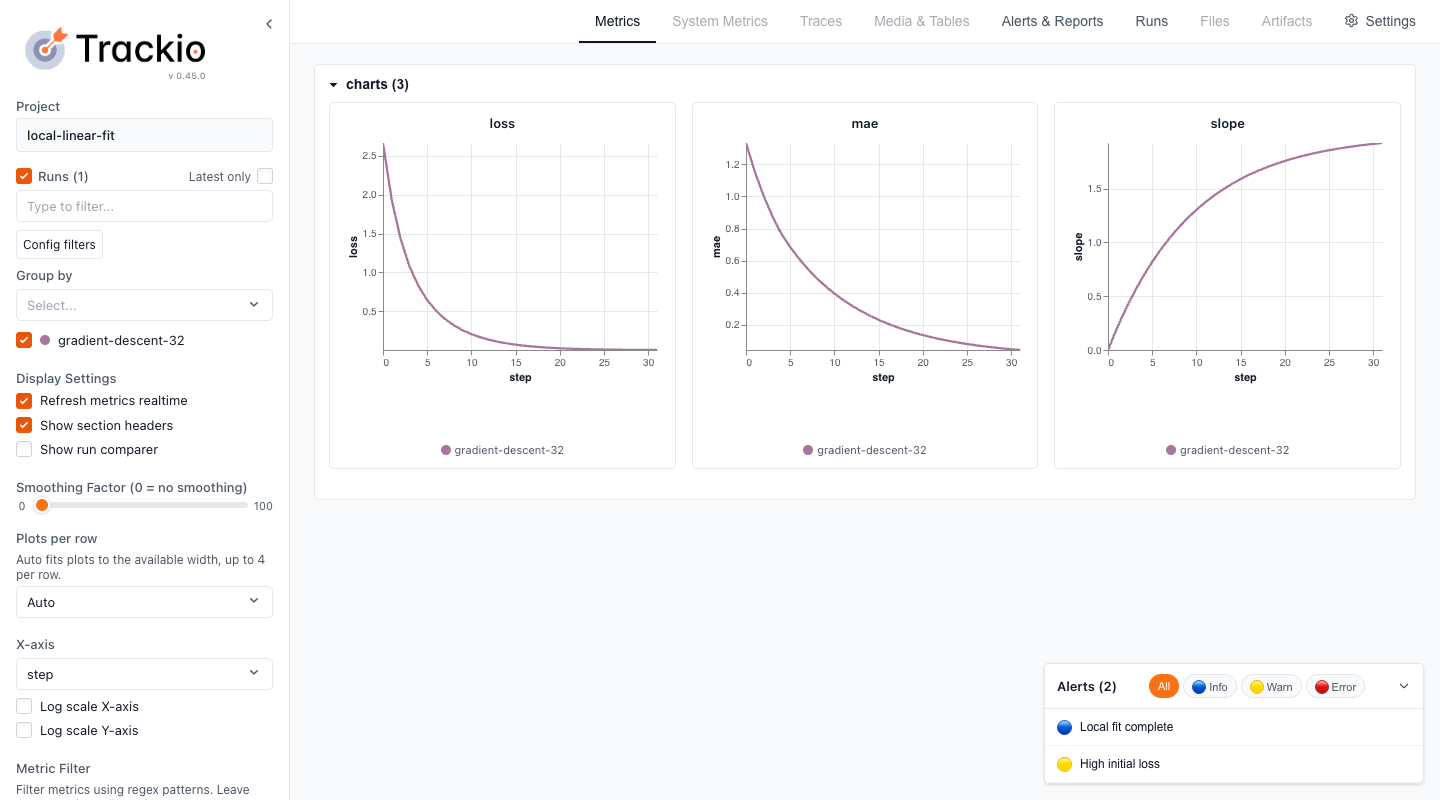
In our representative test, a CPU fit of y = 2x + 1 produced 32 saved steps, three numeric metrics and two alerts. History was read back in separate processes and displayed in the actual local dashboard.
A Python experiment, the metrics worth measuring, run configuration and conditions that should raise an alert.
Saved experiment history, queryable JSON, structured diagnostic events and a browser dashboard backed by your local data.
ML engineers inspecting runs, researchers comparing experiments and coding assistants monitoring instrumented training scripts.
Model selection, dataset authoring, managed training infrastructure or guaranteed hyperparameter optimization. Trackio records what your code logs.
Install the separately distributed trackio library (Python 3.10+) and use a skill-aware coding assistant. Local logging and querying need no Hugging Face API key.
The Skill package contains instructions and three reference guides. It does not bundle the Trackio runtime or a model.
Upstream also documents HF Space syncing and webhooks. These require network access, suitable accounts and permission to share the data.
Auto-created Spaces are public by default. Request private=True when appropriate; it does not change an existing Space's visibility.
A coding assistant still needs its own model access, and your training job may have separate compute costs. This edition's verification used no paid model API or cloud training.
Codex exercised the unchanged Skill's local API/CLI workflow with Python 3.12.11 and Trackio 0.45.0 on macOS. Metric roundtrip, snapshots, alert filtering, missing-metric rejection and SQLite integrity passed.
HF Space sync, webhook delivery, TRL/Transformers integration, GPU telemetry and other assistant clients remain untested. Library interfaces can change independently of this frozen Skill snapshot. Only log data you are authorized to retain or share.