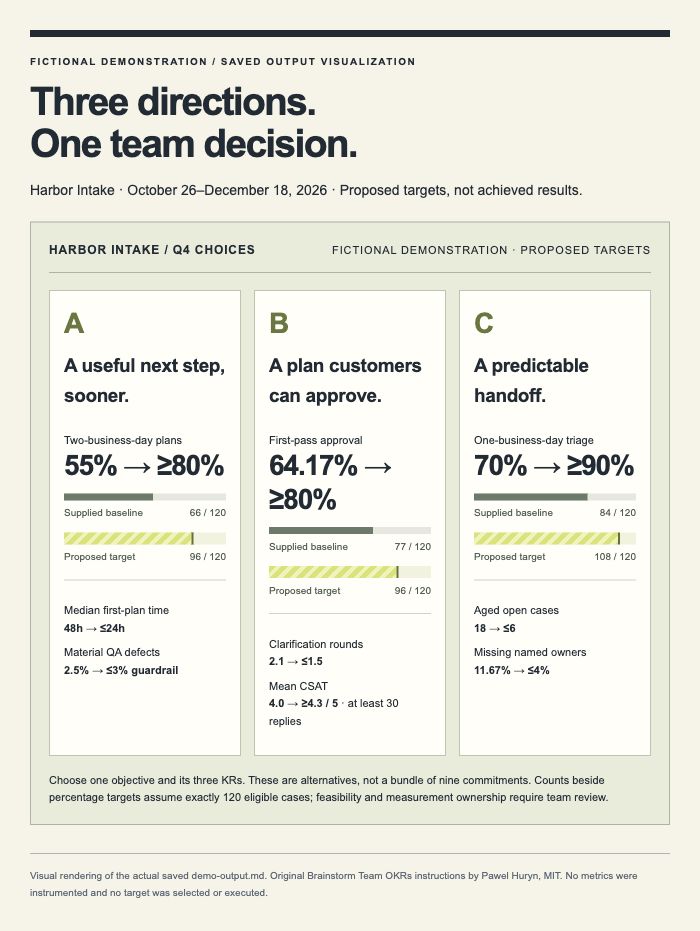
A useful next step,
sooner.
Two-business-day plans55% → ≥80%
Median first-plan time
48h → ≤24hMaterial QA defects
2.5% → ≤3% guardrail
Turn a strategy brief into three alternative OKR sets, each with a clear objective, three measurable key results and a reason to care.
Share company objectives, what the team can influence, the review window, current metrics and constraints. Mark missing baselines explicitly.
Each option connects a qualitative objective to three numerical targets and a short rationale. The substantial output can be saved as a Markdown document.
Useful for team leads, operators and product managers who need to connect day-to-day work with company priorities. It helps prepare the planning conversation; it does not select a goal on the team's behalf.
A defined team, a real direction, an agreed period and metrics that someone can measure.
A request for impressive numbers without baselines, unknown team influence, or a claim that an unobserved improvement already happened.
80% of 120
means 96 timely plans.
A fictional intake team received three options focused on speed, approval clarity and reliable handoffs. The proposed targets remain discussion hypotheses.
The local validator checked exact KR counts, denominator arithmetic, integer rate boundaries and the missing-data response. It did not measure the team's performance.
Extract the source ZIP and use your host's supported Skill method, or ask a file-capable AI assistant to read SKILL.md and apply it to the supplied brief. No additional service API key is needed for text-based planning. Model access and its usual fees still apply; uploaded files need host reading tools.
Conditional industry research needs the assistant's browsing and fresh evidence. No analytics system, dashboard, task, meeting or message is created.
The complete original English instruction file is preserved under MIT, with Pawel Huryn's copyright and framework attribution. Source-guided Codex preparation and bounded local artifact checks were completed; clean-client installation, Claude execution and real business outcomes were not tested.
Use only authorized company material. Confirm measurement ownership and definitions, review confidentiality before sharing, and never treat proposed targets as forecasts or achieved results.