Connect the goal
to what you test next.
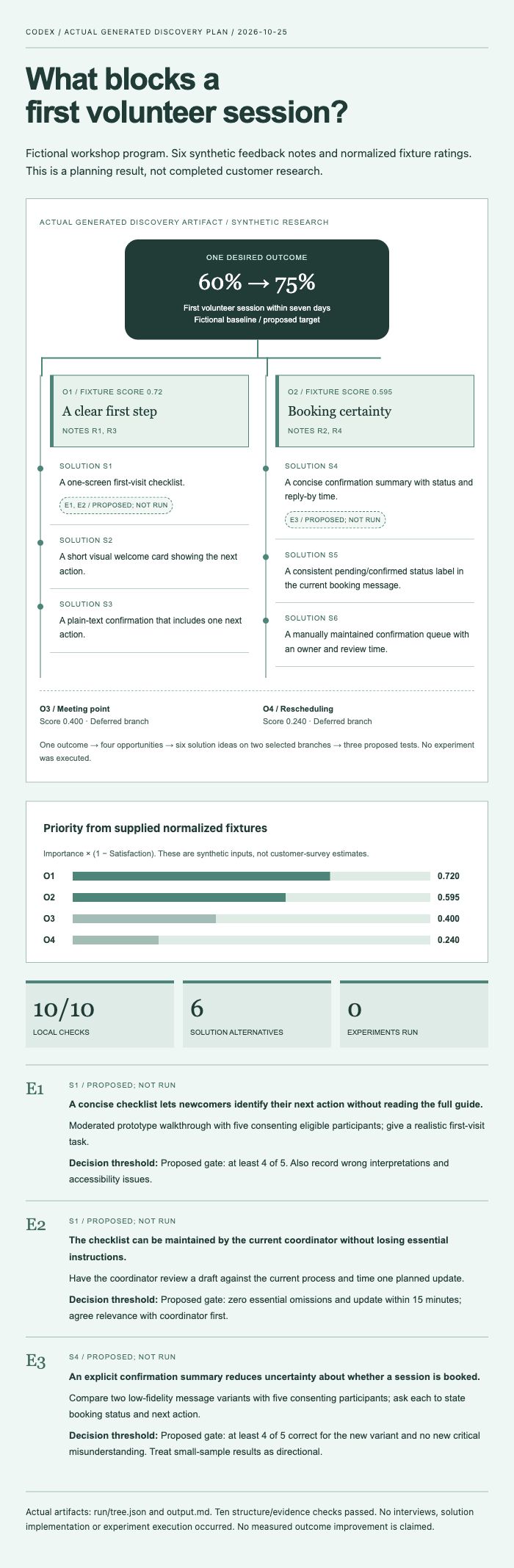
Fictional baseline / proposed target
A one-screen first-visit checklist.
E1, E2 / proposed; not runA short visual welcome card showing the next action.
A plain-text confirmation that includes one next action.
A concise confirmation summary with status and reply-by time.
E3 / proposed; not runA consistent pending/confirmed status label in the current booking message.
A manually maintained confirmation queue with an owner and review time.
One outcome → four opportunities → six solution ideas on two selected branches → three proposed tests. No experiment was executed.
Build a four-level map from one desired outcome to customer needs, multiple solution options and proposed experiments.
Fictional controlled demonstration. Quotes, ratings and targets are supplied fixtures. No customer research, implementation or experiment result is claimed.
For teams deciding what to try.
Useful for product, service and operations teams that already have customer feedback and want to avoid jumping straight to one feature.
Provide a single outcome and authorized research. Receive 3–7 customer-framed opportunities, prioritized branches, at least three options per selected branch and test designs.
A reasoning workflow.
The original PM Skills instruction file structures discovery; it does not bundle analytics, survey collection, a diagram editor or service integration.
A model/assistant is required and can have costs. Supplied-material work needs no extra service API key. Reading uploads needs host file tools.
What was verified
Codex produced one outcome, four traceable opportunities, two prioritized branches, six solution options and three proposed experiments. Python recomputed the fixture scores and passed ten structure/evidence checks.
Not a prediction or a substitute for research. Missing data can use qualitative assessment; an opportunity score is only as trustworthy as its inputs.
Original Pawel Huryn / PM Skills source, MIT. Framework attribution to Teresa Torres is retained in the original instructions. Original copyright and license are preserved; no endorsement implied.