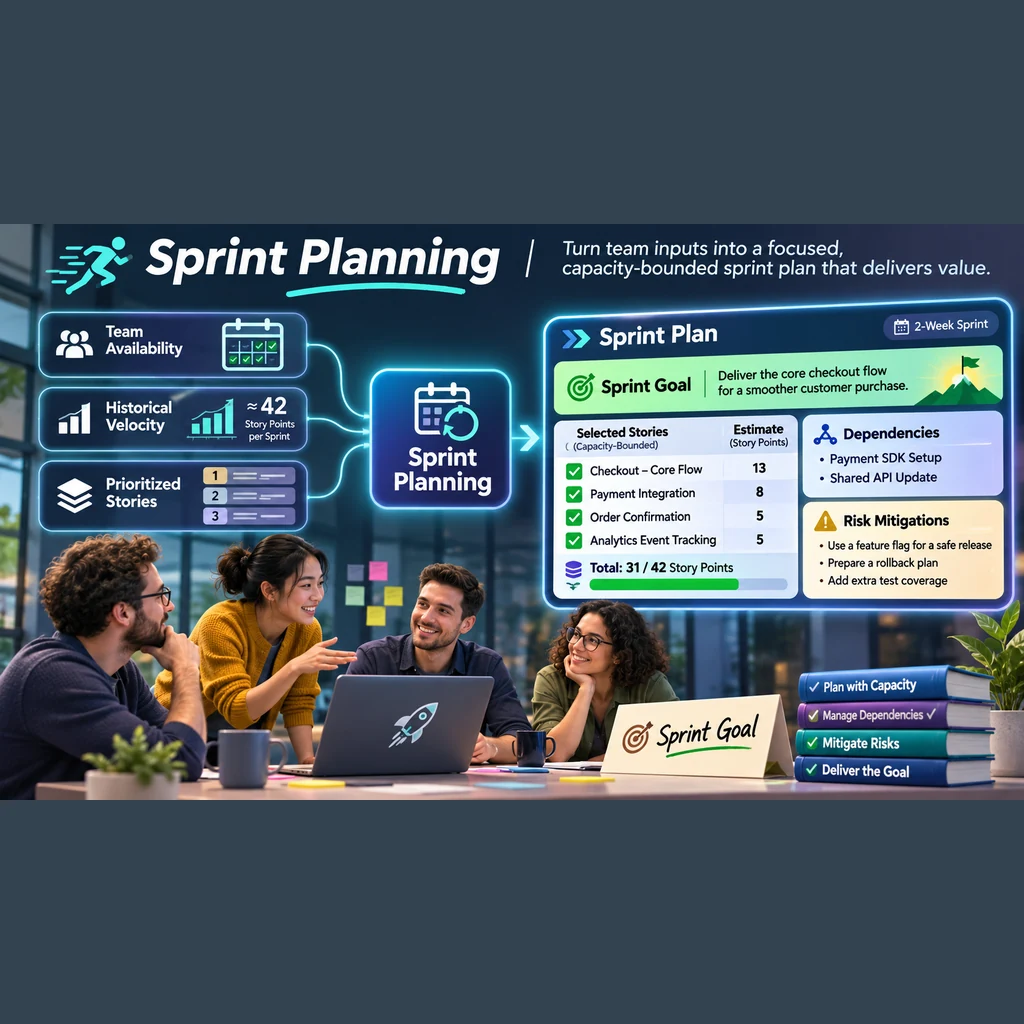
You provide
A team roster, sprint duration, PTO, meetings, on-call duties, recent velocity and its availability basis. Add the ordered backlog with estimates, acceptance criteria, owners and readiness rules.
Turn availability and a prioritized backlog into a clear goal, a bounded commitment and an owned dependency sequence.
Saved result / fictional two-week sprint
Availability-adjusted capacity
Commitment ceiling after the 20% reserve
Selected scope: five ready stories
180 available ideal hours · 5.67 points protected · 7.33 total points uncommitted. Bars compare values against the 28.33-point projection.
In the saved Tidewell Desk run, the plan stops at 21 points even though more work is waiting. Dietary filters would push the total to 26, above the 22-point ceiling. The unestimated Slack bot is excluded because its acceptance criteria and security approval are missing.
Let Portland office managers adjust next-week meal counts by Wednesday noon while keeping the 40-meal minimum and an auditable kitchen handoff.
Verbatim sprint goal from the actual Codex output. All people, estimates and company facts in this example are fictional.
A team roster, sprint duration, PTO, meetings, on-call duties, recent velocity and its availability basis. Add the ordered backlog with estimates, acceptance criteria, owners and readiness rules.
A Markdown plan: one goal, capacity math, selected and excluded stories, dependency sequence, critical path, named risks and mitigations. The assistant makes uncertain assumptions visible for team review.
Faithful excerpt from five selected stories. Owner names are supplied test data. The full output also records excluded work and release gates.
Product owners, delivery leads and engineering teams preparing a planning meeting, checking whether work fits or making dependencies explicit before commitment.
Works best when estimates and acceptance criteria already exist and historical velocity is comparable to the upcoming team's availability.
It does not estimate actual delivery reliability, replace a team's commitment or update your project tracker. Missing estimates require refinement; a buffer is not extra feature capacity.
It cannot turn fictional or incomplete backlog data into verified team facts.
Extract the official source ZIP. Load the folder with your assistant's supported Agent Skill mechanism, or ask a file-capable assistant to read SKILL.md and follow it. State the sprint subject directly; the package does not install an upstream plugin or a guaranteed slash command.
Suitable for Skill-aware assistants such as Codex or Claude Code; this batch tested only a Codex worker following the source. A capable model is required and model access may cost. No extra service API key or web research is required. Python was used for this test's arithmetic validator, not by the core instruction workflow.
One controlled Codex run
All 7 required output sections were present. The saved Python validator passed 14 capacity, readiness, priority and dependency checks. Native-client installation, repeatability across models and real engineering delivery were not run.
Finch Skill #313 · Base 8453 · version 1 · published-verified.
Saved publication readback: Manage True, public page True, source download True. These checks concern delivery, not sprint outcomes.
Delivery note: Public plaintext download verified with Finch login; no acquire or gas.