



Core premise, keep/cut/merge tables, risk plans, decision notes, and verbatim source evidence.
THE ARCHIVE · OUTPUTS
One novel in. A complete short-drama outline system out.
Creative decisions no longer live across disconnected prompts, notes, and manually reconstructed tables. The complete adaptation structure is stored in one outline.json that can be validated, rendered, revised, and passed forward.
Lead, support, and functional tiers with arcs and an explicit record of source-character merges.
Major/minor classification and episode placement, with pacing limits that prevent empty stretches.
Synopsis, hook, and suspense for every episode, written as narrative prose rather than screenplay dialogue.
Automatically calculated characters, settings, props, episode usage, reuse plans, and generation risks.
Markdown
Readable and editable by writers, producers, and reviewers.
JSON
Structured production data for tools and downstream skills.
HTML
An offline, single-page visual review report.
THE TRANSFORMATION · CASE STUDY
From the original novel to a production-ready short-drama outline
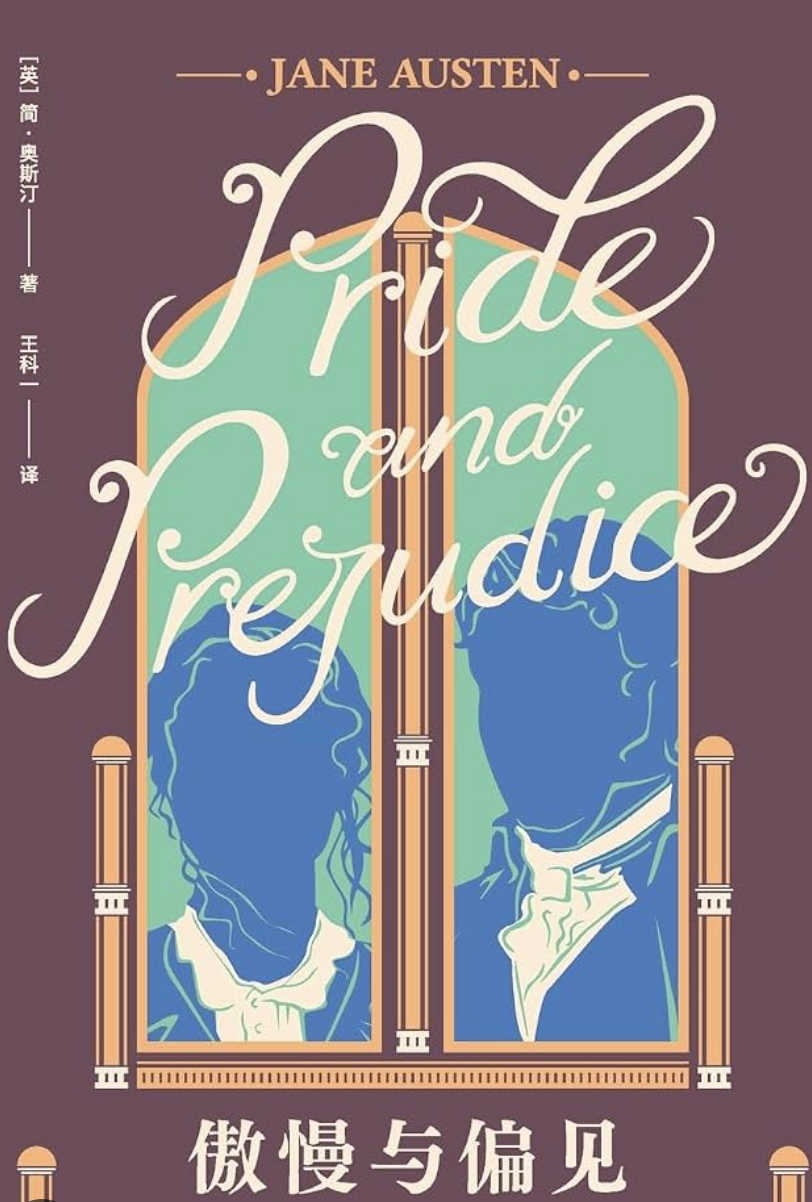
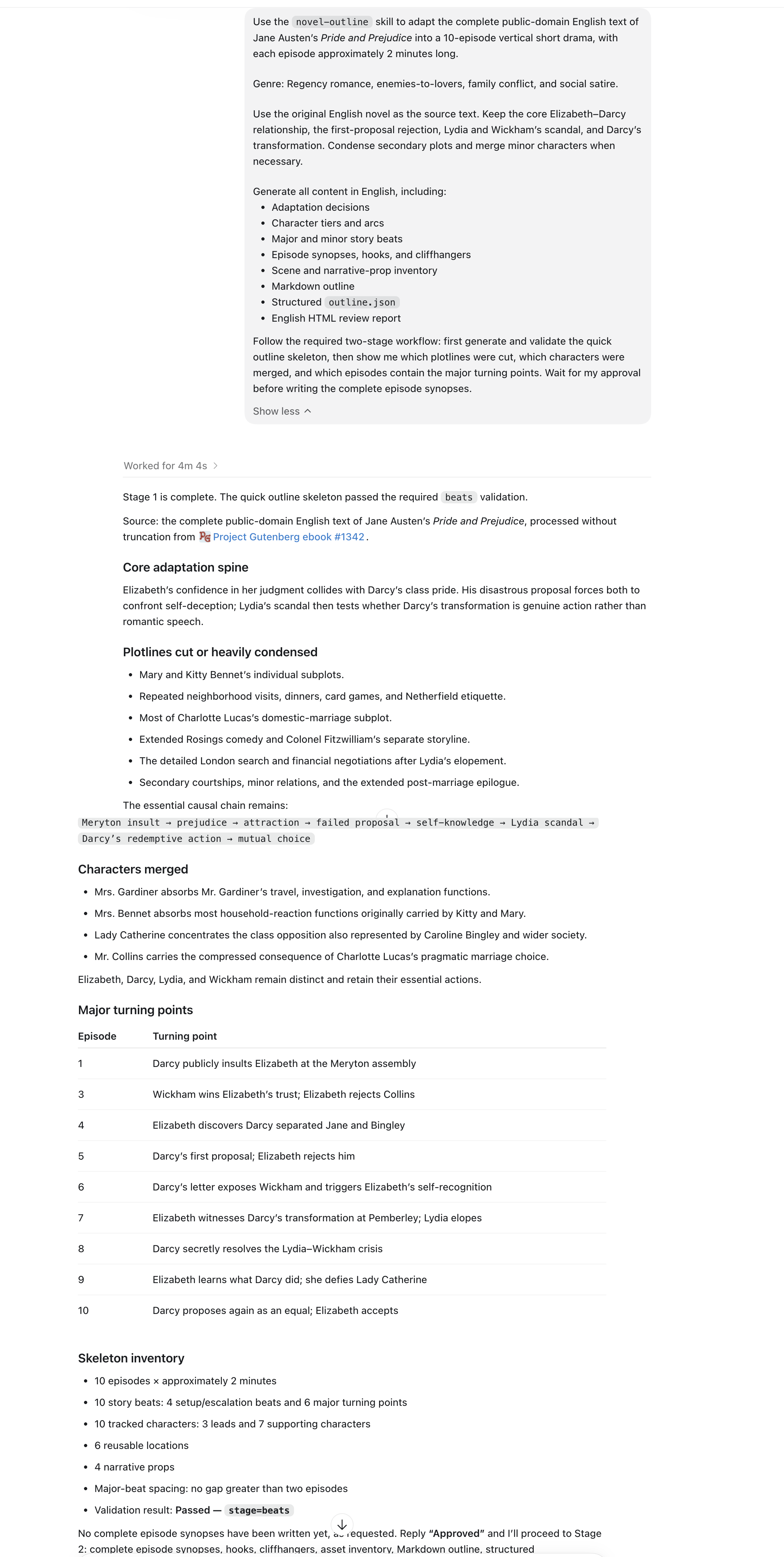
The English case study uses the complete public-domain text of Jane Austen’s Pride and Prejudice: ten vertical episodes at approximately two minutes each, preserving Elizabeth and Darcy’s relationship, the rejected first proposal, Lydia and Wickham’s scandal, and Darcy’s transformation.
THE VALUE · WHY IT MATTERS
It does not simply finish an outline. It turns novel adaptation into a standardized process that can be approved, quality-checked, and carried forward into production.
01
Approve early. Reduce rework.
Confirm plot cuts, character merges, and major turning points before complete episode drafting begins.
02
Validate with code
Fourteen deterministic gates inspect pacing, characters, scenes, props, completeness, and references.
03
See the production load
Automatically calculate character, environment, narrative-prop, and generation-risk requirements.
04
Hand the structure forward
Markdown is for reading, HTML is for review, and JSON continues into character, art, and screenplay production.
THE INSPECTION · 14 GATES
Fourteen gates, all enforced in code
A checklist left to model self-discipline is unreliable. Every gate is a deterministic check inside validate, not prose that the model may interpret or ignore.
| Gate | Default threshold or requirement |
|---|---|
| Lead characters | 1–5, including protagonists and primary antagonist |
| Named supporting characters | Maximum 10 |
| Functional characters | Maximum 10; face-bearing roles identified by labels rather than unnecessary names |
| Primary settings | 4 + ⌈episodes/10⌉, constrained between 5 and 15 |
| Narrative props | Maximum 8 by default; the gate is explicitly skipped when props are omitted |
| One-use settings | Must include a practical reuse or redressing plan |
| Beat spacing | No story-beat gap greater than 3 episodes by default |
| Episode-one hook | Required |
| Major-turn timing | The earliest major beat cannot be delayed until the final episode |
| Three episode fields | Synopsis, hook, and suspense are all required |
| Multi-character scenes | Three or more tracked characters require a staging plan |
| Generation risks | Rain, crowds, physical contact, hand close-ups, and similar risks must be flagged |
| Reference integrity | No unemployed character, unused setting, zero-use prop, or missing ID |
| Outline form | Narrative prose without quoted dialogue; screenplay writing belongs downstream |
Platform-specific limits can override individual values through params.thresholds without modifying the validator. Every gate has an intentional failure fixture in the self-test suite.
Why character tiers matter
A single total confuses audience memory with visual-asset cost. The lead cap controls how many central figures viewers must retain. Supporting and functional caps control the number of consistent character faces the AI production pipeline must maintain.
Why AI short drama allows more settings
AI-generated settings do not follow the economics of physical set construction. The primary-setting cap protects cross-episode consistency and spatial clarity while still allowing the visual variety that generated environments make possible.
THE CHECKPOINT · USER DECISION
The most valuable step: approve before expanding
The quick skeleton presents exactly three decisions: what was cut, who was merged, and which episodes contain the major turning points. Before any full episode writing, it must pass validate --stage beats.
DRAMATURGY REVIEW
Why the workflow pauses
A wrong skeleton costs one planning pass. Discovering the same problem after dozens of episodes have been drafted forces character, hook, setting, and asset decisions to be rebuilt together. Episode drafting is also batched in groups of no more than ten to reduce late-run drift.
THE PRODUCTION DOSSIER · REPORT
One report connects creative review with production planning
The report is a wide, searchable review surface. It is not merely a screenshot: it exposes the structural data used for decisions and diagnosis.
KPI Band
Total episodes, story beats, character tiers, primary settings, generation risks, and adaptation mode.
Beat Rhythm
Major beats use solid markers; regular beats use lighter marks; pacing gaps are drawn directly on the axis.
Episode Overview
Expandable cards contain synopsis, hook, suspense, setting, character, beat, and warning tags.
Setting Overview
Each location shows episode appearances, story-beat load, characters, and one-use reuse plans.
Key Decisions
Approved cuts, merges, lead roster, and major-turn positions are generated from the underlying structure.
Scheduling Matrix
Characters and settings share one grid. Reading a single episode column reveals the production requirement.
Asset Conversion
Character tiers, environments, props, and generation difficulties become a production workload estimate.
Quality & Export
Header badge, failure banner, complete gate list, and a JSON export containing the original outline data.
Offline by design: visualizations are embedded as SVG and CSS. The report opens locally without external chart libraries, APIs, or an internet connection.
THE EVIDENCE · TRACEABILITY
Every major adaptation decision can be traced back to the novel
Important retained elements use keep[].evidence. The evidence is verbatim, allowing editors to verify the adaptation against the supplied text rather than trust a vague memory of the book.
What · Retained element
Darcy’s first proposal and Elizabeth’s rejection
Why · Dramatic function
The scene concentrates desire, pride, class prejudice, Jane’s heartbreak, and Wickham’s accusation into the central collision.
Evidence · Source text
In vain have I struggled. It will not do. My feelings will not be repressed. You must allow me to tell you how ardently I admire and love you.
No adaptation built from a title alone. No missing plot filled in from memory.
THE DIAGNOSIS · EXISTING OUTLINES
Already have an outline? Diagnose it without regenerating it.
Convert the existing plan to outline.json and run checkup. The quality panel becomes a structural diagnostic report. Failed gates do not prevent HTML rendering because exposing the problems is the purpose of the mode.
node scripts/novel-outline.mjs checkup outline.json
node scripts/novel-outline.mjs render outline.json --html --lang en > outline-report.html
Built for long manuscripts
When a novel cannot fit in one context window, chunk splits it by chapter, normally fifteen chapters per volume. Each volume is summarized and then consolidated. If chapter headings cannot be detected, the script falls back to size-based splitting. It supports up to sixty volumes and reports truncation explicitly.
THE NEXT ACT · PRODUCTION PIPELINE
One outline serves people and machines
Creators
Gain a clear episode structure, visible beat plan, traceable source decisions, and automatic detection of downstream breakage.
Writers & Producers
Approve direction before screenplay work, estimate cast and environment scale, and review projects against consistent standards.
AI Production
Stable IDs reduce naming drift, while outline.json becomes the standard input for characters, art, scripts, and storyboards.
Relationship to novel-characters
novel-outline owns adaptation structure: cuts, merges, beats, and episodes. novel-characters owns portraits, visual prompts, voice prompts, and character sheets. The outline’s characters block is the upstream production roster.
THE ARCHIVE IS OPEN
From source novel to short-drama production blueprint
Approve the structure, prove quality in code, calculate the assets, and continue into the next act.