1
Original ideaBuild a pickup-slot selector
Customer outcomeCollect an order in a feasible promised window.
On-time collection82% → ≥90%Proposed; at 100 pickups,
82 → at least 90.
82 → at least 90.
Rewrite a list of features as customer outcomes, success measures and a flexible sequence the team can discuss.
Keep the destination flexible. Capacity, measurement definitions, permissions and effort are not yet confirmed. These are planning proposals, not ship dates or achieved improvements.
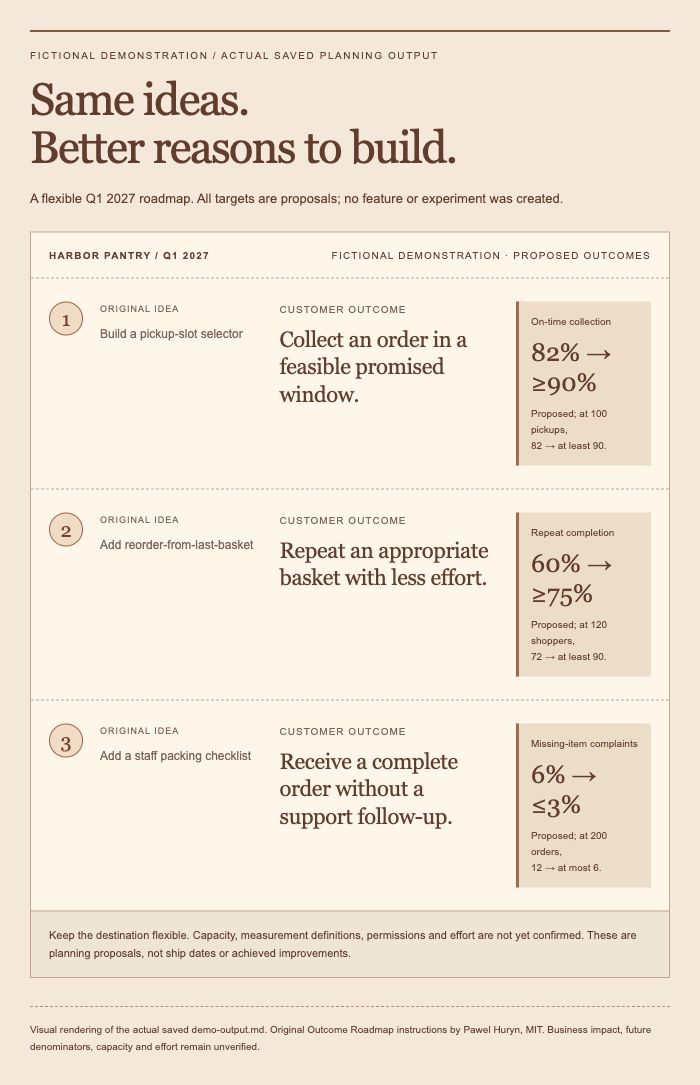
Original: Build a pickup-slot selector.
Enable customers to collect an order in a feasible promised window.
Success is on-time collection, not the existence of a selector.
Supply initiatives, target customers, company direction, known baselines and constraints. Identify uncertain dates and missing evidence.
Receive original-to-outcome mappings, key success measures, dependency notes, assumptions and quarter-level release windows.
Useful for product leaders, operators and cross-functional teams who want to explain the customer or business change behind a plan. It helps review strategic intent without committing to one implementation too early.
It is not a software builder, project-system integration or proof of a future revenue gain. If the customer problem is unknown, the next step is a question rather than a made-up metric.
Extract the ZIP and load SKILL.md using a supported host method, or have your file-capable assistant read it. Supplied-text planning needs no additional service API key. Assistant/model access and fees still apply; uploads need host file tools. Conditional external strategy research needs browsing.
The fictional Harbor Pantry run mapped three initiatives to customer outcomes and recomputed the proposed rate thresholds: 90/100 on-time pickups, 90/120 repeat completions and at most 6/200 missing-item complaints.
Original MIT instructions by Pawel Huryn remain unchanged. Only source-guided Codex preparation and bounded artifact checks were completed; no installation, live experiment or business effect was established.
Use authorized material, distinguish facts from targets, agree measurement definitions and validate capacity. A quarter is a planning window, not a delivery promise.