From the fictional Harbor Table run
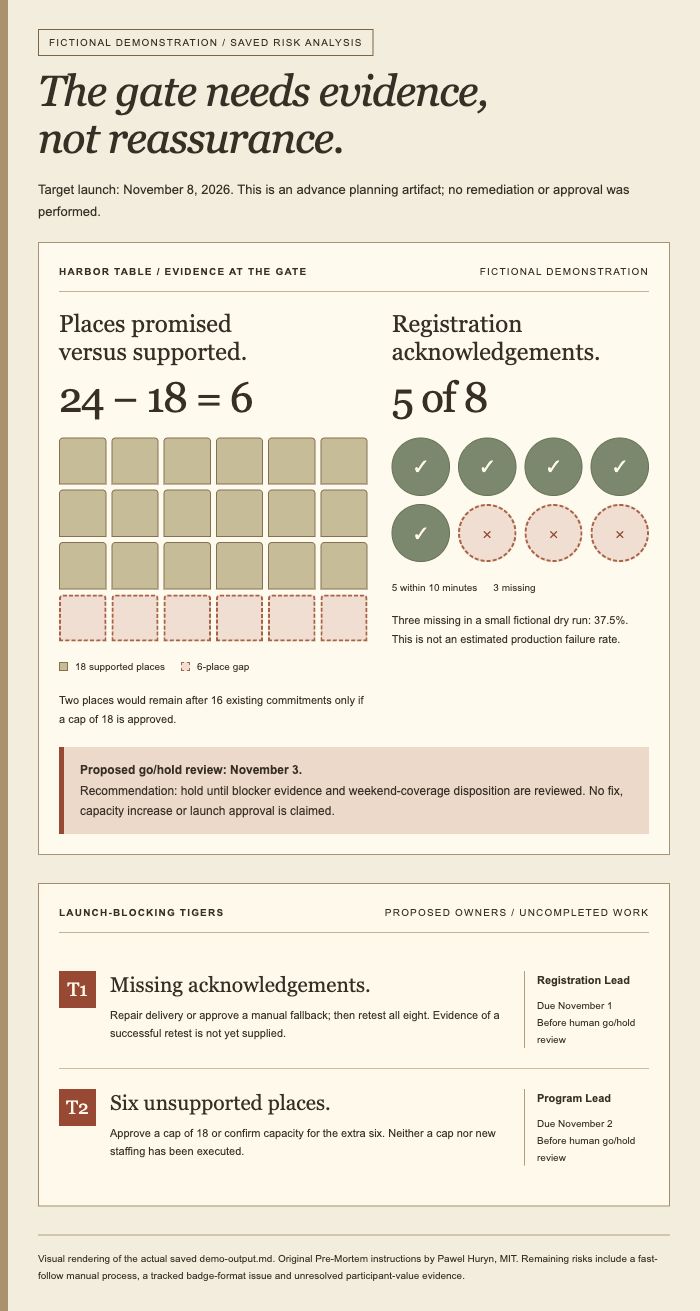
24 places offered.
18 places supported.
That six-place gap becomes a launch-blocking Tiger with a proposed owner, deadline and evidence needed to clear it.
Turn a product or project plan into an evidence-linked risk register and practical mitigations before the deadline arrives.
Two places would remain after 16 existing commitments only if a cap of 18 is approved.
Three missing in a small fictional dry run: 37.5%. This is not an estimated production failure rate.
24 places offered.
18 places supported.
That six-place gap becomes a launch-blocking Tiger with a proposed owner, deadline and evidence needed to clear it.
Concrete risks that need action, classified as launch-blocking, fast-follow or track.
Scoped worries whose apparent urgency is not supported by the available context.
Unspoken or unvalidated concerns that need investigation rather than silent agreement.
Supply the product or project brief, launch window, relevant evidence, assumptions, owners and constraints.
Receive categorized risks, Tiger urgency and launch-blocker mitigations with proposed accountable roles and dates.
For product leads, operators and cross-functional teams preparing a launch or a time-bound pilot. It turns “what could go wrong?” into a document people can review.
It is not a compliance audit, a forecast or proof that risks have been fixed. A human still validates evidence and makes the launch decision.
Extract the ZIP and load SKILL.md through a supported host method, or ask your assistant to read it. Model access and usual charges still apply; uploaded plans need host file tools. Optional external research requires browsing and fresh evidence.
Pawel Huryn's English instructions and MIT license remain unchanged. A fictional Codex source-guided run and local source/artifact checks were completed; installation, live remediation and real launch outcomes were not tested.
Use only authorized plans, protect sensitive details, and keep uncertainty visible. A concern should not be relabeled merely to make a launch look ready.