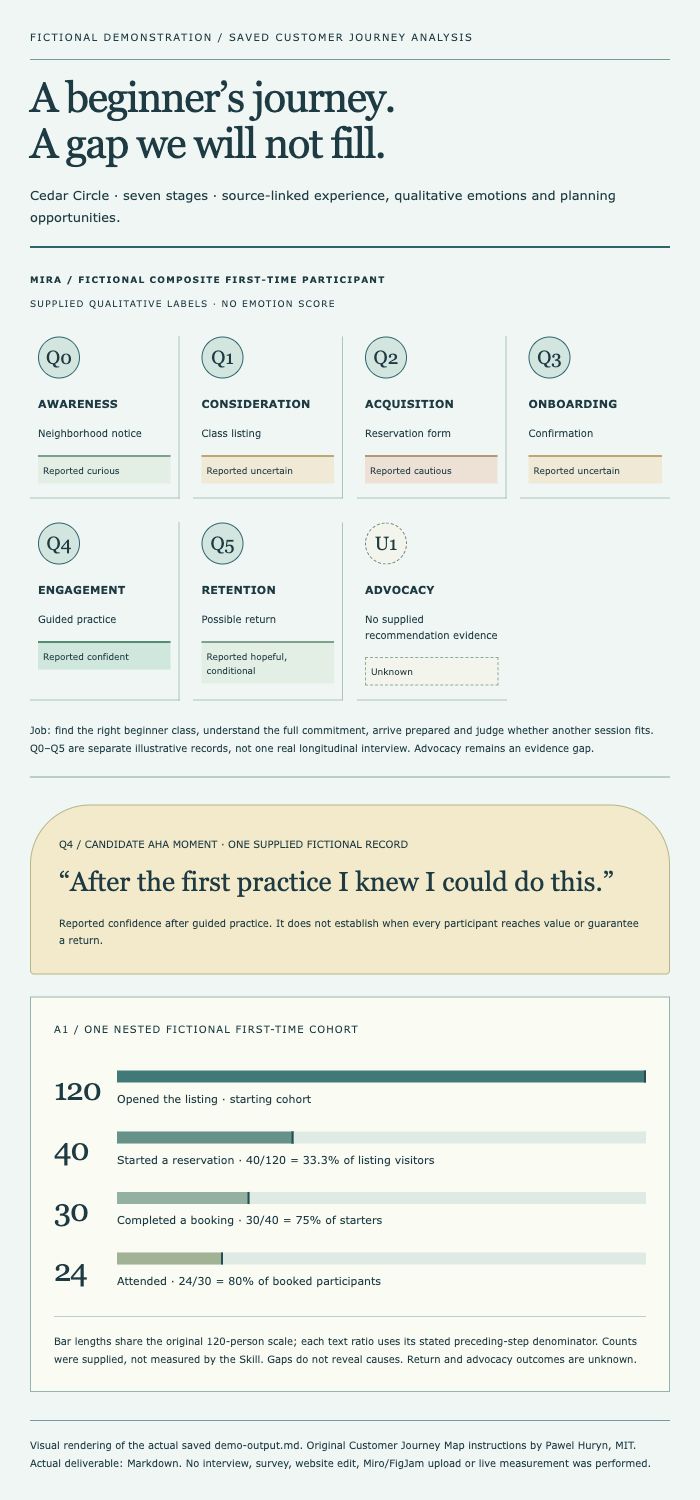
Q0
Awareness
Neighborhood notice
Reported curiousOriginal English instruction Skill
Follow the experience a customer is trying to have. Keep the evidence, the emotions and the unknowns in view.
Persona + jobSeven adaptable stagesPrioritized opportunitiesNeighborhood notice
Reported curiousClass listing
Reported uncertainReservation form
Reported cautiousConfirmation
Reported uncertainGuided practice
Reported confidentPossible return
Reported hopeful, conditionalNo supplied recommendation evidence
UnknownJob: find the right beginner class, understand the full commitment, arrive prepared and judge whether another session fits. Q0–Q5 are separate illustrative records, not one real longitudinal interview. Advocacy remains an evidence gap.
Start with a specific traveler
Bring a product context, an evidence-backed persona and authorized interview, support, survey or analytics materials. The workflow maps touchpoints, actions, thoughts, emotions, friction and improvement opportunities.
A saved Markdown journey map with a persona, stage table, candidate Aha moment, moments of truth, possible churn triggers and prioritized improvements.
It can inform a visual map in Miro or FigJam. It does not generate or upload a board file.
This is an instruction Skill, not a customer-research application. Supplied-text analysis needs no additional service API key. An AI model and its usage terms still apply; files need host file-reading tools. If you supply a product URL, the upstream workflow calls for web research and fresh source checks.
No outreach, tracking instrumentation, website change or experiment is executed. Emotion labels and recommendations are only as reliable as the supplied evidence and explicit assumptions.
Unchanged English SKILL.md from phuryn/pm-skills, with the original MIT license and attribution. A fictional source-guided Codex demonstration and bounded local checks are included in the presentation evidence. Clean-client installation, Claude execution and real customer outcomes were not tested.