One idea.
Nine connected questions.
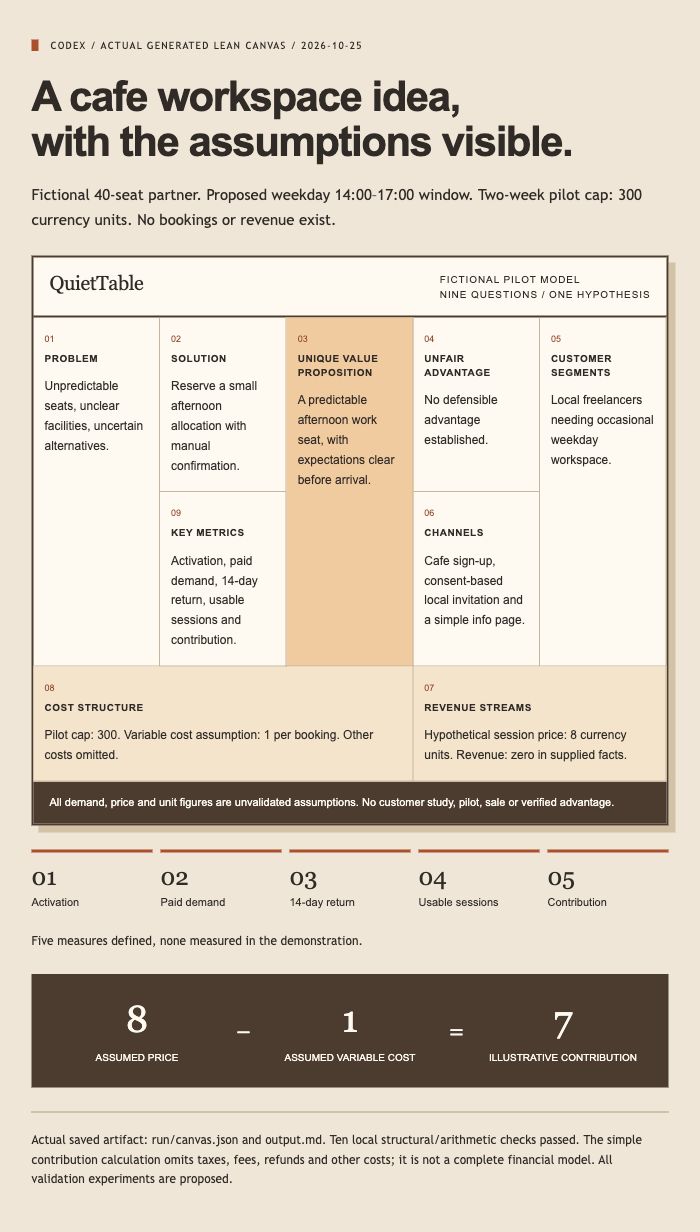
Nine questions / one hypothesis
Problem
Unpredictable seats, unclear facilities, uncertain alternatives.
Solution
Reserve a small afternoon allocation with manual confirmation.
Unique Value Proposition
A predictable afternoon work seat, with expectations clear before arrival.
Unfair Advantage
No defensible advantage established.
Customer Segments
Local freelancers needing occasional weekday workspace.
Channels
Cafe sign-up, consent-based local invitation and a simple info page.
Revenue Streams
Hypothetical session price: 8 currency units. Revenue: zero in supplied facts.
Cost Structure
Pilot cap: 300. Variable cost assumption: 1 per booking. Other costs omitted.
Key Metrics
Activation, paid demand, 14-day return, usable sessions and contribution.
Turn a product idea into a structured business hypothesis, with unknowns and proposed tests alongside the story.
Fictional QuietTable demonstration. Every demand, price and economic claim is an unvalidated assumption. The canvas is a working hypothesis, not an investment case.
For an early decision.
Useful for founders, small-business teams and product groups exploring a new service before committing to build or scale.
Bring the idea, customer segments, problem context and known constraints. Receive nine sections, 3–5 key measures, assumptions and proposed validation experiments.
Lightweight by design.
The original PM Skills instruction file supplies a structured reasoning workflow. An assistant/model runs it; no extra API key, code runtime or external service is required for supplied-material work. Model costs may apply.
Test the weakest link.
The local run created all nine sections, five measures and three proposed tests. Ten structural/arithmetic checks passed. “No defensible advantage established” was kept explicit rather than filled with a confident story.
Know its boundary
Not a complete strategy, market study, verified forecast or financial advice. Numbers need sources or assumption labels. Experiments are plans until actually run; the Skill does not conduct interviews, accept payments or launch a pilot for you.
Original Lean Canvas Skill by Pawel Huryn, MIT. Attribution, original source and license are retained. The underlying Lean Canvas framework is attributed to Ash Maurya in the original instructions; no endorsement implied.