Product manager
Business value, strategic fit and customer impact. What deserves a place in the product?
Three perspectives / one useful shortlist
Explore an existing product opportunity with a product trio. Give your assistant the goal and evidence; receive fifteen ideas and five selected proposals with reasons and assumptions to test.
A real excerpt from our fictional-case run
“Ask employees to confirm next week's in-office lunch days before Friday so managers can approve a more credible meal count.”
Selected from the design perspective for the Tidewell Desk case. This is a generated proposal, not a tested customer outcome.
The original Skill asks for five ideas from each professional perspective. It then compares ideas across the full set, using strategic alignment, potential impact, feasibility and differentiation.
Business value, strategic fit and customer impact. What deserves a place in the product?
Usability, experience and delight. How could the opportunity feel simpler for people?
Technical possibilities, data and scale. Which mechanisms can make the idea work?
These are perspectives simulated by one assistant. They do not replace participation by your actual product manager, designer or engineer.
You provide
You receive
Extract the source ZIP into an empty folder. Load the folder with your assistant's supported Skill mechanism, or ask a file-capable assistant to read SKILL.md and follow it. Supply the context in your own request; this standalone package does not install the upstream plugin marketplace or its slash commands.
A capable AI model is required. Model subscriptions or usage charges may apply. No separate service API key or bundled executable is required for the instruction workflow. A host such as Codex can follow the file; native Skill installation across assistants has not been tested here.
If you mention a product URL, the original instructions call for web search to understand it. That branch needs a browsing-capable host. Our saved run had no URL and used only supplied fictional material; browsing was not tested.
An executable checker passed all ten declared structural rules, including the required fields on each shortlisted idea. Source and license bytes match the pinned upstream; the local ZIP passed CRC and fresh-extraction checks.
These checks establish traceable structure and package integrity. They do not establish originality, predictive accuracy, repeatability, real-user benefit or universal client compatibility.
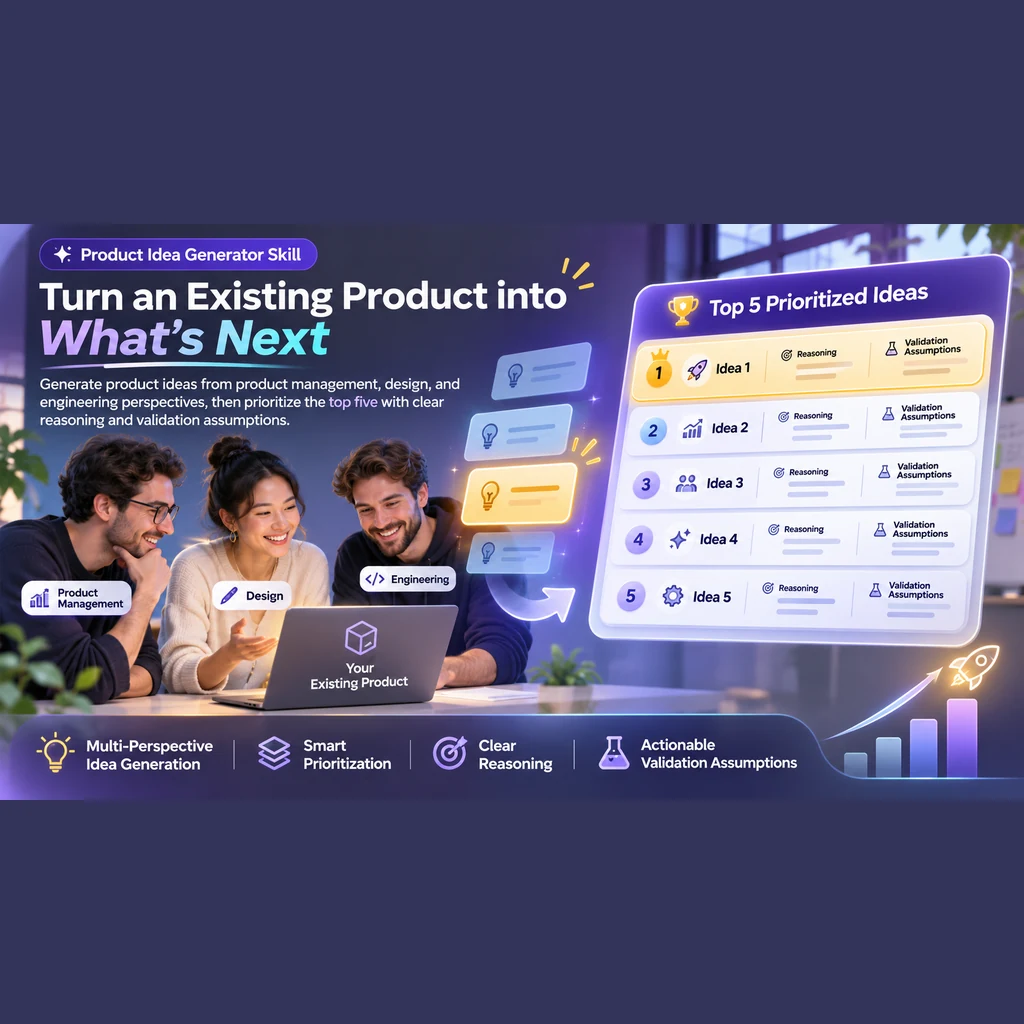
AI-generated cover, not a screenshot of an app or a customer session. The package includes the 1024 × 1024 WebP.
Generated options depend on the quality and scope of your input. Distinguish claims from assumptions, protect customer information, and ask the real team to review feasibility. The reading links in the original Skill are references, not included subscriptions or access entitlements.