Test the commitment.
Turn a new-product concept into a behavioral hypothesis and a practical plan for learning with less build effort.
At least 20% of eligible office managers will pay for a two-week snack pilot within 14 days.
Faithful excerpt from one saved Codex run. This is a proposed test for the fictional Tidewell Plus concept; no market experiment ran.
01 / purpose
Make an idea testable.
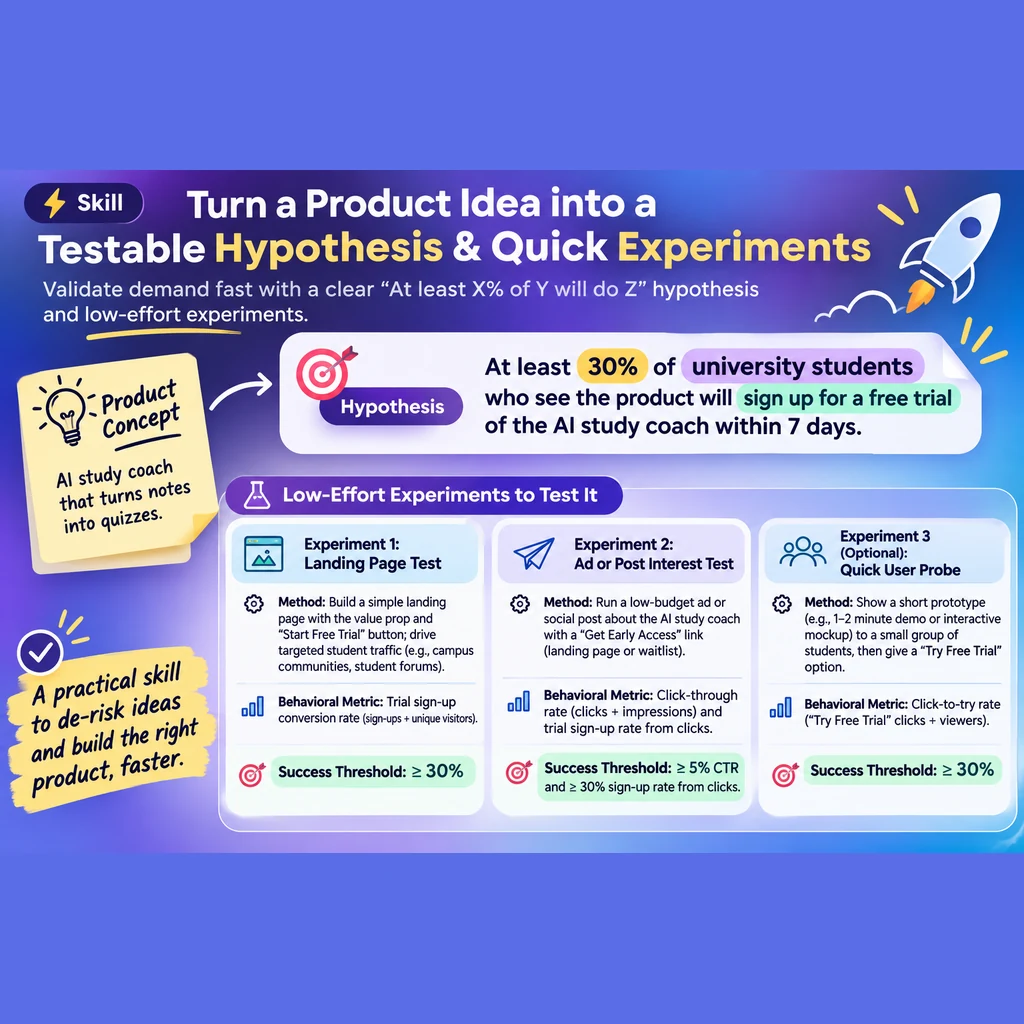
A promising concept still leaves a hard question: what would someone actually do for it? This Skill converts a new-product description into an XYZ hypothesis and two or three low-effort pretotype proposals. Each proposal names the hypothesis, method, behavioral metric and success threshold.
The original instructions emphasize skin in the game, Your Own Data (YODA), and observed behavior. An email opinion is a different signal from attending a session, making a reservation, or paying for a specific offer. The output helps you choose the next learning step before building the full product.
Each with a method, metric and predeclared threshold
02 / exchange
From a concept to a brief.
You provide
The product concept, target market, current evidence and constraints: budget, timeline, channels, prototype capacity and what commitment you can responsibly request.
State what is known and what is assumed. If you supply research or mockups, the workflow reads them first.
You receive
A substantial Markdown brief with an “At least X% of Y will do Z” hypothesis and two or three experiments. Each includes a method, measurable behavior and a success threshold.
The assistant may propose a landing page, email, explainer video, pre-order, waitlist or manual concierge service. It does not automatically deploy or run them.
A fit for early product decisions.
Founders and discovery teams
Use it when an unlaunched offer needs an inexpensive demand test, the target audience can be named, and the team can act on a clear next-step decision.
Product managers exploring an add-on
Describe the new offer separately from the existing product. In the saved example, a lunch-kit company explores an unlaunched snack subscription; existing adoption does not prove appetite for the add-on.
Boundaries to keep visible
This is not an experiment deployment service, payment system, recruitment platform, statistical power calculator or evidence of market demand. It cannot validate an unsafe or operationally impossible offer simply by writing a test.
03 / environment
Where it runs.
Load the source folder using your assistant’s supported Agent Skill mechanism, or ask a file-capable assistant to read SKILL.md and follow it. The package is one Skill, not the complete upstream plugin marketplace or its slash commands.
A capable language model is required. Model access or usage fees may apply; no additional service API key is required by this instruction-only Skill. The supplied-input workflow does not require web access. Further-reading links do not include paid content access.
Compatibility boundary
The saved run was performed by a Codex worker reading the source. Native client installation, Claude execution, other hosts and repeated-run consistency were not tested. A host must be able to read the supplied instructions and files.
What the saved run proves.
One Codex run produced the XYZ hypothesis and three experiment designs for the invented Tidewell case. An executable Python validator checked seven required sections, the fields in each experiment, three threshold fractions and the invoice example.
The validator checked the artifact’s structure and selected arithmetic. It did not recruit office managers, collect payments, assess real demand, run a power analysis or measure a business result. The proposed percentages are decision assumptions to review with the team.
Source and artwork.
Original MIT source
The complete original SKILL.md and upstream MIT license are preserved. Attribution: Copyright (c) 2026 Pawel Huryn.
Distribution additions include README, NOTICE, pinned provenance and the cover. No core instructions were rewritten. HTML, video and model access are not included in the source ZIP.
Pinned commit
2a12295a7717569baa7be181b4cfebe3ca38a6bb