Some $600 billion is pouring into AI, yet almost only NVIDIA is making real money. But the iron law of industrial history hasn't changed — value always migrates from the "shovel-sellers" at the bottom up to the "rent-collectors" in the application layer. The premium you pay for compute today is buying you last era's winner.
In December 2025, something quietly fascinating happened: Cisco — yes, the old-school company that sells routers and networking gear — saw its share price, for the first time in a full 25 years, climb back to the peak it hit during the dot-com bubble of 2000.
Around the same time, "Big Short" Michael Burry — the man who famously saw the subprime crisis coming early — kept drawing a comparison between one company and that very same Cisco. That company is the hottest name in today's AI boom: NVIDIA.
Burry's point is blunt: NVIDIA may be sitting at the dead center of yet another bubble, running the exact same script as 25 years ago.
Whether that comparison is right, we won't rush to judge in this piece. But it hits a question no AI investor can avoid: with trillions of dollars flooding into AI, which layer is the money actually piling up in right now — and which layer will it flow to next? Who's "selling shovels," and who ends up "collecting the rent"?
This is the first installment of my "AI Industry Research" series. We're not here to call which coin will pump or which stock to buy. We're going to slice the AI cake open, layer by layer, to see its profit structure clearly — and where it's most likely headed next.
CHAPTER 01
$600 Billion Goes In — Yet the Money Piles Up in One Hand
Start with a number. In 2026, a handful of U.S. tech giants — Microsoft, Amazon, Google, Meta, plus Oracle — are expected to spend, on AI capital expenditure alone (buying land, building data centers, stockpiling chips, expanding the grid), a combined sum closing in on $700 billion, with roughly three-quarters of it pointed straight at AI infrastructure. To put that in perspective: it's higher than the annual GDP of the vast majority of countries on Earth.
With that much money flowing, you'd expect a whole chain of companies to eat well along the way. But open the books, and you find something deeply counterintuitive: of all that cash gushing in, the one truly raking it in, right now, is almost a single company — NVIDIA.
$68.1B
Q4 FY2026 quarterly revenue, up 73% year-over-year
75.2%
Gross margin — sell a $100 chip, gross $75 of it
91%
Data-center share of total revenue — essentially its whole business
That's NVIDIA's report for the quarter ending January 2026. Revenue of $68.1 billion in a single quarter, of which the data-center business alone contributed $62.3 billion — over 91% of the total. GAAP net income hit $42.96 billion, up a staggering 94% year-over-year. Zoom out to the full year and it netted $120 billion, with $97 billion in free cash flow. What's the scale here? Since ChatGPT launched in late 2022 and the AI wave began, NVIDIA's data-center revenue has grown nearly 13-fold.
And that 75% gross margin? Put plainly: it sells a $100 chip that costs it only $25 to make, pocketing $75 in gross profit. This is a flat-out money-printing machine. Nowhere else on the entire AI value chain does anyone make money this easily, or this concentrated.
Slice it finer and you feel just how powerful this machine is. Within that $62.3 billion of data-center revenue, the GPU compute business alone contributed $51.3 billion; and the "networking" business — the high-speed interconnect gear that wires thousands of chips into a giant cluster — did $11 billion in a single quarter, up a blistering 263% year-over-year. In other words, NVIDIA long ago stopped selling just chips; it sells a full "chips + interconnect + software" AI-infrastructure stack. Over the past four quarters it shipped 6 million of its latest Blackwell GPUs; in a single year it returned $41 billion to shareholders through buybacks and dividends. While the whole industry is pouring money in, only NVIDIA is bleeding it back out at scale — a position that is, on this entire chain, one of a kind.
One detail worth pinning down up front (so the sharp-eyed don't): NVIDIA's "fiscal year" runs a year ahead of the calendar. Its "Q4 of fiscal 2026" actually corresponds to roughly late 2025 through January 2026 — not the fourth quarter of calendar 2026. The kind of thing a knowledgeable reader will catch, so let's call it out ourselves.
Which brings us to the question: a technology wave that claims it will remake every industry, with trillions of dollars going in — why is the profit so highly concentrated in the single link of "selling chips"? All those cloud providers, model companies, all those application firms shouting about disrupting a thousand industries — where did their money go?
To answer that, we first need a complete "cake diagram."
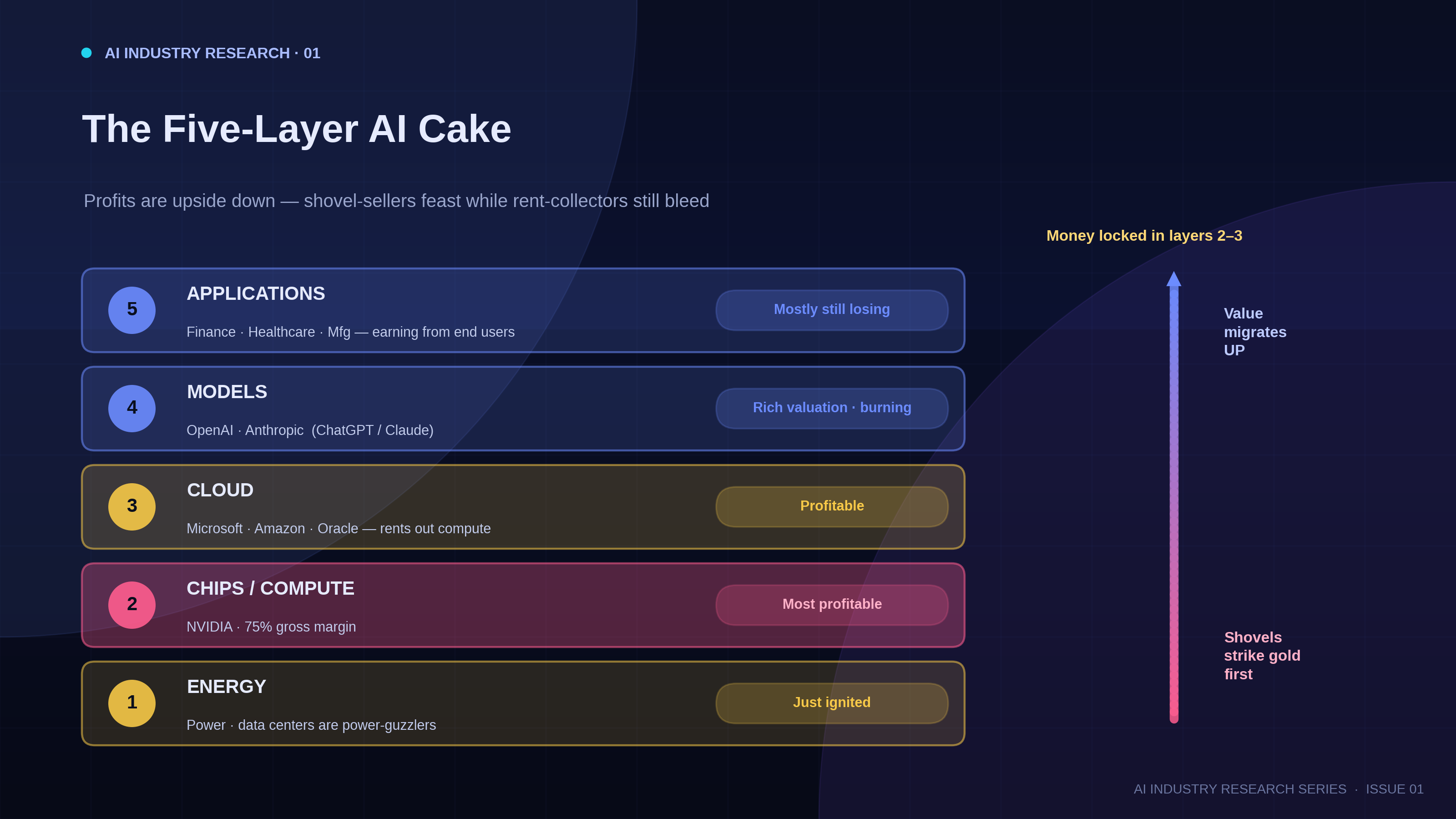
Fig 1 · The Five-Layer AI Cake — profits inverted: shovel-sellers feast, rent-collectors still bleed
CHAPTER 02
The Five-Layer Cake: Why Profit Is "Inverted"
To see where AI's money flows, Jensen Huang himself gave us a remarkably useful framework. At the Davos forum in January 2026, he likened the entire AI industry to a "five-layer cake." Let me lay it out from the bottom up, spelling out who's on each layer and what kind of money they're making.
Layer 1Energy — Power
The bottom layer is energy. AI data centers are outright "power-guzzlers"; without electricity, the four layers above are dead in the water. This used to be a dull-as-dishwater business, but now, because AI is fighting for power, electricity, nuclear, and the grid have suddenly become market darlings. It's just been ignited.
Layer 2Chips & Compute — NVIDIA
The second layer is chips and compute, where NVIDIA stands. This is the most profitable spot on the whole cake. The reason comes down to one word: scarcity. Right now the bottleneck choking the entire industry is compute, and whoever holds the best GPUs holds the pricing power. That's why NVIDIA can sustain a 75% gross margin — not because it's well-liked, but because everyone else has no alternative.
Layer 3Cloud — Microsoft, Amazon, Oracle
The third layer is cloud. Microsoft, Amazon, and Oracle — the old-line enterprise-database giant — package compute into a service and rent it out. This layer is profitable, but there's an awkward catch: a big chunk of what it earns gets handed straight back downstairs to NVIDIA. They're the landlords; NVIDIA built the building.
Layer 4Models — OpenAI, Anthropic
The fourth layer is AI models. OpenAI and Anthropic live here — the companies behind ChatGPT and Claude. This layer is the most surreal: valuations are eye-watering — OpenAI reached $850 billion in a funding round, Anthropic $380 billion — yet they're still deep in the red, still burning cash furiously. The valuation is tomorrow's story; the losses are today's reality.
Layer 5Applications — Finance, Healthcare, Manufacturing
The top layer, the fifth, is the actual applications. Finance, healthcare, manufacturing — the people genuinely using AI to earn money from end users. In theory, this layer is where AI's value finally gets cashed in. In reality, the vast majority of application companies are still trying to prove the most basic thing of all: that they can reliably collect money at all.
Alright, framework laid out. Now do the crucial thing — map "who makes money" onto these five layers.
You get a counterintuitive picture: the money is locked into the bottom two layers. Energy is just catching fire, the chip layer is swimming in profit, the cloud layer is comfortably making money; but the higher you go, the worse it gets — layer four has rich valuations yet bleeds, and layer five mostly loses money.
And here's a useful way to see the mechanism. Trace the relationships and you'll spot a "food chain": end users pay the application layer, the application layer passes a cut up to the model layer, the model layer passes a cut to the cloud layer, and the cloud layer hands the lion's share down to the chip layer. Money flows from the top down, but profit piles up at the very bottom — that, in miniature, is the "inversion" mechanic of the whole cake. The closer you are to the end user, the harder you grind; the closer you are to the bottleneck at the bottom, the easier you have it.
This cake is top-heavy and upside down: the shovel-sellers (the bottom) are eating until grease runs down their chins, while the ones who should be sitting back collecting rent (the top) are still going hungry.
Hold onto that "inverted" picture. It's the starting point for everything that follows. And one question immediately arises: will the layer making money now be the layer making money in the end?
History, as it happens, answered this long ago.
CHAPTER 03
"Shovel-Sellers Get Rich First" — and This Is the Third Time
This pattern — "the bottom gets rich first, the top earns later" — is not new to industrial history. Over the past 150 years, nearly every great infrastructure revolution walked the same road: the shovel-sellers get rich first, the rent-collectors win in the end. Three comparisons — feel for yourself how closely the script rhymes.
①Railroads: rail-makers rich first, freight-collectors win later
The 19th-century railroad mania. The first to strike it rich were the makers of rails and locomotives — wherever track got laid, their orders followed. But decades later, the ones who truly devoured the railroad prize were the operators who consolidated the lines and sat back collecting tolls and freight. The equipment-makers earned the money of "the building years"; the operators earned the money of "the decades after."
②Electricity: generator-makers rich first, factories that mastered power win last
The early-20th-century electrical revolution. GE and Westinghouse, selling generators and electrical gear, cashed in first. But the real value electricity created — the leap in productivity once factories were rebuilt around electric power — took a full two to three decades to show up. The big winners in the end were the manufacturers who learned to reorganize production around electricity, not the ones who sold the equipment.
There's a particularly delicious detail here, known in economics as the "productivity paradox": electricity was widespread by the late 19th century, yet society-wide productivity didn't truly take off until two or three decades later. Why so slow? Because factories at first merely swapped a steam engine for one big electric motor and left the floor plan untouched; only when someone figured out you could give each machine its own small motor and completely redesign the production line was electricity's power unleashed. In other words — the "shovel-selling" money was earned in the building phase, but the real value created by "using the shovel" arrives only after users learn how to use it. And that is often measured in decades. A sober reminder for anyone judging when AI's application layer will pay off.
③The Internet: Cisco crowned, Google and Amazon collecting rent to this day
The closest analog, and the most alike, is the dot-com bubble of 2000. And its protagonist happens to be the very Cisco we opened with.
Back then, the "shovel-seller" was Cisco — to get online, you needed its routers and switches. From early 1998 to the 2000 peak, Cisco's stock rose over 1,000%. On March 27, 2000, it hit an all-time high, its market cap blowing past $500 billion to make it the most valuable public company in the world at the time, overtaking Microsoft. Everyone believed it would just keep going up.
And then? The bubble burst. Over the next year or two, Cisco's stock collapsed from over $80 to the low teens, a drop of more than 80%, with its market cap shrinking to around $60 billion by the end of 2002. Worse still was Nortel — peak market cap of $270 billion, stock crashing from over $120 to under $1, ending in bankruptcy.
And who ended up "collecting rent" all the way to today? The names almost nobody favored at the top of the bubble: Amazon and Google. Amazon was still just a bookselling website then; its stock fell from $100 to as low as $6 and barely survived. Today it's one of the largest cloud providers on the planet.
The most ironic detail: Cisco's stock took a full 25 years — until late 2025 — to climb back to its 2000 high for the first time. And even then, its market cap remained more than 40% below that peak. The shovel-seller can crown itself the world's most valuable company in the building era; but that peak may take a quarter-century to digest.
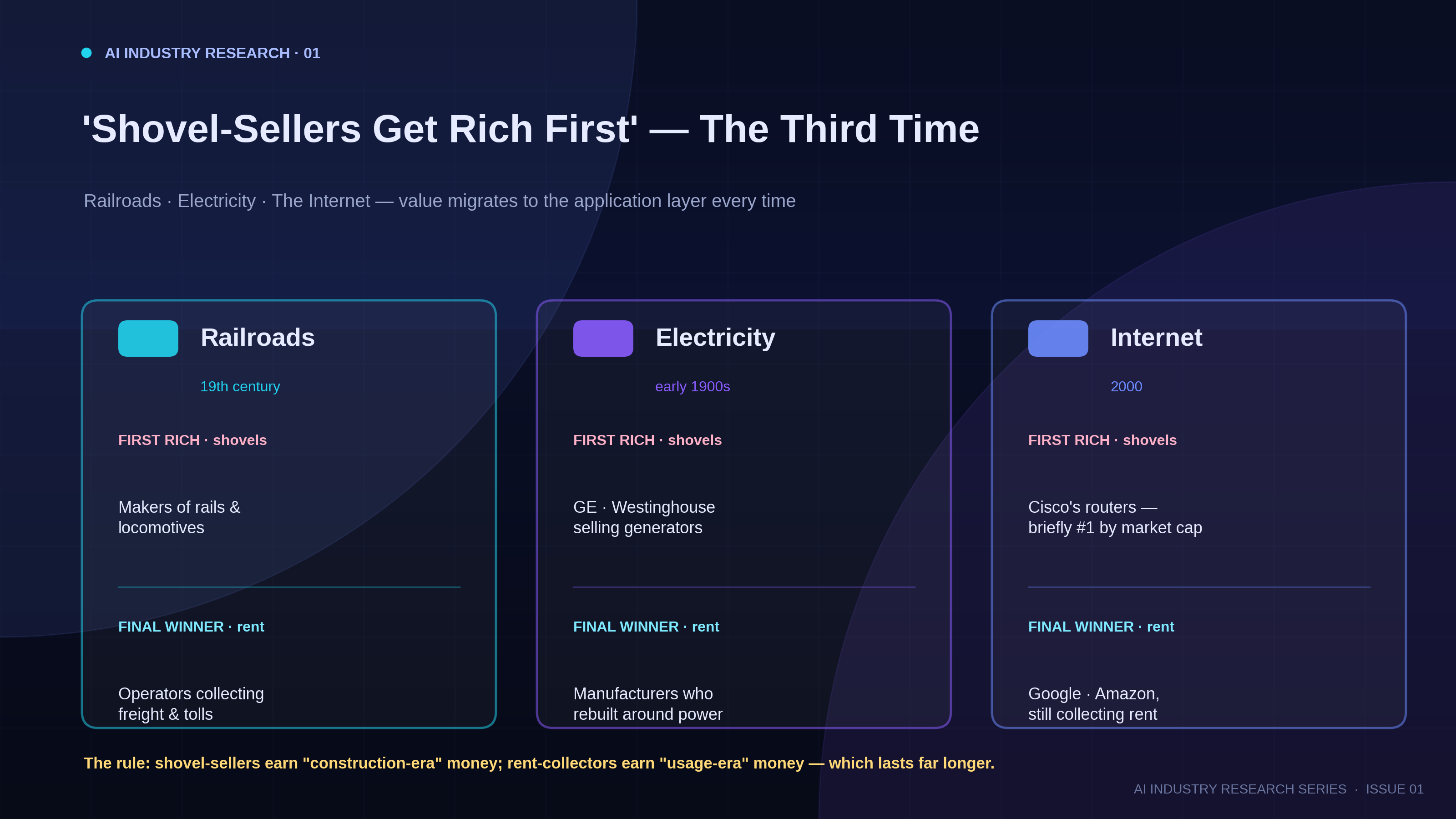
Fig 2 · Railroads / Electricity / The Internet — long-term value migrates to the application layer every single time
A note on data (laying my cards on the table): On Cisco's 2000 peak market cap, sources range between "$500 billion" and "$550 billion"; the drawdown between "80%" and "90%," depending on whether you use closing or intraday, monthly or annual figures. I've used the more conservative "over $500 billion" and "over 80%." The direction is crystal clear; verify the exact figure against a primary source yourself. The point isn't the decimal places — it's the script.
The rule, in one line: shovel-sellers earn the money of the "construction era"; rent-collectors earn the money of the "usage era." And the usage era lasts far longer.
So when you stare at NVIDIA's surging stock chart today, cheering its market cap — from the vantage point of industrial history, what you're looking at is the dispatch from the last war. The winner of the building era is already decided, but the real cake is still ahead.
Of course, "history repeats itself" is a dangerous oversimplification. Whether this time really plays out the same, we'll argue out in Chapter 5. But before we argue — here's the good news: this migration has, quietly, already begun.
CHAPTER 04
The Good News: the Migration Is Already Climbing, Layer by Layer
"Value will migrate upward" sounds like some distant prophecy. But the good news is, in AI's case, you can already see clear early signals of that migration — and it's climbing from the bottom up, one layer at a time.
Step 1 · DoneThe chip boom spilled into the energy layer
The first to catch fire was the bottom-most layer. Data centers fighting over power turned electricity, nuclear, and the grid — those once-sleepy sectors — into market hot spots. The boom in compute is being transmitted downstream into energy. This step is essentially complete — you can already see a wave of "AI power plays" getting bid up in public markets.
Step 2 · In progressThe model layer is installing a "cash register"
One layer up, the model companies are scrambling to turn "burning cash" into "collecting cash." Subscriptions, pay-per-call APIs, paid enterprise tiers — at bottom, these moves are all about installing a cash register on layer four. They know full well that telling stories to raise money can't last forever; they have to grow their own cash flow. This step is in full, fierce swing.
Step 3 · Just emergingThe application layer is sprouting "rent" prototypes
The very top layer is the most exciting — and the most uncertain. The application layer is beginning to show forms that can truly "collect rent." The clearest examples are AI coding tools and various vertical Agents — they don't sell compute or models, they sell "getting the job done for you," charging by the month or by the outcome. This is the most primitive prototype of the "rent" model: you pay for the result, not for the tool.
This has to be said clearly (source type): Step 3 is only "just emerging." Which application company wins in the end, who becomes the "Amazon" of the AI era — it's far too early to conclude. This is my judgment based on the trend, not an established fact. I'm not picking a name for you to buy, but this is the direction to start watching now.
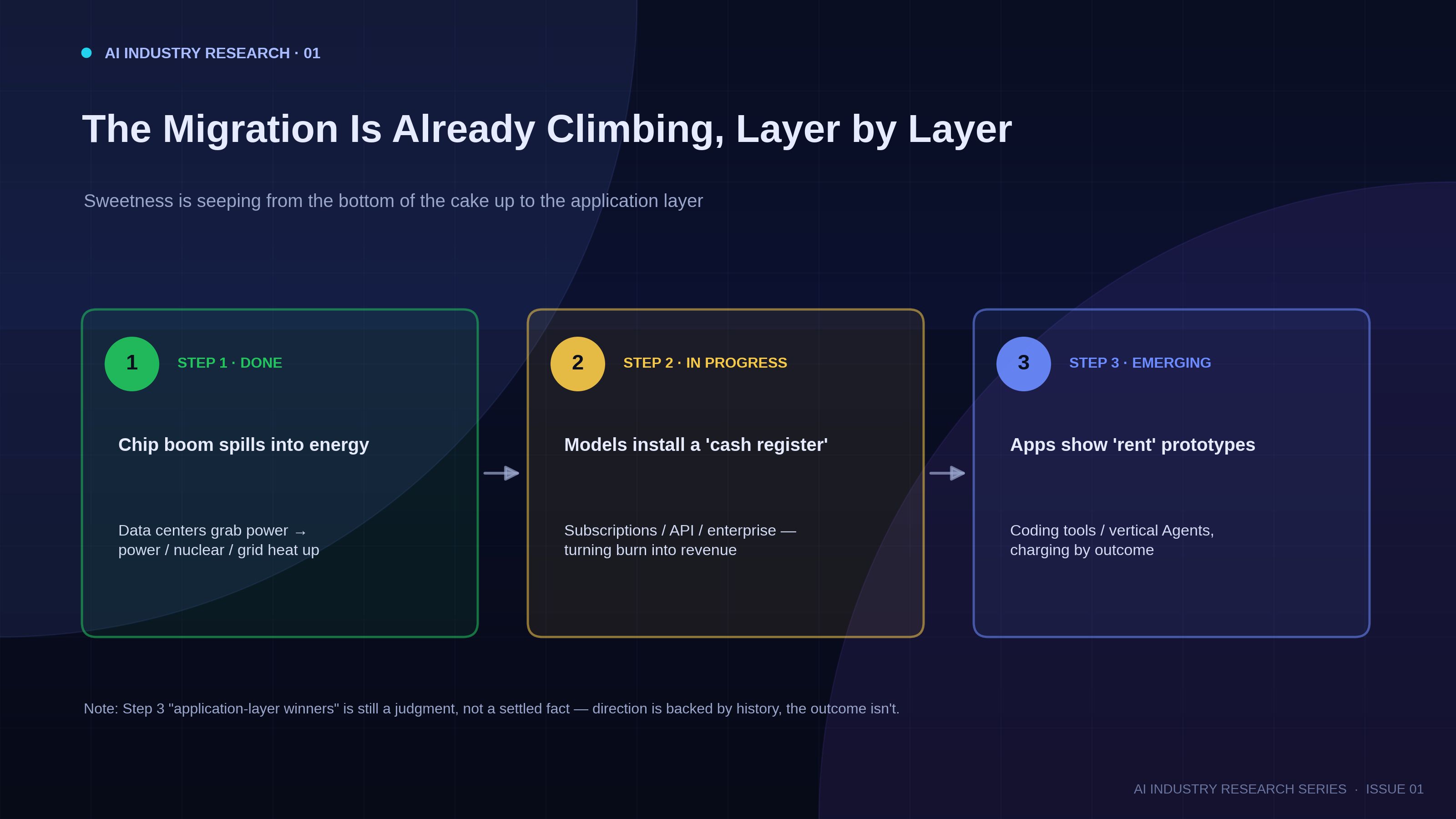
Fig 3 · The sweetness is seeping from the bottom of the cake up toward the application layer
String the three steps together and the direction is clear: the sweetness is seeping up from the bottom of the cake. But — if the story ended here, that would be naïve. Because this time, there really are a few variables that could rewrite a century-old script.
CHAPTER 05
But This Time, There May Really Be Three "Differences"
Here I have to throw cold water on myself. "Value will migrate upward" is a historical rule, but a rule is not an iron law. Back to Burry's "NVIDIA = Cisco" analogy from the opening — its biggest weakness is precisely this: NVIDIA and Cisco may not even be the same kind of business. This time, there are at least three variables that could steer the script toward a different ending.
Variable 1NVIDIA's moat may be far deeper than Cisco's
What Cisco sold back then was standardized hardware — a router is a router; switch suppliers and your network still runs. So its moat couldn't hold once the bubble burst.
NVIDIA is different. It doesn't just sell chips; it has a thing called CUDA — put simply, a whole suite of software tools and an ecosystem that AI programmers can't write without. For over a decade, AI engineers worldwide have grown used to it. Switching to another company's chips means making that whole crowd relearn a language and rewrite a pile of code. That kind of "software lock-in" is something Cisco simply never had. In other words, NVIDIA's "shovel" is far stickier than Cisco's.
Variable 2This time, it could be "winner-take-all"
In the internet era, the application layer eventually bloomed into a hundred flowers — Google, Amazon, Meta, Netflix, each collecting its own rent. But AI has a dangerous property: it could be winner-take-all. If the strongest models and strongest applications end up as just two or three players, then the application layer's "rent" concentrates in those very few hands, rather than being shared around. The migration still happens, but the upside doesn't necessarily reach ordinary players or ordinary investors.
Variable 3The most lethal one — the end-user payment chain hasn't been proven yet
This is the most critical of the three, and what the Burrys of the world fear most. As mentioned, part of the bottom layer's prosperity is propped up by "circular financing."
What is circular financing? Break it open: NVIDIA invests in OpenAI; OpenAI takes that money and turns around to buy NVIDIA's chips; Oracle, NVIDIA, and AMD run similar loops among themselves. On paper, every party's results and valuation are rising — but in essence, this is a closed loop of capital: the money circles among a few giants without truly flowing in from "end users." Some in the market even argue that the scale of this kind of capital structure in AI is several times that of the 2000 internet bubble.
The subtlest thing about this structure is that it blurs the line between "customer" and "investor." Suppliers invest in their customers to ensure the customers have money to come back and buy their products; on paper, everyone looks good, revenue and valuations rise together. But the moment any link in this chain fails to sell a real product or service, the whole loop collapses in reverse — because there's no genuine "external cash" actually flowing in; it's the same money circling among a few giants. That's exactly why "can the application layer collect real money" is not some trivial financial detail, but the life-or-death switch for the entire migration chain.
If the top layer ultimately can't collect enough real, hard cash, then this migration chain — from energy to applications — could snap halfway up the climb.
So I won't thump my chest and tell you "the application layer is guaranteed to win." The only thing I can be sure of is this: the migration's direction has 150 years of industrial history behind it; but its speed, and who the eventual beneficiaries are, depend on how these three variables play out. Whether CUDA holds the lock, whether it's winner-take-all, whether the end-user payment chain gets proven — these three things determine how fast this migration moves and who the spoils go to.
CHAPTER 06
Don't Fight This War With the Last War's Map
String together the five-layer cake, the three histories, and the three variables, and I want to land on one line you can remember, repeat, and use to judge —
In an infrastructure revolution, the shovel-sellers get rich first, but the rent-collectors win in the end. What NVIDIA is taking today is the money of the building era; the real AI cake sits in that application layer almost nobody is profiting from yet.
So if you're using NVIDIA's stock chart to judge "whether AI is still investable, whether this run has topped" — what you're reading is the map of the last war. The building-era winner is magnificent, no doubt; but using building-era logic to bet the outcome of the usage era gets the direction wrong.
So what should you watch? I won't shill or hand you a ticker, but I'll give you three "migration signals" you can track yourself. Add them to your watchlist — they beat any influencer's hot take, because they directly measure whether value is actually climbing upward.
01
Application-layer real paid-revenue growth
This is the single hard indicator of whether "rent" is genuinely starting to be collected. Not funding raised, not valuation, not user count — the actual money end users pay, and how fast it grows. The moment this curve steepens, it's the strongest proof the migration chain has been proven out.
02
The point at which model-layer gross margin turns positive
When model companies like OpenAI and Anthropic shift from "burning cash" to "making money" — i.e. gross margin turns positive. That moment means layer four's "cash register" is truly working, and value has reached the second-to-last layer. Watch their financial disclosures and earnings guidance.
03
Signs of compute prices peaking
When GPUs are no longer so scarce you have to queue to grab them, when compute prices start to soften or even peak, it means the chip layer's bottleneck pricing power is weakening — and the scale of profit will, from that moment, start tipping upward. This is the inflection where bottom-layer gains peak and upper-layer gains begin.
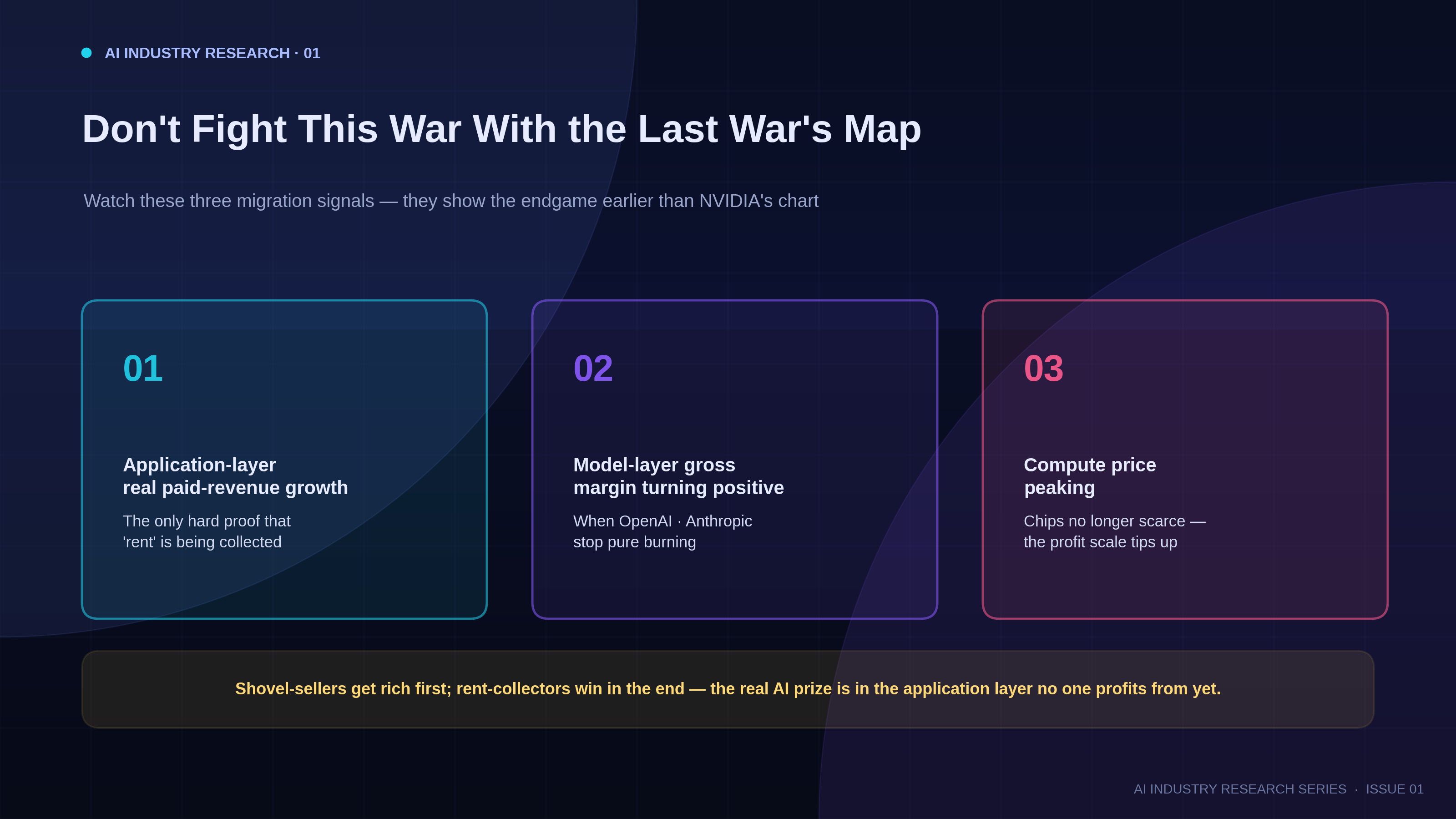
Fig 4 · Watch these three migration signals — they reveal the endgame earlier than NVIDIA's chart
This framework works just as well for friends in crypto, in U.S. equities, in private markets: it doesn't teach you "what to buy," it teaches you "at which stage of an industry value migrates from which layer to which layer." Once you understand layer migration, you won't mistake the shovel-seller for the eternal winner at the peak of the building era; nor will you miss that still-unloved "rent seat" when the migration is just getting underway.
And in a crypto context, this "layer migration" lens applies all the same. When everyone is chasing the hottest compute token or AI-concept coin, the questions truly worth asking are three: which layer of the AI value chain does this project sit on? Is it selling "construction-era shovels" or "usage-era rent"? Is anyone actually paying for its service, or is it just telling a story in a circle among a few wallets? The same ruler measures bubbles — and it measures the real thing. That, in the end, is what the word "research" is for.
Disclaimer: This piece is industry research and opinion. All data comes from public sources (NVIDIA's Q4 FY2026 report, public statements at Davos, public market reporting, etc.); cited forecasts and analogies are labeled as "judgment/forecast" and do not constitute investment advice. Markets carry risk; make your own decisions. Some historical figures cited here (such as Cisco's 2000 market cap and drawdown) vary by source — please verify against a primary source before citing.