Across nearly 200 of the latest Silicon Valley startups, not one pitch deck talks about "expanding headcount" — they all talk about replacement, layoffs, outcomes. But what AI is really doing isn't erasing "jobs"; it's splitting your work into individual "tasks" and eating the standardizable, repeatable ones first. The real question isn't "will I lose my job," but "how much of what's left can no machine take."
If you want to know which way the technology winds are blowing this year, there's one unusually accurate place to look — Y Combinator, the top startup accelerator in Silicon Valley, the one that hatched Airbnb and Stripe. Every cycle it picks nearly 200 of the most promising early-stage teams.
Looking at the 2026 batches, someone did something telling: they read every company's pitch from start to finish, then wrote down a line that stings — not one talks about "seat expansion"; everyone talks about "replacement, layoffs, outcomes." And an even blunter one: "job titles are gone."
These teams used to politely say "we use AI to assist with X." Now they've dropped the pretense and say it straight: "we use AI to replace X."
This isn't a one-off slogan. By public counts, 85% of YC's Winter 2026 batch is "AI-first" (built around AI from day one); of 198 companies, 56 are building fully autonomous agents positioned as "AI employees," aimed at every knowledge-worker role paying $50–150K — there's an "AI accountant" that closes a company's books without a human, and an "AI law firm" staffed entirely by models. By the Spring 2026 batch, 95% of companies touch AI, and 137 are building agents — more than every other category combined.
We've heard "AI is coming for jobs" cried wolf many times. But this time there's a clear inflection: that gentle "assistant (Copilot)" era lasted maybe 18 months, and the wind has already shifted to "replacement."
And this time, it isn't only cash-hungry startups shouting "replace." Look at what the biggest companies are doing: in the first two months of 2026 alone, the global tech industry shed over 150,000 jobs, and large firms in both the U.S. and China have, almost in unison, tied "AI efficiency" to "organizational slimming." When even the richest, most over-staffed giants start using AI to subtract, it stops being a slogan and becomes a structural shift, happening top-down.
So the question is: how is this "wolf" different from the ones cried for years? How will it name your job? This piece takes it apart, coolly, and answers three things — who gets named first, why, and what you should do.
CHAPTER 01
First, Correct a Misconception: AI Replaces Tasks, Not Jobs
To understand how AI actually affects work, you have to correct a misconception almost everyone holds. The picture in most people's heads is this: AI arrives, and the accountant is replaced wholesale, the programmer wholesale, the support agent wholesale — one "job," one "machine," gone as a unit.
But that's not how AI works. What it actually does is take your "job" and split it into individual "tasks," then ask, task by task: should this go to a human, or to a machine?
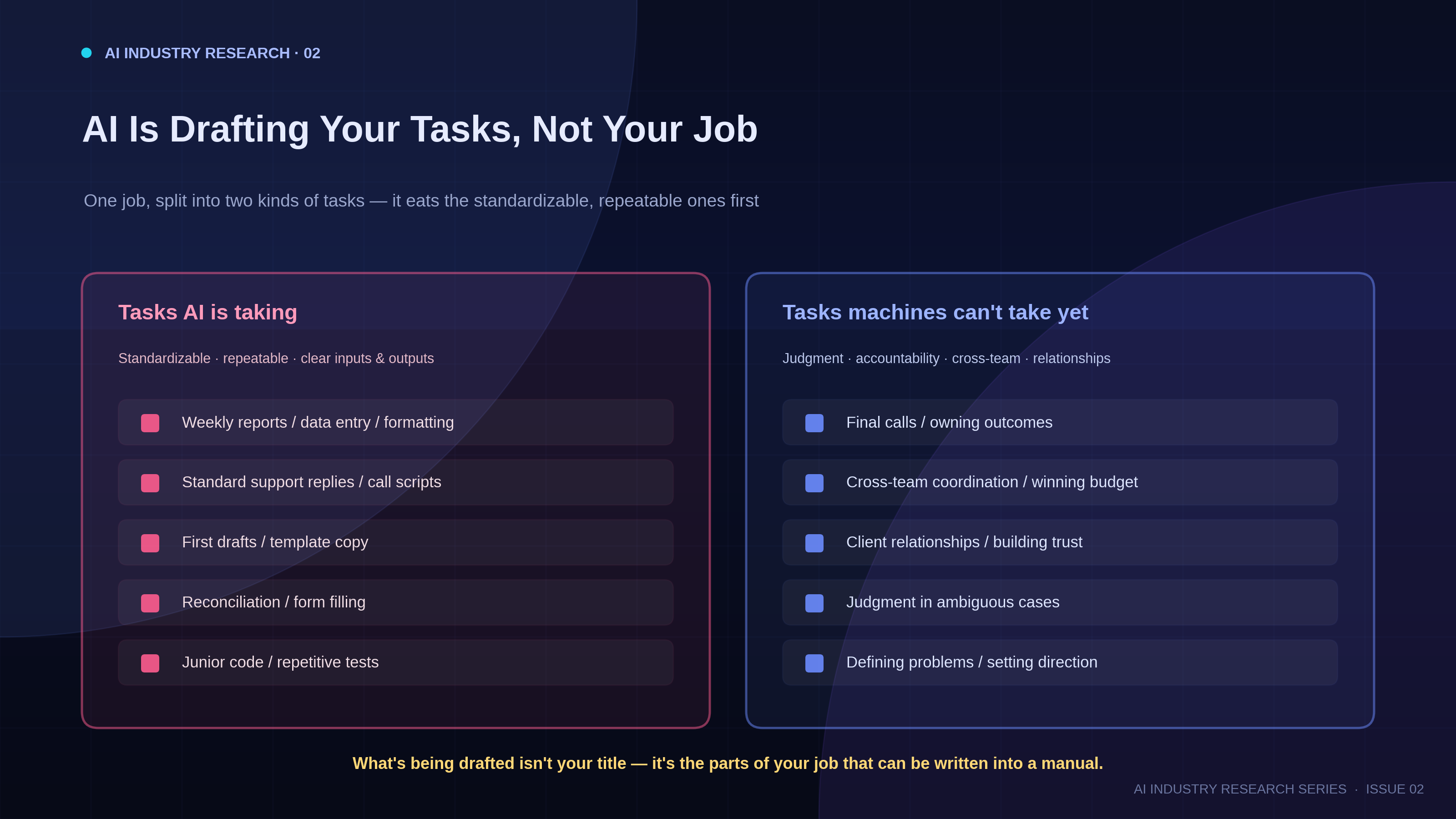
Fig 1 · AI names tasks, not jobs — it eats the standardizable, repeatable ones first
Which tasks does it eat first? The rule is clear: the standardizable, repeatable ones with clear inputs and outputs. Weekly reports, data entry, template-based first drafts, standard support replies, reconciliation, junior repetitive code — these "can be written into a manual," which is exactly what AI is best at.
What it can't take yet is the other kind of task: the ones that need judgment, that require owning the outcome, that involve cross-team coordination, client relationships, calling the shot in ambiguous territory. And these two kinds of task can live inside the same job — even inside the same person.
So remember this line — AI replaces tasks, not jobs. Whether your job survives depends on what fraction of it, once split apart, lands in the "standardizable" column.
Why does this inflection deserve attention? Because for decades, automation mostly replaced "physical labor" and "dead rules" — repetitive motions on an assembly line, an ATM counting cash, a tollbooth making change. They share one trait: the action is fixed and requires no understanding of context. This wave of AI is different: for the first time it reaches into "cognitive" work — reading a contract, writing an analysis, answering an email, debugging code. These brain-jobs, long assumed to require a human, are being peeled off task by task and handed to machines. That's why this "wolf" sounds different.
A concrete example makes it click. Take a "marketing specialist." Their day might split like this: tidy last week's data, produce a templated weekly report, reformat copy for three platforms, answer a dozen routine inquiries — AI can basically do all of that now. But the job has another half: judging which selling point this campaign should lead with, fighting with sales over budget, soothing an irritated key client, deciding which of two contradictory datasets to trust — AI can't do those yet. The same title, "marketing specialist," gets sliced by AI's knife: one half its prey, the other half their moat. Whether your job is safe was never about the title — it's about the ratio between those two halves.
Some put it more bluntly: AI isn't just adding a tool to a company; it's rewriting the company's "production function" — the way a company turns inputs into outputs. There's a logic here that's simple to the point of being brutal: when an industry's total workload doesn't explode in step, and AI lifts each person's output by 1.5×, 2×, 3×, then the number of people that industry needs must be compressed. Anthropic (the company behind Claude) estimated in January 2026 that, with broad AI adoption, U.S. labor-productivity growth over the next decade could rise by roughly 1.8 percentage points a year — close to doubling the prior trend.
This chapter sets the whole article's coordinate: stop asking "will my job disappear," and ask "how many tasks in my job are being drawn away." Coordinate set — now let's look at which tasks, and which roles, are being named in the first wave.
CHAPTER 02
Who Gets Named First: A Strikingly Clear Order
Point the "task-level replacement" ruler at the real labor market and you get a roll-call order that's clear to the point of stinging.
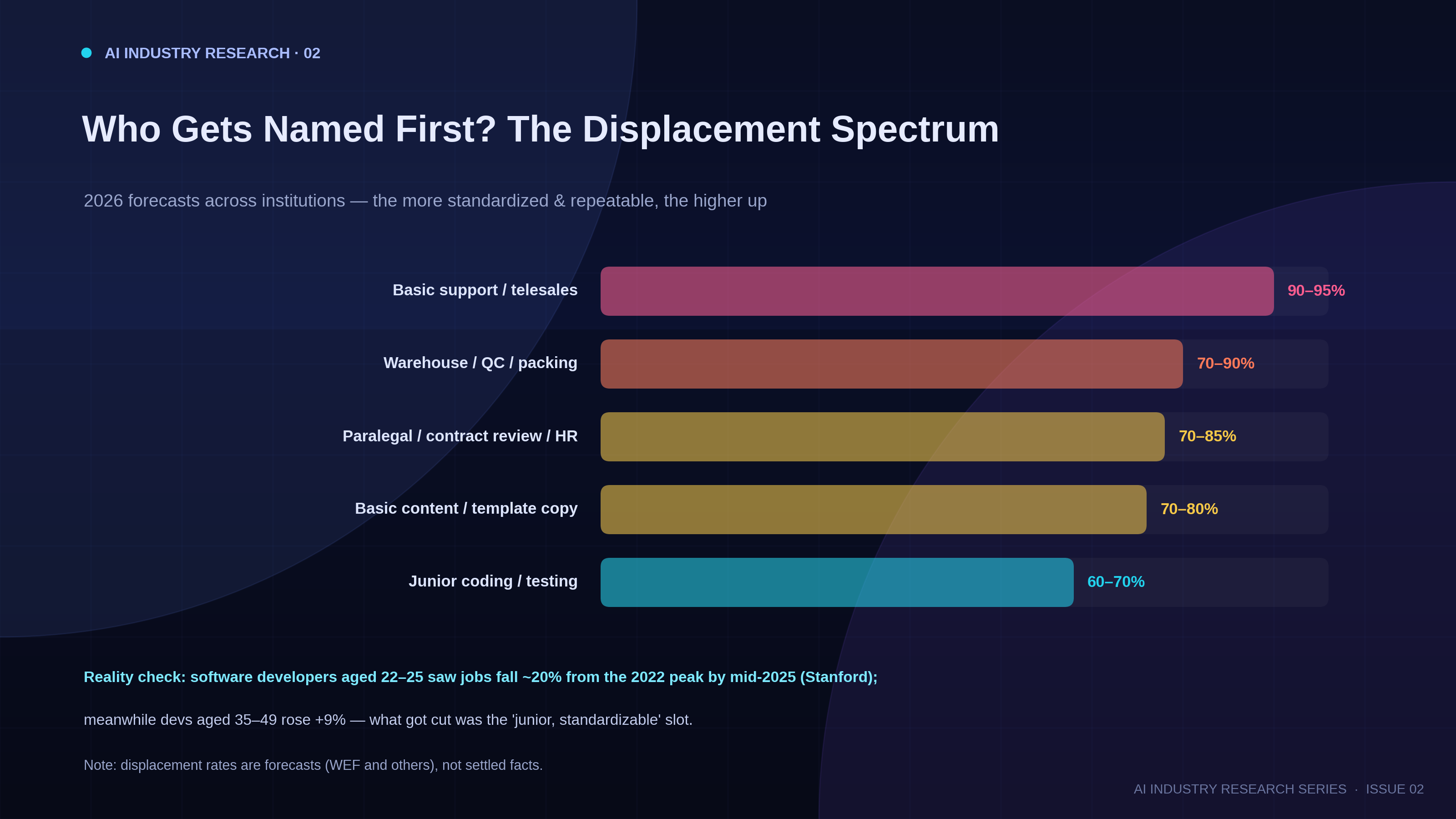
Fig 2 · The displacement spectrum — the more standardized and repeatable, the higher up (2026 forecasts)
The World Economic Forum (WEF) projects that from 2026 to 2029, AI agents will autonomously "remove" a set of mid-level roles: support team leads, data-entry operators, paralegals, graphic designers, financial analysts, HR coordinators, content writers. Various institutions' 2026 displacement-rate forecasts — note, these are forecasts, not things that have happened — run roughly: basic support and telesales 90–95%, warehouse sorting / QC / packing 70–90%, paralegal / contract review / basic HR / admin 70–85%, basic content 70–80%, junior coding and software testing 60–70%. The rule is plain: the more standardized and repeatable the task, the higher up the list.
There's a counterintuitive point worth flagging: this round, "mid-level" is actually more exposed than "ground-level." Ground-level physical work (hauling, sorting) still needs robotics hardware — slow and costly to deploy; whereas mid-level "information-processing" work — reviewing contracts, building reports, writing analyses, coordinating workflows — is pure text and numbers, exactly the home turf of large language models, needing no hardware, runnable from a single prompt. So you get an odd sight: the most anxious aren't the workers on the line, but the office floor's mid-level white-collar crowd who "make a living on Excel and PowerPoint."
And some of this is no longer forecast but already happening. Stanford research shows that by mid-2025, employment of software developers aged 22–25 had fallen nearly 20% from the 2022 peak; over the same window, developers aged 35–49 actually rose 9%. What got cut was, precisely, the "junior, standardizable" slot.
−20%
Devs aged 22–25, mid-2025 vs 2022 peak (Stanford)
−30%
Tech internships, 2023 to now (Handshake)
150K+
Global tech layoffs in the first two months of 2026
The mechanism is cold and simple: one senior engineer, paired with an AI coding tool like Copilot or Cursor, can lift output per sprint by 40–55%. That compresses the old "one senior plus one junior" pairing into "one senior alone." To cut costs, companies naturally start where it's easiest — hiring fewer juniors. In LeadDev's survey, 54% of engineering directors plan to cut junior hiring this year; tech internships are down 30% since 2023; new CS graduate unemployment sits at 6.1%, already among the highest of all majors.
Here's the counterintuitive part worth naming: many assume AI would start with manual, blue-collar work. But look at this roll call — the first names called are the educated, office-bound, standardized-brain-work "junior white-collar" roles. Precisely because that work is the most "writable into a manual."
I should also put a card on the table, so no one accuses me of selling panic. The U.S. did see something in 2025: unemployment among educated under-25s rose noticeably. But economists caution against pinning it all on AI. UBS's chief economist points out that over the same period, eurozone youth unemployment hit a record low, UK youth unemployment was falling, and Japan's youth labor participation was near an all-time high — if AI were truly eating junior roles worldwide, why would only American youth be hit so hard? The more plausible read: U.S. growth slowed, firms entered a "hiring freeze," and in such periods new graduates are always the first affected. In other words, "AI replacement" and "the business cycle" are tangled together right now — don't put the whole bill on AI. That said, the direction of the trend doesn't change; only its magnitude and speed are still developing.
The conclusion of this chapter is clear: the roll-call order isn't sorted by "brain vs. body," it's sorted by "can the task be standardized." The more you do work that can be written into a manual, the higher your name sits. But more worrying than "who's being cut now" is a subtler, longer-term, structural problem.
CHAPTER 03
A Subtler Danger: the Bottom Rung Has Been Pulled Out
If you only watch "how many are being cut now," you'll miss the most dangerous layer of this shift.
First, a question: what is a junior role actually for in an industry? It's far more than "doing junior work" — it's the entire industry's "training ramp." New people make mistakes here, accumulate, get mentored by veterans, then get promoted to mid-level, and mid-levels season into seniors. It's a talent conveyor belt that has held for decades.
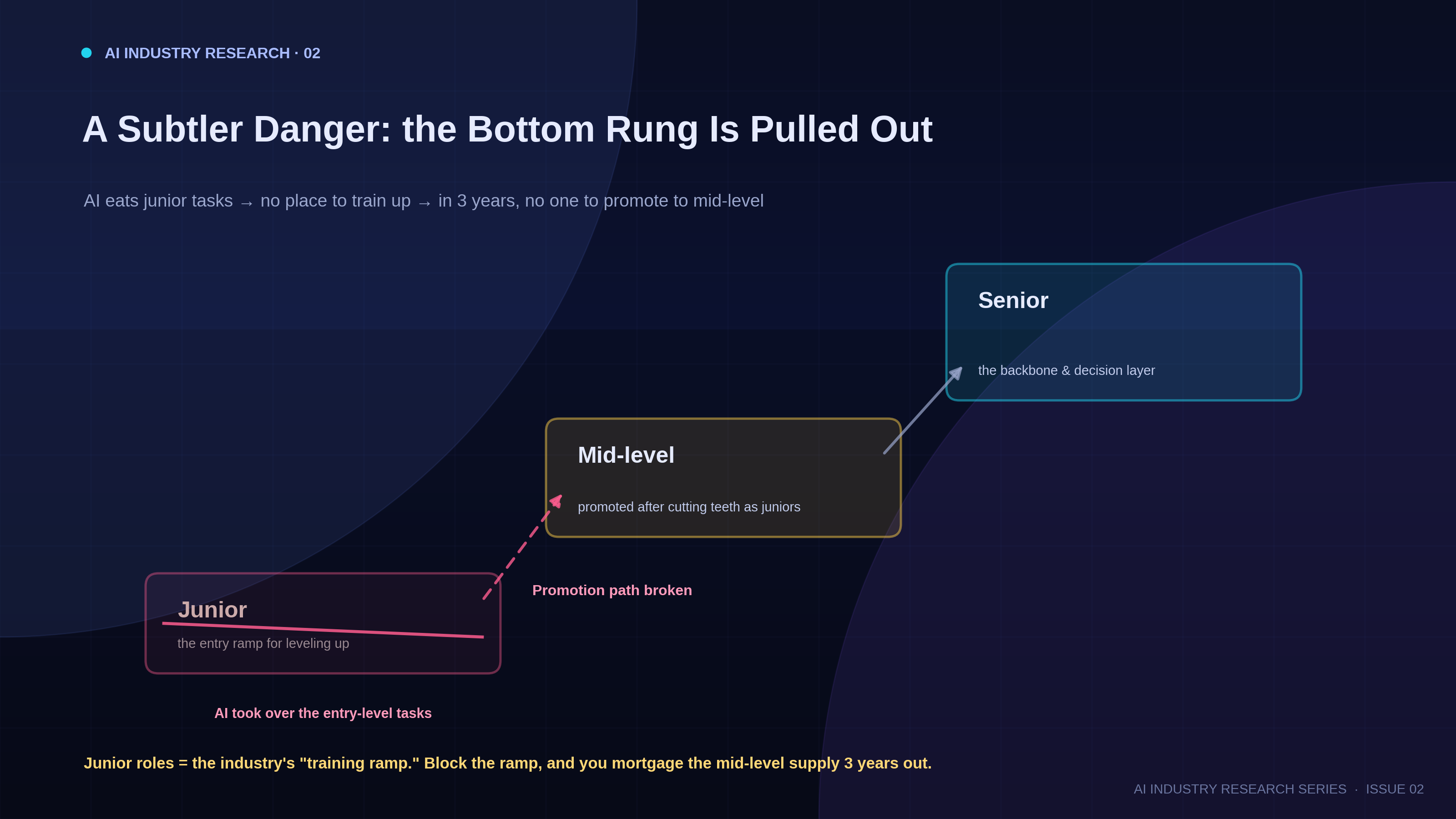
Fig 3 · A subtler danger — pull out the junior rung and the whole ladder wobbles
Now AI has eaten the "junior tasks." Short term, companies save money and run more efficiently. But medium term, a chilling chain is forming: fewer junior roles → new people have nowhere to train up → in three years, not enough people can be promoted to mid-level → the backbone develops a generation gap.
The big U.S. firms discuss this privately, but no one can solve it — because "hiring a junior" is a money-losing move right now (their output trails AI's), and nobody wants to blink first. The result: the whole industry is mortgaging its future mid-level supply. This isn't one company's problem; it's a collective prisoner's dilemma — everyone knows it's harmful long term, but whoever lets go first loses short term.
This isn't only Silicon Valley. In China, Alibaba in 2026 scrapped its long-standing "P-track" leveling system — that full promotion ladder from P4 junior engineer to P11 senior expert — moving toward a flatter, more outcome-oriented (rather than seniority-oriented) model. Whatever the intent, one signal is clear: that traditional ladder of "climbing rung by rung on seniority" is being redesigned.
So what does this mean for those already on the board — say you're already mid-level, or senior? It means a brief but real window: as masses of junior roles get absorbed by AI, people who are "experienced, can direct AI, and can own outcomes" become, short term, more valuable. As noted, 2026 features layoffs of juniors on one side and big firms paying six figures a month to fight over AI talent on the other — that "fire and ice" is itself a hallmark of a window. The catch: the window won't stay open forever. It tests whether you can move yourself, before it closes, from "doing tasks" to "defining tasks, directing AI, owning outcomes."
What this chapter proves isn't "people are losing jobs now," but a slower, deeper problem — pull out the entry-level step, and the whole upward ladder loosens. The junior-hiring cost you save today may be money borrowed from your mid-level supply three to five years out.
The mood's gotten heavy. But if you conclude from this that "white-collar work is doomed," you're wrong too — history happens to offer a very important counterexample.
CHAPTER 04
Don't Panic Yet: the Story of ATMs and Bank Tellers
Every technological revolution brings people crying "this time humans get replaced by machines." But there's a classic case, cited again and again by economists, worth using to throw cold water here.
That case is ATMs and bank tellers. Economist James Bessen (2015) told this history: when ATMs spread last century, everyone assumed tellers were finished — counting and dispensing cash, their core tasks, were now fully handled by machines. The result surprised everyone: the number of tellers, for a good long while, rose rather than fell.
Why? Because ATMs reduced the tellers needed per branch, which lowered the cost of opening a branch, so banks opened more branches, and total teller headcount went up. But the crucial change was that the work itself transformed. Cash-counting, a standardized task, went to the machine; tellers shifted to what machines couldn't do: building client relationships, recommending credit cards, loans, investment products. The teller went from "the person who counts cash" to "the person who does relationship banking."
The title of Bessen's research is precise: technology "moves workers to new roles" rather than "fully replacing" them. But he left a sober caveat — this story shouldn't be treated as an inevitable template. Whether you benefit hinges on one thing: whether your tasks are complementary to automation, or substituted by it. A teller who can only count cash and can't do client relationships won't thrive in the new bank either.
ATMs aren't the only case. Take a closer one: the spreadsheet — Excel. When it spread in the 1980s, countless people predicted accountants were finished — after all, manual bookkeeping and calculation, their core tasks, were now one-click. The result? The accounting profession didn't vanish; headcount grew. What changed was the work: from "manual number-crunching" to "using the results to do analysis, forecasting, decision support." The machine took the calculation; humans moved to judgment. It's the exact same script as the ATM — every time, the machine eats "execution," and people get pushed toward "judgment."
Back to today. The more restrained, more credible research we have now strikes the same note. In its 2026 labor-market research, Anthropic is notably careful, repeatedly urging humility: many estimation methods can't be equated directly with real labor-market outcomes. OECD's macro data also shows that, at least through mid-2025, overall unemployment in developed economies remained low. Meanwhile, AI is also spawning new roles — by some counts it has created around 21% new role types, and demand for "AI trainers" rose 112.4% year-over-year in 2025.
This must be said clearly (cards on the table): the more certain fact today is that task structures, wage structures, and skill structures are changing — not the finished conclusion that "AI has caused mass unemployment." Reading this article's title as "you'll be unemployed tomorrow" is a misread. The real danger has never been "the machine is too strong," but the transition period — when old roles are compressed while new roles and skill systems haven't yet caught the people displaced.
I don't want to make it sound too easy, either. "New jobs will eventually be created" and "you personally transition smoothly" are two different things. Across history, technological revolutions always create new work — but the specific people living through the transition may endure years of pain: old skills devaluing, new skills not yet learned, new roles not yet grown. "Fine in the long run" is no comfort to someone "hurting in the short run." So the right stance is neither blind optimism nor panicked surrender, but: accept the direction, and position early.
History and data point to the same conclusion: technology replaces "tasks" and creates "new tasks"; what truly decides your fate isn't how strong AI is, but whether your work is "complementary" to AI or "in competition" with it. So in practical terms, how do you get onto the "complementary" side?
CHAPTER 05
How to Position: From "Doing Tasks" to "Directing AI"
String it all together — from YC's "no more seat expansion," to task-level replacement, to the junior generation gap, to the ATM history — and it lands on one line you can use directly:
AI replaces tasks, not jobs. What it names is never your title, but the parts of your work that "can be written into a manual." What decides your fate is how much of what's left only a human can do.
So rather than endlessly worrying "will I be replaced," do three things.
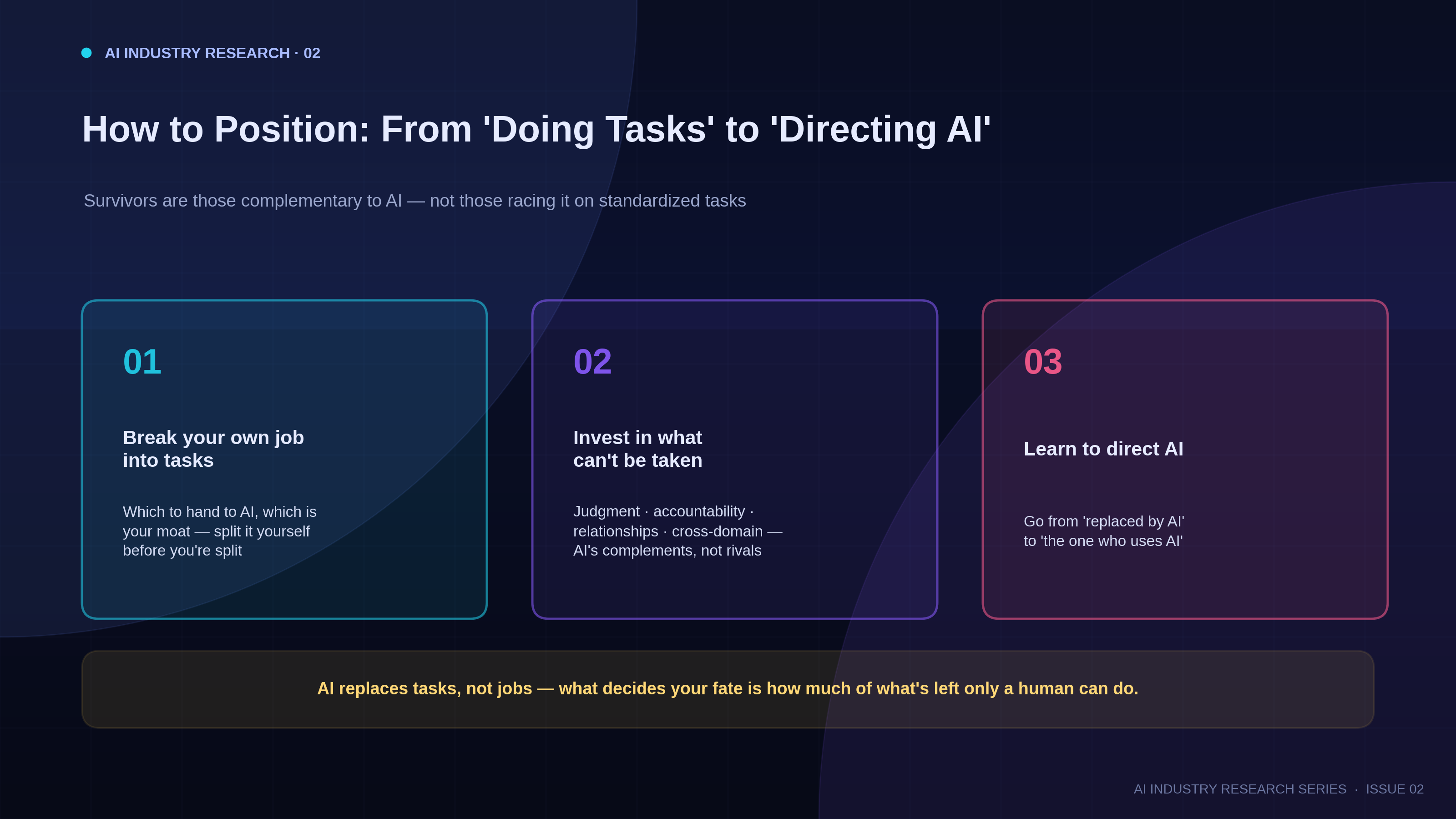
Fig 4 · How to position — from "doing tasks" to "directing AI and owning the outcome"
01
Split your own job into tasks, by hand
Which are standardizable and repeatable (these go to AI eventually — don't cling to them), and which are your moat (judgment, relationships, accountability). Splitting it yourself beats being split by someone else — and it's how you re-learn where your value actually is.
02
Invest in what "can't be taken"
The ATM story is clear: the surviving tellers were the ones who could do "relationship banking." Translated to today: judgment, accountability, cross-team coordination, client relationships, the ability to define problems — these are AI's complements, not things to fight it head-on over.
03
Learn to direct AI
The steadiest seat in this shift isn't "racing AI on standardized tasks" (you'll lose), but becoming "the one who uses AI" — going from someone replaced by AI to someone who directs AI and owns the final outcome. The people who wield tools have never been the ones the tools retire.
You may have noticed these three are three faces of a single move: deliberately shifting yourself from the "execution layer" toward the "judgment layer." We were raised to "do the work well," to treat fast, standardized delivery as a virtue; but in front of AI, "fast and standardized" is exactly its home turf — you can't out-grind it. What becomes scarce is the stuff that's "hard to specify, impossible to standardize, requiring accountability" — which data to trust, which path to take, who takes the fall when things break. It's counterintuitive, but it's the deepest layer of this shift: it isn't weeding out "people who are bad at their jobs," it's redefining "what counts as ability."
I know — reading this, some will feel anxious. But my point is the opposite: the ones who should be anxious are those pretending this isn't happening, still treating "fast and standardized" as their only skill. Once you understand "it names tasks, not jobs," you already hold a layer of agency most people don't — because you know where to push. Technology never waits for anyone, but it never only eliminates people either; every time it closes a door, someone finds the window already opening, sooner. The point of this article isn't to scare you — it's to make you one of the people who "sees the window earlier."
Finally, three concrete moves: first, tonight, spend ten minutes splitting your own job into a task list, marking what AI can already do and what it can't yet; second, tell me in the comments — what's the first task in your industry that's been named by AI; third, this is the second installment of the "AI Industry Research" series — next we take apart "Compute as the New Sovereignty." Pass this to the friend still on the fence about "whether to learn AI."
Stop asking whether AI will take your job — ask how much of your work still "can't be written into a manual." Hold that part, make it thicker, and learn to direct AI to clear the rest, and you're still at the table.
Disclaimer: This piece is industry research and opinion. Data comes from public sources (public analyses of YC batches, World Economic Forum reports, Stanford-related research, Anthropic's 2026 labor-market research, James Bessen's 2015 work, etc.). Displacement rates and future role removals are institutional "forecasts," labeled as such, and do not constitute career or investment advice. Sources differ in methodology and samples; please verify against primary sources before citing.