Everyone's arguing "is AI a bubble, will Nvidia crash?" That's actually the wrong question. The real one is a cold accounting problem: trillions of dollars of infrastructure get spent, and ultimately someone has to actually pay real money for AI's output to pay it back. This piece walks through that math step by step — and why the thing to watch isn't the stock price, but the gap labeled "where's the end-user revenue?"
Let's throw out a question that's been asked to death: "Is AI a bubble?"
That question is useless, because it has no answer — any sufficiently large tech wave looks, in hindsight, like it was "both a bubble and not a bubble." Was the internet a bubble? In 2000 when it crashed, yes. Looking back from 2010, no. So obsessing over "is it a bubble" is waiting on a verdict that will never come cleanly.
What's actually worth asking — and what you can actually calculate — is a different question. It isn't sexy, but it decides everything:
These trillions poured into data centers and chips ultimately have to be repaid by "end users paying for AI."
So — **where exactly is that end-user revenue? When does it arrive? Is it enough?**This isn't an emotional question. It's an accounting problem about cash flow and depreciation. It can be computed, and it can't be dodged.
This piece doesn't predict a crash date, and it won't tell you to dump everything. I just want to lay out every line item of this accounting problem, along with the real numbers and the water in them. By the end you'll see: whether the bubble pops doesn't hinge on emotion — it hinges on whether a pair of diverging lines can close before GPU depreciation eats through the books.
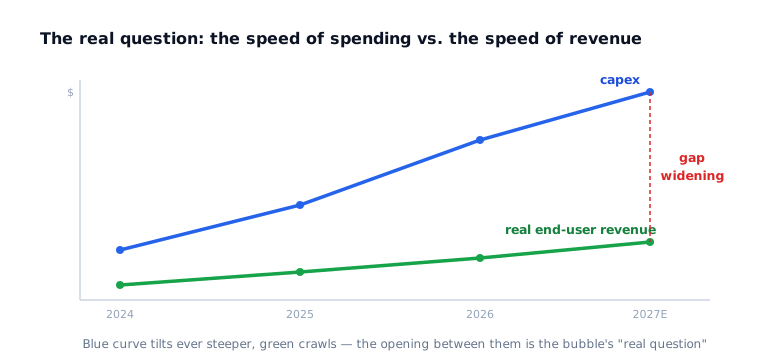
Fig 1 The core of every argument is this chart: infrastructure spending (blue) shoots up almost vertically, real end-user payment (green) climbs far slower. The question isn't "is there a gap" but "can it close, and when."
01First, how violently is the money being spent? The scale of capex
To grasp how heavy this problem is, you first need a feel for "how much got spent." The keyword here is capex (capital expenditure).
What is capex? Simply put, money a company spends on "hard assets" — buying land, building data centers, buying hundreds of thousands of GPU chips. It's fundamentally different from "marketing spend": marketing is gone once spent, but capex buys an asset, which over the next several years is gradually expensed via "depreciation." This becomes deadly later — remember it.
How big is the scale? By estimates from Goldman Sachs, Morgan Stanley, CreditSights, and others (numbers vary by source): US Big Tech's AI-related capex was roughly $410 billion in 2025, planned to surge to about $725 billion in 2026, and projected to top $1 trillion in 2027. Widen the lens to all hyperscalers, and some estimates (MUFG) put 2026 total capex above $600 billion.
~$410B2025 Big Tech AI capex
~$725B2026 planned capex
**$1T+**2027 projected capex
What does that mean? A single year's spend already exceeds the entire annual GDP of many countries. And these numbers keep getting revised upward — almost every earnings season, the giants raise their guidance. The market calls it a "supercycle."
Spending itself isn't the problem. The problem is the next sentence: this money isn't just spent and gone — it becomes hard assets, and hard assets, to earn back, require a comparable scale of "real revenue." Which leads to Section 2 — why this money "has to be repaid."
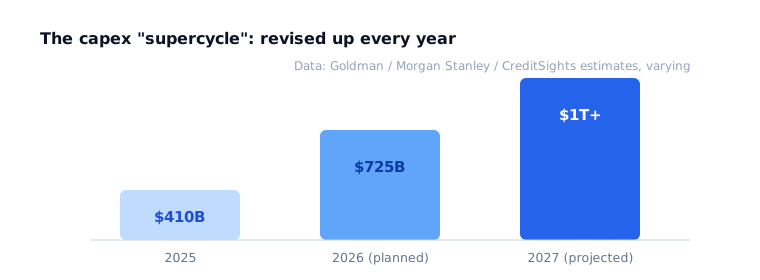
Fig 2 In two years, annual capex climbs from ~$410B toward $1T+. Note these are analyst estimates, continually revised up — but even discounted, the scale is staggering.
02Why this money "must be repaid": capex is an asset that depreciates
Many people misread capex, assuming the giants "have endless cash, spent is spent." Wrong. In accounting, the moment capex is spent it doesn't immediately become a loss; it first becomes an asset on the balance sheet, then over the next several years turns into a cost on the income statement via depreciation.
What is depreciation? If you spend $100 on a machine you'll use for 5 years, accounting won't let you book the full $100 as cost in year one — it books $20 a year, spread over 5 years. That $20 is depreciation. For data centers: the hundreds of billions spent today become hundreds of billions of depreciation cost each year going forward, subtracted straight out of profit.
What does that mean? It means capex isn't "a gamble" — it's a bill that must be repaid. To keep that bill from becoming a massive loss, you need a comparable scale of real revenue to cover depreciation + electricity + operations.
How much revenue is that? The two most-cited estimates give you the size of the gap:
Sequoia's David Cahn and the "gap thesis": in September 2023 he first calculated an AI "hole" of about $125 billion a year; by his 2024 update, the annual revenue gap that needs to be filled had grown to roughly $600 billion — and heading into 2026 it's still widening, not closing.
Bain & Company's September 2025 report: by 2030, sustaining AI's compute demand requires about $2 trillion in new annual revenue globally; and even counting every possible saving and reinvesting it all, there's still a ~$800 billion shortfall that can't be filled.
A note on framingBoth figures are analyst estimates / forecasts, not established facts, and rest on plenty of assumptions (depreciation life, return rates, demand growth). I cite them to give the gap a sense of scale, not as ironclad prophecy. But even on conservative assumptions, the direction is the same: the money that has to be repaid is far larger than the money coming in.
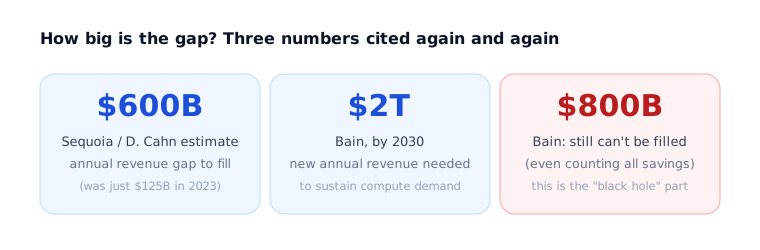
Fig 3 Three commonly cited gap numbers (all analyst estimates/forecasts): Sequoia's annual revenue gap has grown from $125B to ~$600B; Bain says 2030 needs $2T in new revenue, and even with extreme savings, ~$800B can't be filled.
03So how much real AI revenue is there? Looks like plenty — but look closer
You might push back here: but AI revenue is exploding! True — but look closely at what is exploding.
First, credit where due: the growth is real and fierce. OpenAI's annualized run-rate climbed from ~$13 billion in mid-2025 to ~$25 billion by early 2026. Anthropic is even more dramatic: ~$9 billion at the end of 2025, $14 billion by February 2026, ~$30 billion by April, and ~$47 billion annualized by May per Sacra's estimate. For comparison, Salesforce took roughly 20 years to reach $30 billion in annual revenue — Anthropic got there from a standing start in under three years. The cloud side is real too: AWS ~$150B annualized (+28% YoY), Google Cloud ~$80B (+63%), Microsoft Azure's AI portion ~$37B run-rate (+123%).
Is there any water in this growth? Yes — three spots you must expose on the spot, or the "growth narrative" will carry you away.
Water spot #1: run-rate ≠ real annual revenue.
"Annualized run-rate" is one month's or one quarter's revenue × 12. It assumes the whole next year stays at that level or higher. It looks great while growth is fast, but once growth slows or churn hits, run-rate and actual booked annual revenue can diverge wildly. Media love run-rate because the number is big; but repaying capex requires real cash in the bank, not an extrapolation.
Water spot #2: the people selling the shovels are bleeding cash. Model companies' revenue is soaring, but their burn is soaring faster. OpenAI is reportedly on track to lose ~$14 billion in 2026, nearly triple its 2025 losses, while targeting $100 billion in revenue by 2029. In other words, today's "dazzling revenue" sits on top of persistent, enormous net losses — it's not earning money, it's buying growth with losses. Whether revenue from a company that's itself hemorrhaging cash belongs in the "can repay trillions of infrastructure" column is itself a question mark.
There's a logical loop here worth pausing on for a second: what the model company has to repay is the trillion-scale compute commitments it took on itself (OpenAI alone carries ~$1 trillion in infrastructure purchase contracts). At a very modest 10% return expectation, it needs to net about $100 billion a year to break even. But right now it isn't netting $100 billion — it's losing $14 billion. To make this equation balance, its profitability has to undergo a reversal that is both opposite in direction and astonishing in magnitude — from losing a hundred-plus billion a year to earning a trillion's worth of profit. How big that leap is, and how long it takes, no one can give you a reassuring answer. That's exactly why "where's the end-user revenue" is the real question: to balance the books, what's missing was never the growth rate of revenue — it's the absolute size of it.
Water spot #3 is the deadliest, so I'll give it its own section — much of this "revenue" is these same players buying from each other.
04Water #1: circular financing — the same crowd buying from each other
This is where the whole accounting problem most resembles the 2000 dot-com bubble. The old playbook was called round-tripping: I buy your service, you buy mine, neither truly earns outside money, but both sides' "revenue" gets inflated. Today a similar loop is playing out in AI, on a staggering scale.
What is circular financing? The supplier is also a major investor in its big customer — it gives you money, and you turn around and use that money to buy its products. The cash circles the same group, and at each hop a "revenue" or "investment" line gets booked — but real demand from outside the circle hasn't grown by a cent.
A few real, publicly disclosed deals (amounts per each party's announcements):
Nvidia → OpenAI: in September 2025, Nvidia agreed to invest up to $100 billion in OpenAI to build data centers; in return, OpenAI committed to buying and deploying millions of Nvidia GPUs. Translation: Nvidia is prepaying its own future sales orders.
OpenAI → Oracle: OpenAI agreed to purchase ~$300 billion of cloud capacity from Oracle.
Nvidia ↔ CoreWeave: by September 2025, OpenAI's commitments to CoreWeave reached $22.4 billion; meanwhile Nvidia holds over 5% of CoreWeave and in September agreed to buy $6.3 billion of cloud services from CoreWeave.
Connect them and you see money spinning in a ring: Nvidia invests in OpenAI → OpenAI uses the money to buy Nvidia chips and rent Oracle and CoreWeave → those machines run Nvidia chips → Nvidia also invests in CoreWeave and becomes its customer too.
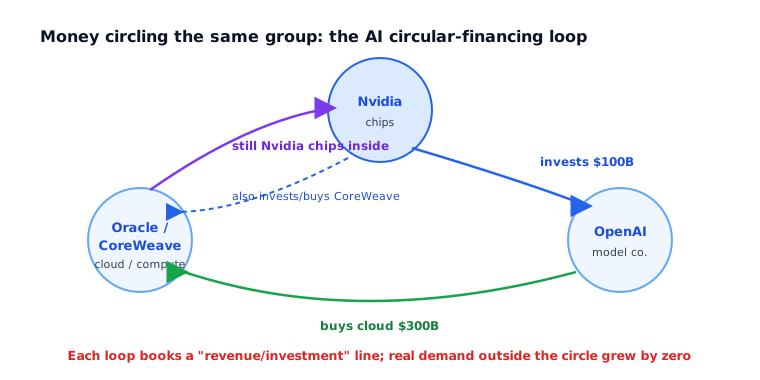
Fig 4 Nvidia invests in OpenAI, OpenAI buys cloud, the cloud runs Nvidia chips, Nvidia invests in and buys from CoreWeave — money spins among three or four players. Note: these deals are legal and have real business behind them; the question is how much final revenue comes from outside the circle.
Disclosing the weak spotTo be fair: these deals are all legal and all have real business behind them — OpenAI genuinely needs compute, Nvidia's chips genuinely run. So you can't just yell "it's all fake." The one metric to watch: what share of these companies' revenue ultimately comes from "outside the circle" — real end customers actually paying for AI output — versus mutual transfusion inside it. That ratio is the litmus test for how much of the bubble is real.
05Water #2: is anyone at the end actually paying? — an MIT report slaps back
Circular financing is about where the money comes from. But is the end actually generating value? This is the most stinging part of "where's the end-user revenue." In August 2025, MIT's NANDA project released a report — "The GenAI Divide: State of AI in Business 2025" — whose conclusion made the whole industry go quiet for a beat.
Based on 52 executive interviews, 153 leader surveys, and analysis of 300 public AI deployments, it found: despite ~$30–40 billion in enterprise generative-AI spending, 95% of projects produced no measurable P&L impact — only 5% of integrated systems created significant value.
What does "no measurable P&L impact" mean? It means the money was spent, the pilot launched, the demo worked — but it didn't make the company a single dollar more, nor save a dollar, at least not enough to show up in the financials. P&L is the income statement, the "are we making money" sheet. On that sheet, 95% of projects are invisible.
The report calls this the "GenAI Divide": sky-high adoption (everyone uses ChatGPT) on one side, dismal conversion (almost none turns into sustainable business value) on the other. And it specifically notes — the problem isn't model quality, it's the "learning gap": organizations and processes haven't learned how to actually embed AI to make money. A telling detail: tools built by external vendors succeed at twice the rate of internally built ones.
The report also punctures a common mismatch: enterprise AI budgets go overwhelmingly to sales and marketing, because that's "sexy and easy to pitch"; yet the real measurable returns are in back-office operations and finance — through process automation, cutting outsourcing, and reducing costs. In other words, many enterprises aren't finding "AI is useless" — they're spending in the wrong place, chasing the illusion of revenue growth instead of the steadier win of cost savings. That's exactly why so much was spent yet so little shows on the P&L: the value isn't absent, it's looked for in the wrong place and extracted too slowly. And when it comes to repaying trillions in capex, "slow" is the biggest enemy — because at the other end, the depreciation timer never stops, not for a second.
**95%**enterprise GenAI pilots with no measurable P&L impact
**5%**share that created significant value
$30–40Balready spent, mostly with little to show
In fairnessDon't over-read this report either: it measures "pilots," and high failure rates in early pilots of a new tech are normal; its sample and "measurable" definition have limits, and the 5% that succeed actually prove the value exists, it's just hard to extract. So the right reading isn't "AI is useless," but — end-user value is being realized far slower than infrastructure money is being spent. Which is precisely the micro-level explanation of the scissors gap in Fig 1.
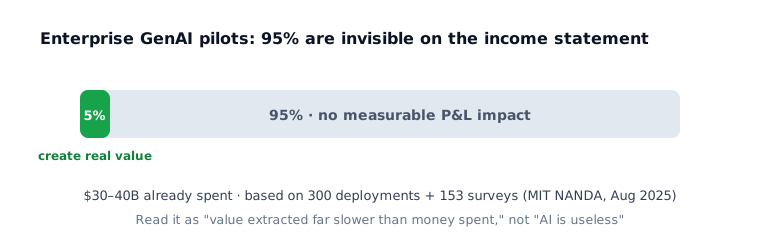
Fig 5 MIT NANDA report: ~$30–40B of enterprise spend, 95% of pilots show no return on the financials. Not that AI is useless (5% do succeed), but that end-user value is "extracted" far slower than capital is "invested."
06The clock is ticking: GPU depreciation, the blade overhead
You might say: a big gap is fine, demand will grow into it — give it time. The problem is, this problem has a time limit. The timer is GPU depreciation.
Back to "depreciation" from Section 2. A GPU is booked to depreciate over X years, which assumes it lasts X years. Here lies a huge dispute, and the person who dragged it into the open is Michael Burry — the subprime short-seller, the prototype from "The Big Short."
Burry's charge: hyperscalers are inflating profits with overly long depreciation lives. His math — these companies depreciate Nvidia chips over 5 to 6 years, but Nvidia's chips iterate so fast that real economic life may be only 2 to 3 years. Stretching the life means smaller annual depreciation cost, which props up book profits. He estimates this mismatch will cause the industry to under-record about $176 billion in depreciation cumulatively over 2026–2028. In September 2025 his Scion fund disclosed ~$1.1 billion notional in put options shorting Nvidia and Palantir; by November he simply shut the fund, saying markets and management estimates were "wildly out of sync."
Why can the depreciation life "conjure" profit? The same $100 machine that really lasts 3 years: at 3-year depreciation, the cost is $33/year; at 6 years, only $17/year. The latter shows $16 more profit per year — but that $16 is fake, because the machine should be retired by year 4, and the deferred cost comes due eventually. That's what Burry is describing, just multiplied by the whole industry.
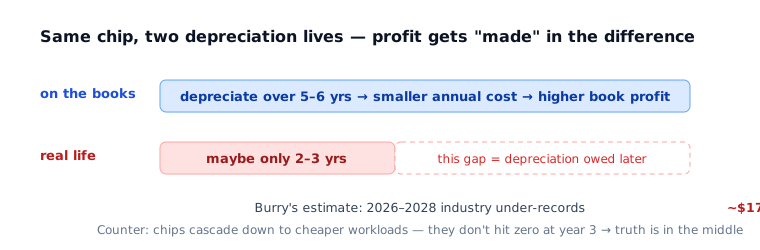
Fig 6 Depreciation is a countdown. Booked over 6 years but maybe lasting only 2–3 — that gap is profit recognized too early, owed later. Burry estimates the industry under-records ~$176B of depreciation over 2026–2028.
It's not just Burry shouting. One objective signal: in February 2025, Amazon proactively shortened the depreciation life of some servers, citing exactly "AI is making tech iterate faster; some assets won't last 6 years" — while in the same period Meta extended its estimate. The same industry gave opposite accounting judgments on "how long a chip really lasts," which itself shows how murky and how pivotal the question is. Put bluntly, even the most expert companies haven't agreed on "what these assets are really worth and how long they last" — and that's exactly the crux of repayment ability: if the assets' real life is shorter than the books assume, then the "real depreciation" owed each year is heavier than the financials show, and the time left for end-user revenue to catch up is tighter too.
Give the other side tooBurry may not be entirely right; the rebuttal is just as strong: chips aren't trashed when retired — they cascade down (cascading reuse). The H100 training a frontier model today might run a customer-service bot next year, render video the year after, then land in a university research cluster. In this "compute waterfall," old chips keep finding the next workload — they don't hit zero in 3 years. So the truth is probably in the middle: lives aren't as rosy as 6 years, but not "dead in 3, total wipeout" either. The point isn't to pick a side, but to watch whether companies start cutting depreciation lives one by one — that would be the first creak of the crack.
07So what is the "real question" — and how it differs from the dot-com bubble
Now we can collapse the whole problem into one sentence. About this AI wave, the real question isn't "is it a bubble," but: can real end-user payment catch up to that near-vertical capex curve before GPU depreciation eats through the books.
The problem has two ways to go. I won't predict which happens; I'll just draw the fork clearly:
Optimistic path: end demand truly arrives (not just pilots, but large-scale paid usage with high retention), cascading reuse holds, depreciation isn't so scary, and circular financing gets diluted by real orders from outside the circle. Time fills the gap. This path maps to the "internet script" — infrastructure overshoots first, then gets absorbed by real demand; the only questions are timing, and who survives to that day.
Pessimistic path: the gap keeps widening by hundreds of billions a year, some link in the circular financing breaks (say, a model company can't raise its next round), triggering a chain of asset re-valuations; layered with forced cuts to depreciation lives, book profits shrink across the board. This path maps to "early liquidation."
One point to avoid equating this simply with 2000: the dot-com bubble's infrastructure (fiber) was ultimately absorbed by real demand — the dark fiber laid back then got fully used a few years later by streaming and cloud. From that angle, "infrastructure eventually absorbed by demand" has historical precedent. But two differences must be heeded: first, fiber barely depreciates and lasts decades, whereas GPUs lose value in three to five years — a far crueler time window; second, that era's round-tripping was nowhere near as concentrated in three or four players as today. So this round's bet is "using a rapidly depreciating asset to bet on end-user demand that hasn't materialized at scale."
There's also a point both bulls and bears overlook: "infrastructure eventually gets absorbed" and "today's players survive to that day" are two completely different things. The dot-com bubble burst, yet the internet won — but Pets.com and Webvan, dazzling in their day, were wiped out en masse, and it was Amazon and Google that survived to reap the rewards. In other words, even if the AI track as a whole is right, a batch of today's brightest names can absolutely die along the way. So "will AI succeed" and "are these companies worth their valuations" are two independent questions — optimism on the former doesn't imply optimism on the latter. The real risk often isn't the track being disproven, but the horse you backed failing to outlast the two years when the gap is widest.
This isn't a gamble on "will it crash."
It's a **race between "end-user payment" and "GPU depreciation."**Whoever reaches the finish first decides whether these trillions are "infrastructure laid ahead of demand" or "scrap metal stuck on the balance sheet" — and which of today's names live to see the payoff.
08Conclusion: don't watch the stock price, watch how the gap moves
Let's close the books.
"Is AI a bubble" is the wrong question, because it'll never have a clean answer. The real question is an accounting problem: trillions of capex are assets that must be repaid by real end-user payment, and right now the speed of spending far outruns the speed of collecting. Sequoia says the annual gap is ~$600B and widening; Bain says 2030 needs $2T with an $800B shortfall; meanwhile the "dazzling revenue" you see is laced with run-rate water, model-company megalosses, and three or four giants buying from each other; and MIT tells you 95% of enterprise spend hasn't yet turned into value on the P&L. Overhead, the GPU depreciation countdown ticks.
But this problem isn't at the verdict stage yet. It might be absorbed by time like the internet, or it might break at some link first. So the right posture isn't guessing the ending, but watching three indicators that tell you the answer early —
Three indicators far more useful than "the stock price"
Watch end-user payment, not run-rate: track real net new paying users + retention + unit economics. If growth runs on discounts and subsidies while retention falls, that "revenue" is paper prosperity.
Watch the outside-the-circle revenue share: of OpenAI's and Nvidia's revenue, how much comes from real customers outside the circular-financing loop? Rising share means the gap is really being filled; stalling share is an alarm.
Watch depreciation re-estimates: track whether companies start cutting depreciation lives in their filings. Amazon already began. If more giants follow, "chips don't last that long" is shifting from doubt to consensus — and the crack in book profits opens here.
So next time someone asks you "is AI a bubble," swap the question: "Don't rush to call life or death — tell me, has that end-user money that's supposed to come actually arrived?" That's the true decider of this trillion-dollar bet.
Sources & methodology note: Data here draws on Sequoia's David Cahn "AI gap" analyses, Bain & Company's 2025 Global Technology Report, MIT NANDA's "The GenAI Divide: State of AI in Business 2025," capex estimates from Goldman Sachs / Morgan Stanley / CreditSights / MUFG, OpenAI and Anthropic revenue and loss figures from public/media disclosures (and estimates such as Sacra's), the Nvidia-OpenAI-Oracle-CoreWeave deal announcements, and Michael Burry / Scion's public positions and statements. Capex, gap, run-rate, and depreciation-understatement figures are largely analyst estimates or forecasts, not confirmed facts, and change over time; framing and limits are noted where possible. This is industry analysis and not investment advice.
#AI #AIBubble #Nvidia #OpenAI #Capex #Compute #Depreciation #TechInvesting